
Contractor Selection Process for Luxury London Homes

Updated: 3 days ago
You've found the right architect, secured planning permission, and settled on the character you want for your Wimbledon or Richmond home. Then the contractor quotations arrive. One is attractively low, another is impressively detailed, and a third comes recommended by someone you trust. On a basement extension, listed-building renovation or bespoke new build, choosing between them isn't a popularity contest. It's a risk decision.
A contractor selection process tests whether a builder can protect the design, manage the programme, control costs and deal intelligently with problems once the work is underway. Price and referrals still matter, but they're only part of the evidence.
Why Contractor Selection Matters More on High End London Projects
A high-value home rarely presents a simple building brief. A basement may involve structural sequencing, waterproofing, ventilation, fire strategy and difficult logistics. A heritage renovation adds listed-building consent, traditional materials and the need to repair rather than casually replace. A new build may depend on specialist glazing, bespoke joinery, complex services and a carefully co-ordinated supply chain.
Consider a homeowner in Wimbledon Village planning to lower a rear basement beneath an existing period property. Three contractors may all say they can do the work. One has completed attractive refurbishments but has limited basement experience. Another has delivered basements but relies heavily on subcontractors whose availability hasn't been tested. The third costs more, but can explain temporary works, waterproofing responsibility, sequencing and how design changes will be priced. The lowest quotation may look efficient until an unclear assumption becomes a variation.
That's why affluent clients need more than a shortlist of names. They need evidence that the proposed contractor understands the property, the construction method and the consequences of failure. A structured process protects design intent, programme certainty and budget control before a contract binds everyone to an unrealistic promise.
The UK public-sector framework provides a useful principle. Government bid evaluation guidance explains that tenders are assessed against published award criteria to identify the Most Economically Advantageous Tender, which may not be the cheapest offer. Under newer Procurement Act guidance, the language is Most Advantageous Tender, with assessment summaries required after evaluation. The important lesson for private clients is the discipline, not the terminology. Decide what matters, state how it'll be judged and keep a written record of the reasoning. UK bid evaluation guidance sets out that approach.
Harper Latter Architects' eight-step project process frames contractor involvement as part of a wider journey from initial consultation through completion. In practical terms, early rigour means defining the scope, filtering capability, preparing comparable tender information, interviewing the team and negotiating proper protections before work starts.

Key takeaway: On a complex London home, the right contractor isn't the one with the lowest headline figure. It's the one whose experience, resources, programme and commercial behaviour stand up to scrutiny.
Prequalification That Filters for Capability Not Just Price
Prequalification is the first gateway. It asks whether a contractor should be invited to tender at all, before comparing their solution for your particular home.
UK procurement guidance describes a two-gateway methodology. The first stage tests capability, financial stability, good standing and technical capacity. The second evaluates the bidder's proposed delivery, including price, construction quality, service and project-specific methodology. That distinction is highly useful for private residential work because it stops a polished tender from disguising weak fundamentals. The Housing Forum procurement guide explains the separation between these two decisions.
Set a minimum threshold first
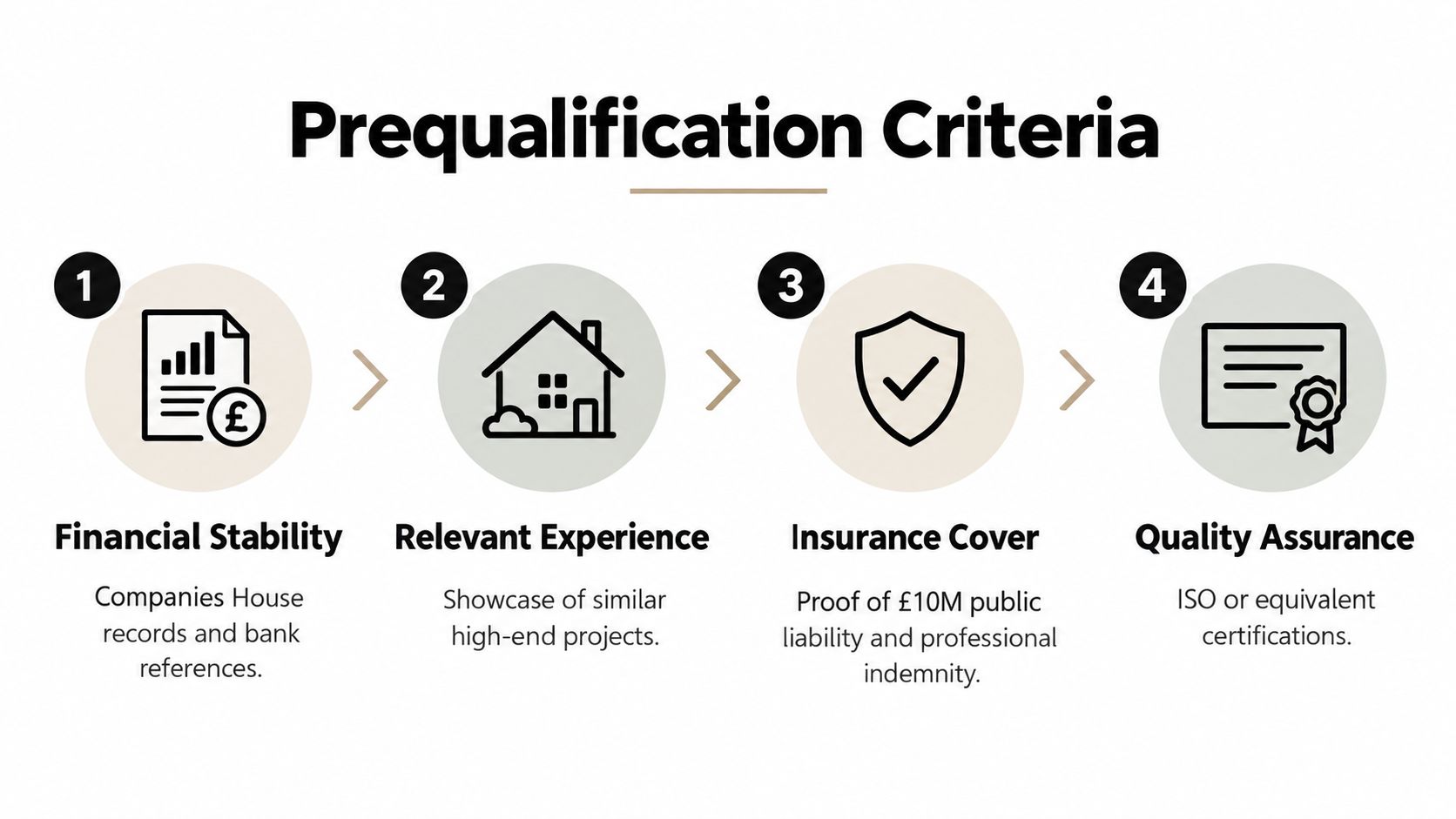
Start with requirements that a contractor must meet, rather than points they can compensate for elsewhere. For a basement, that might include relevant waterproofing experience, competent structural coordination and evidence of managing restricted access. For a heritage project, ask for conservation experience, familiarity with traditional materials and credible relationships with specialist trades.
Check:
Financial stability: Review Companies House information, request suitable financial evidence and ask how the business manages cash flow on projects with substantial material commitments.
Relevant experience: Look for completed work with comparable complexity, not merely similar photographs. A luxury kitchen refurbishment isn't evidence of basement construction competence.
Insurance: Verify current policies and limits, including public liability, employers' liability and any cover relevant to the contractor's role.
Technical capacity: Identify who will manage the site, who will co-ordinate subcontractors and whether the named team will remain involved.
Quality and safety systems: Ask how defects, inspections, site records and safety briefings are handled in day-to-day practice.
A Standard Selection Questionnaire style review is a sensible private-client tool. The government's sourcing guidance says the questionnaire should be used to assess exclusion grounds, suitability and financial capacity before award. You don't need to reproduce a public-sector form word for word, but you should adopt its habits. The Sourcing Playbook supports this structured approach.
Score evidence, then test the scoring
Use a simple matrix with written criteria. You might assess relevant experience, team quality, programme approach, technical methodology, sustainability competence, commercial clarity and price. The weights should reflect the project. A heritage refurbishment needs stronger emphasis on conservation methodology than a straightforward internal redecoration.
Run a dry test before issuing the tender. Apply the model to hypothetical responses and check whether a contractor could win on price despite failing an essential capability test. Set minimum thresholds for required criteria, then score the areas where bidders can demonstrate different levels of strength.
Referrals belong in the evidence set, not at the top of it. The 2026 HomeOwner Survey found that 55% of surveyed homeowners cited word-of-mouth recommendations when selecting a builder, compared with 23% for specialist qualifications, 19% for trading history or financial stability and 6% for independent contracts and staged payments. Recommendations should therefore be supported by checks on relevant experience, qualifications, insurance, references and contract terms.
For further guidance on distinguishing genuine capability from attractive presentation, see this resource on selecting luxury home builders. The outcome should be a small, defensible shortlist of contractors who can perform the work.
Choosing the Right Tendering and Procurement Route
The tender route changes what you're asking contractors to price, when you involve them and where risk sits. Choosing badly can create false cost certainty. Choosing well gives the project team a realistic basis for comparing price, quality and delivery.
An open tender invites a broad field. It can discover unfamiliar contractors, but it often creates a large administrative burden and attracts bidders who don't understand the property. A selective tender invites a prequalified group, which is usually more appropriate for a bespoke South West London home. A negotiated route can work where specialist expertise is scarce or where the design needs early contractor input, but the client must control scope and pricing carefully.
Historical UK research illustrates why informal selection deserves caution. In a 1999 ARCOM paper covering 1,415 projects, 89% were awarded using ad-hoc contractor lists, while 11% used standard lists. The research describes a period in which informal or semi-formal routes dominated. That history helps explain the modern preference for clearer prequalification and comparative evaluation. The construction procurement study provides the underlying figures.
Match the route to the project
A single-stage tender works best when drawings, specifications and the scope are sufficiently developed for contractors to price on a common basis. It can provide a clearer initial comparison, but bidders may include risk allowances where design information remains incomplete.
A two-stage tender brings a preferred contractor into the process earlier. The first stage establishes the contractor and preliminaries, while later design and subcontract packages are developed before agreeing the final sum. This can improve buildability and procurement planning, particularly where specialist trades or long-lead items affect the programme. It also demands transparency because the final cost evolves rather than arriving as one fixed number on day one.
Traditional procurement generally gives the architect and client greater design control. Design and build can simplify contractual responsibility, but the client needs a strong performance brief and must understand how design changes, quality standards and heritage details will be protected.
Procurement Route | Best For | Control and Risk Profile |
|---|---|---|
Selective single-stage tender | Well-developed refurbishments and many new builds | Strong initial comparison, but incomplete information may produce higher risk allowances |
Selective two-stage tender | Basements, complex services and projects needing early contractor input | Better buildability and programme planning, with less early cost certainty |
Traditional contract | Heritage work and design-led homes | High design control, with clear consultant responsibility and detailed documentation required |
Design and build | Clients prioritising a single delivery responsibility | Potentially simpler administration, but performance requirements must be precise |
Negotiated procurement | Specialist contractors or unusual construction constraints | Useful for scarce expertise, but requires open-book pricing and disciplined scope control |
Tender documentation should make comparison possible. A well-prepared package can include an invitation to tender, drawings, specification, schedule of works, site information, tender return form and contract information. The guidance on tender document preparation explains why these components matter.
For a Wimbledon basement, I'd favour a route that gives the contractor enough early involvement to test logistics and sequencing, without handing over design decisions that ought to remain with the architect. For a listed house in Richmond or Surrey, design control and conservation competence may carry more weight than speed alone.
Interviewing and Vetting Contractors Like a Professional Client
A tender return tells you what a contractor is prepared to write. An interview shows how they think when the information is incomplete, the site is difficult and the programme comes under pressure.
Invite the proposed project manager and site manager, not only the business owner or estimator. Ask them to talk through your actual property, including access, neighbours, party-wall constraints, structural risks, existing fabric and the specialist elements that matter to the finished home.
Start with project-specific questions:
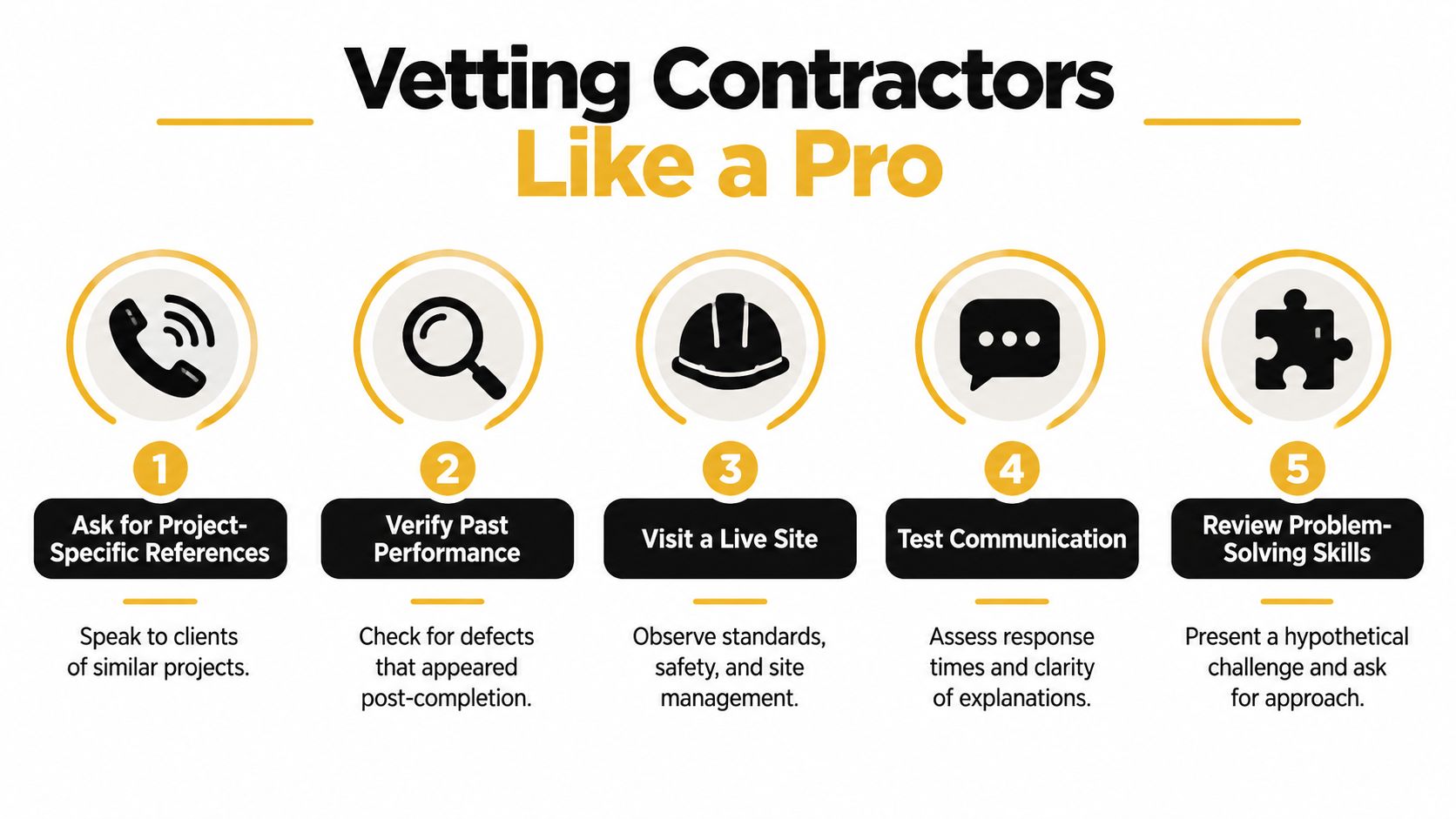
“Which completed project is most comparable to this one, and what made it difficult?”
“Who managed it day to day, and who would be on our site?”
“Which defects appeared after completion, and how did you resolve them?”
“Which parts of this scope would you subcontract, and how do you secure those trades?”
“What information do you need from the design team before committing to the programme?”
Strong answers contain sequence, ownership and evidence. A contractor may explain that a basement requires early confirmation of temporary works, waterproofing details, drainage interfaces and access for spoil removal. A weak answer stays at the level of “we've done plenty of these” without identifying assumptions or decision points.
Test programme resilience
Current market pressures make programme claims worth challenging. Reporting on the second half of 2025, CIOB's summary of the FMB State of Trade Survey said 49% of responding firms experienced delays linked to skills shortages and 22% reported cancellations. It also reported rising material costs for 75% of firms and higher client prices for 61%. These survey results are context for checking a contractor's resources and programme, not a prediction for your project.
Ask for the contractor's current workload, planned start date and resource plan. Don't accept “we'll sort it out” as a programme strategy. Ask what happens if a specialist subcontractor becomes unavailable, a specified product is delayed or an opening-up survey reveals an unexpected condition.
For a heritage project, ask how the team distinguishes a defect from historic fabric and who decides whether to repair, retain or replace it. For sustainable design, ask how the contractor will protect airtightness, insulation continuity, ventilation performance and responsible material choices during construction, rather than treating sustainability as a brochure statement.
Visit a live site and speak to clients
A completed portfolio is curated. A live site reveals housekeeping, protection of finished work, safety standards, sequencing and the relationship between the contractor and design team. Ask permission to speak privately with recent clients about variations, communication, defects, final account discussions and aftercare.
Call references yourself. Ask whether the contractor raised problems early, whether applications for payment matched progress and whether the site manager was the person promised at appointment. Check warranties and manuals, and ask who responds when a problem appears after handover.
“The most revealing reference question is often, ‘What would you want to know before appointing them?’”
Communication is part of competence. If the contractor can't explain risk clearly during selection, they're unlikely to make complex decisions easier once the walls are open.
Contracts Insurance Warranties and Red Flags to Avoid
Selection isn't complete when you choose a preferred bidder. The appointment becomes safe only when the scope, payment mechanism, responsibilities, insurance and remedies are documented in a contract suited to the project.
For many high-end residential projects, a properly administered JCT-style contract can provide a familiar structure for design responsibility, payment, extensions of time, variations, practical completion and defects. The correct form depends on the procurement route and project circumstances, so the architect, contract administrator and legal adviser should confirm the choice rather than treating a standard template as automatically suitable.
Make the award decision auditable
Your evaluation criteria should be clear, measurable and proportionate to the complexity and cost of the work. Government guidance says criteria must relate to the subject matter of the contract and be specific enough to assess consistently. Guidance on assessing competitive tenders sets out that principle.
Evaluate exactly what the tender documents say you'll evaluate. Official UK guidance also states that the process must follow the original tender documentation and use quantifiable factors based on information contained in the tender. For a private project, that means don't award the job because of an impressive late conversation that wasn't offered to the other bidders. Tender evaluation guidance explains the importance of consistency.
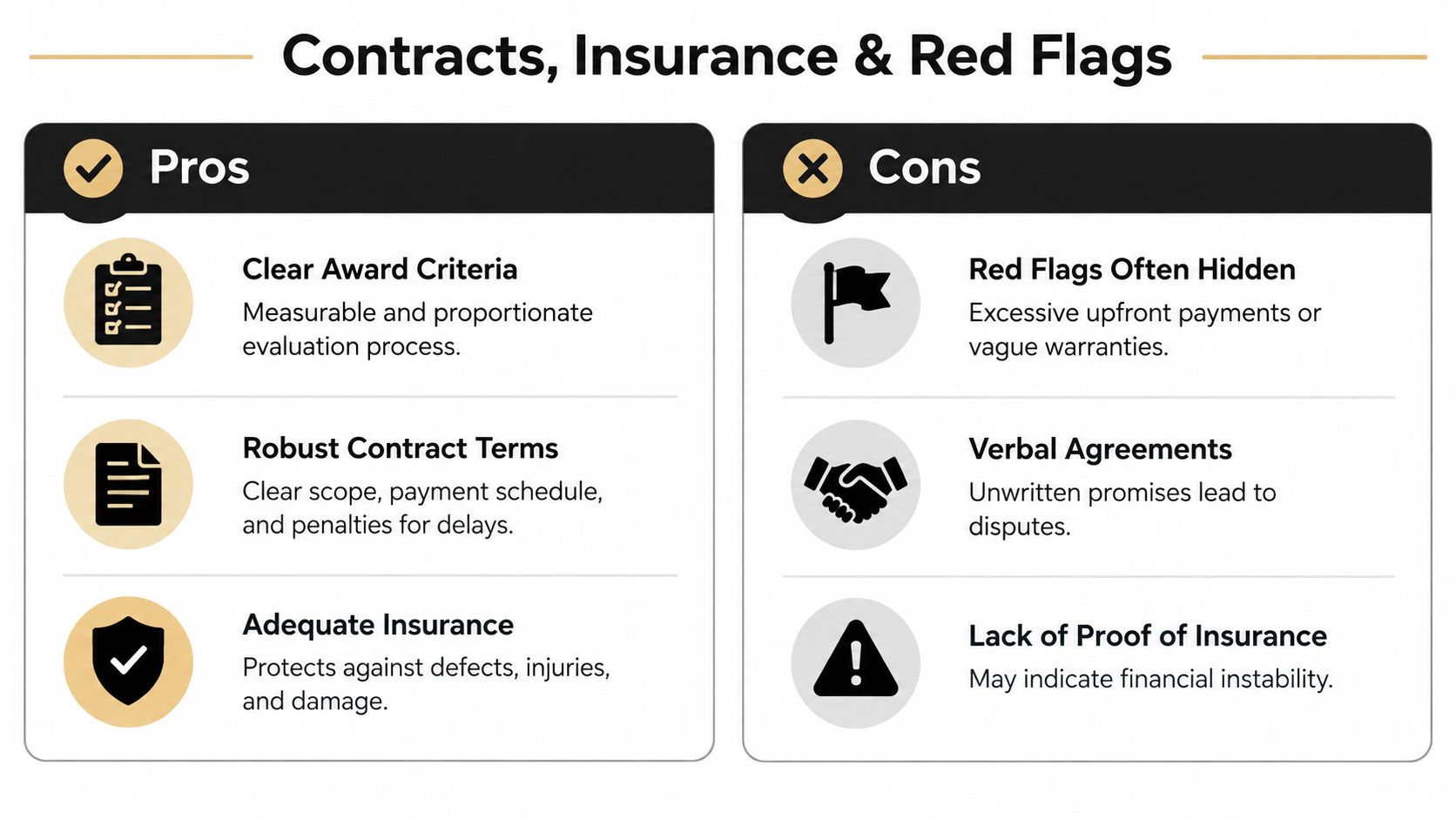
Use a written scope, a payment schedule tied to progress, a process for approving changes and a clear route for resolving disputes. Staged payments protect cash flow and give the client an advantage, but they must reflect completed work rather than arbitrary dates. Retention, warranties and insurance should be discussed before signature, not introduced after the first disagreement.
Check current certificates, policy exclusions and renewal dates. A contractor's insurance must be adequate for the work they're undertaking, and specialist elements may need separate warranties or collateral warranties depending on the project structure.
Recognise warning signs
Be cautious if:
The price is dramatically lower: Ask which scope assumptions, provisional items or exclusions create the difference.
The methodology is vague: A credible programme should identify sequencing, resources, procurement risks and responsibilities.
The contractor resists financial checks: Reluctance to provide reasonable evidence is itself relevant evidence.
The proposed team keeps changing: Confirm who priced the work and who'll manage it.
Insurance evidence is incomplete: Don't rely on verbal reassurance.
Payments are front-loaded: Large unexplained upfront demands can expose you before value is delivered.
The contractor dismisses documentation: If promises aren't recorded, they're difficult to enforce.
A practical contract administration service can help maintain records, assess applications and manage instructions during construction. That role matters particularly where the project includes bespoke finishes, concealed services or conservation details that need careful inspection.
A low tender isn't automatically wrong. It becomes dangerous when nobody can explain it. Ask the contractor to reconcile the quotation against the schedule of works, identify exclusions and confirm how inflation, substitutions and unforeseen conditions will be handled.
The most advantageous offer balances commercial value with delivery confidence. On a luxury home, a small saving at appointment can disappear quickly if poor sequencing damages finishes, a specialist trade leaves site or a vague allowance becomes a disputed variation.
Your Actionable Checklist for a Confident Appointment
Treat the appointment as a sequence of decisions, not a single comparison of totals. Before inviting tenders, make sure the design information, schedule of works and site constraints are sufficiently clear for contractors to price the same project.
Use this checklist:
Define the risk profile: Identify whether the project is a new build, basement, heritage renovation, complex refurbishment or a combination.
Set gateway requirements: Decide which experience, insurance, financial and technical checks are mandatory.
Create evaluation criteria: Weight quality, programme, methodology, sustainability, heritage competence and price before seeing the returns.
Issue comparable information: Give each bidder the same drawings, specifications, schedules and tender instructions.
Interrogate the programme: Ask who'll deliver each stage, which trades are secured and what contingency exists.
Verify the evidence: Contact comparable clients, visit a live site and check certificates, qualifications, accounts and warranties.
Reconcile the price: Review exclusions, provisional sums, assumptions, payment stages and proposed alternatives.
Document the decision: Record why the preferred contractor met the thresholds and how unresolved risks will be managed.
Sign the right contract: Confirm responsibilities, variations, payment, insurance, completion, defects and dispute procedures before mobilisation.
Walk away if the contractor won't provide credible evidence, pushes for unexplained upfront payment, avoids questions about defects or offers a programme that depends on unnamed trades. A respectful challenge during selection is healthier than a difficult confrontation after work starts.
The right appointment gives you more than a builder. It gives the design team and client a reliable decision-making partner for the difficult parts of construction.
For a complex Wimbledon, Richmond or Surrey home, professional support can make the process calmer and more objective. Harper Latter Architects can prepare tender information, invite contractors, compare proposals and advise on suitability as part of its wider residential design and delivery service.
Harper Latter Architects helps South West London and Surrey homeowners turn complex briefs into well-co-ordinated, buildable homes, from basements and heritage refurbishments to bespoke new builds. Visit Harper Latter Architects to arrange an initial conversation about your project and establish a contractor selection process that protects its design, programme and long-term value.

Comments