
Architect for Extension Cost: A UK Homeowner's Guide
So, what does an architect for an extension actually cost? It’s the million-pound question, isn’t it? The short answer is that professional fees typically land somewhere between 8-15% of the total construction budget. To put that in real terms, for a £100,000 extension, you should plan for an additional £8,000 to £15,000 to cover your architect's fees.
Decoding Architect Fees for Your Home Extension
Starting a home extension is an incredibly exciting journey, but getting a firm grip on the costs is absolutely fundamental to a successful project. While the builder's quote will make up the lion's share of your budget, the architect for extension cost is a crucial upfront investment that really shapes the entire outcome. It’s about so much more than a set of drawings; an architect adds immense value, preventing costly mistakes and unlocking the true potential of your home.
Think of your architect as the conductor of an orchestra. They take your vision, the physical constraints of your property, and the maze of planning regulations and harmonise them into a space that’s not just beautiful, but functional, compliant, and built to last. Here at Harper Latter Architects, our job is to guide homeowners through this entire process, ensuring every pound spent adds real value to their home and lifestyle.
Why Are Architect Fees a Percentage of the Build Cost?
One of the first things people ask is why our fees are often tied to the construction budget. It’s a fair question. This percentage-based model helps create a true partnership. It ensures our goals are perfectly aligned with yours—to achieve the highest quality result within your financial framework. As the project scope grows or shrinks, the fee adjusts with it, reflecting the level of design, detail, and management needed.
An architect's real value lies in their ability to see possibilities you might not, navigating complex regulations and delivering a design that maximises space, light, and ultimately, your property's value.
Let's look at a real-world example. For a standard 30m² single-storey extension in South West London, architect fees typically fall between £4,500 to £6,500. This works out to be around 10% of a total project budget of £82,500 (excluding VAT), according to recent market figures. That fee covers everything from the initial chats and concepts right through to the detailed, RIBA-compliant drawings needed to secure planning permission and satisfy building regulations.
Understanding the Different Fee Structures
To help you move forward with confidence, it's good to know that architects don't just use one method to calculate fees. The approach we take often depends on the scale and complexity of your project. Before we get into the specifics, our guide on how to choose an architect in the UK is a great read for some extra background.
Here’s a quick look at the main ways fees are structured.
Architect Fee Structures at a Glance
We’ve put together a simple table to break down the three most common fee structures you'll come across. This should help you understand which one might be the best fit for your specific project.
Fee Structure | How It Works | Best Suited For |
|---|---|---|
Percentage Fees | A percentage (e.g., 8-15%) of the total construction cost. This fee adapts if the project scope changes. | Full-service projects where the architect is involved from the initial concept right through to completion. |
Fixed Fees | A single, agreed-upon price for a clearly defined scope of work. | Specific, well-defined tasks like producing drawings for a planning application or building regulations approval. |
Hourly Rates | You're charged for the time the architect spends on your project, usually for smaller, specific tasks. | Ad-hoc advice, feasibility studies, or work where the scope isn't yet fully defined. |
Ultimately, the goal is to find a fee structure that provides clarity and aligns with the scale of your ambition. We always discuss this transparently at the very start, so you know exactly what to expect.
How Architects Actually Calculate Their Fees
When a fee proposal from an architect lands in your inbox, it can look a bit daunting at first. But once you understand the logic behind how we structure our fees, you’ll find it much easier to compare quotes and see exactly what you’re paying for. The method we choose usually comes down to the nature and scale of your project.
Let's pull back the curtain on the three main ways architects calculate their fees: percentage-based, fixed fees, and hourly rates. Each has its place, offering a different balance of flexibility, cost certainty, and partnership depending on what your project needs.
The Partnership of Percentage-Based Fees
This is the most common approach for a full-service project, where we’re with you from the first sketch to the final build. The fee is typically a percentage of the final construction cost, usually falling somewhere between 8% and 15%. Think of it as a partnership. Because our fee is tied to the total build cost, it keeps everyone focused on the same goal: delivering the highest quality result for your budget.
It means we’re motivated to find smart design solutions or specify materials that give you the best value, rather than just inflating the cost. This alignment is brilliant for more complex or long-term extensions where the scope might need to adapt. It ensures your architect is a true partner on the journey, sharing your goal of creating the best possible home for your investment.
The Certainty of Fixed Fees
For clear, well-defined stages of work, a fixed fee is perfect. It gives you complete certainty over your budget. We agree on a single, all-inclusive price for a specific set of tasks, which is ideal when the amount of work involved is easy to predict.
You’ll most often see fixed fees used for things like:
Planning Permission Drawings: Creating all the detailed plans and documents needed for your local council application.
Building Regulations Submissions: Producing the technical drawings and specifications to prove your extension meets UK building standards.
Feasibility Studies: An upfront piece of work to explore what’s possible with your property before you commit to the full design process.
With a fixed fee, you know exactly what you’re paying and precisely what you’ll get in return. It’s a great way to manage the critical early phases of your project. This work often follows a structured framework like the RIBA Plan of Work. If you're not familiar with it, our guide on what is the RIBA Plan of Work is a straightforward explainer for homeowners.
The Flexibility of Hourly Rates
Finally, we have hourly rates. It’s as simple as it sounds—you pay for our time as we spend it on your project. While we wouldn’t typically use this for an entire extension (it’s just too unpredictable), it’s incredibly useful for smaller, specific, or one-off tasks where you need a bit of expert input.
An hourly rate is perfect when the scope isn't fully defined, or you just need some targeted advice without committing to a full service.
You might book an architect for an hour or two for an initial consultation to brainstorm ideas, for minor tweaks after the main plans are finished, or for a one-off site visit to check a specific detail during the build. This pay-as-you-go approach ensures you only pay for the exact professional support you need, when you need it.
By getting to grips with these three methods, you’ll be in a much stronger position to understand any fee proposal. A good architect will often blend these approaches—perhaps using fixed fees for the pre-construction stages and then a percentage fee for overseeing the build—to give you the best of both worlds: certainty and a true partnership.
Key Factors That Influence Your Architect's Quote

It’s no surprise that just as no two home extensions are the same, no two architect quotes are identical. Several key variables come together to determine the final architect for extension cost, and each one reflects the time, expertise, and detailed work needed to bring your ideas to life. Getting a handle on these factors is the first step to setting a realistic budget.
Think of it like commissioning a bespoke suit versus buying one off the rack. While both do the same job, the level of customisation, the complexity of the materials, and the expert craftsmanship involved in a tailored suit naturally command a different price. The very same principle applies to architectural services.
A simple, single-storey rear extension with standard fittings just requires a different level of design input compared to a complex basement conversion with a home cinema, custom joinery, and light wells. These factors help shape a fee that is fair and proportional to the work involved.
Project Complexity and Ambition
The single biggest driver of an architect's fee is, without a doubt, the complexity of the project. A straightforward rectangular extension on flat ground is a far simpler task than a multi-level extension on a sloped site that needs to blend seamlessly with the original building's character.
Here’s a glimpse at how complexity can vary:
Structural Intricacy: A design that involves removing multiple internal walls, adding large spans of glass, or excavating a new basement requires significantly more detailed structural design and coordination.
Bespoke Features: Elements like custom-designed staircases, handcrafted joinery, or unique glazing solutions demand far more design time and technical detailing than standard, off-the-shelf products.
Site Conditions: Tricky-to-access sites, unconventional plot shapes, or challenging ground conditions all add layers of complexity that need to be solved during the design phase.
Essentially, the more unique and ambitious your project is, the more time and expertise your architect will need to invest to get it right. This has a direct impact on the overall quote.
The Impact of Size and Location
While complexity is key, the overall size of the extension also plays a significant role. It's simple really: larger projects mean more work—more drawings, more detailed specifications, and more time spent coordinating with other professionals. Having said that, there can be economies of scale; the cost per square metre often decreases as the overall project size increases.
Location is another critical factor, and the 'London premium' is a very real thing, affecting both construction costs and professional fees. In the bustling South West London property scene, where homeowners in areas like Wimbledon Village and Richmond are clamouring for more living space, the average cost for a single-storey extension is now between £2,775 and £3,461 per square metre. That's about 9% higher than the UK average, a difference that’s mirrored in the associated professional fees. You can dig deeper into the data on UK extension costs over at builderexpert.uk.
Specialist Expertise and Level of Service
The specific nature of your property and the level of service you need from your architect are also major considerations. Certain properties simply demand a specialist skill set that goes beyond standard residential design.
For a property in a Conservation Area or one that is Listed, an architect's fee will reflect the additional research, specialist knowledge, and detailed negotiations required to secure heritage consent.
This is a crucial point. Navigating the intricate planning policies for listed buildings requires a deep understanding of conservation principles and historic materials. The sheer volume of paperwork and design justification needed is far more extensive, which naturally adds to the architect's workload.
Finally, the scope of your architect's involvement will shape the fee. Are you just looking for drawings to secure planning permission? Or do you want a full service, where the architect manages the entire project from initial concept through to the final handover on site? A full project management service, while carrying a higher fee, provides invaluable peace of mind and often saves money in the long run by ensuring the build is delivered on time, on budget, and to the highest quality.
Budgeting for Your Full Professional Team

While the architect for extension cost is a significant part of your project budget, it’s crucial to remember they are just one player—albeit a key one—in a much larger team. To build a truly realistic budget that won’t spring any nasty surprises, you need to account for all the other essential experts whose input is both legally required and vital to your project's success.
Overlooking these costs is one of the most common pitfalls we see homeowners fall into. These aren't optional extras; they're fundamental pre-construction expenses that guarantee your extension is safe, legally sound, and built without causing issues for your neighbours. Getting these figures on paper early on saves a lot of stress down the line.
At Harper Latter Architects, we don’t just hand over a set of drawings. We act as your project partner, helping to coordinate this team of specialists on your behalf. This ensures everyone is working from the same script, making the journey from initial idea to final build a much smoother ride.
Who Else Is on the Team?
Before a single shovel hits the ground, several other key professionals will need to be involved. Each has a distinct and non-negotiable role, and their fees should be factored into your total project costs right from the start.
These experts include:
Structural Engineer: This is the person who makes sure your extension will actually stand up. They design and calculate all the critical structural elements—like foundations, steel beams (RSJs), and the roof structure—to ensure the building is completely safe and stable.
Party Wall Surveyor: If your extension is being built on or near the boundary with a neighbour, you’re legally required to serve a Party Wall Notice. A surveyor manages this formal process, protecting both your property and your neighbours'.
Approved Inspector or Local Authority Building Control (LABC): They are the official checkers. They review your detailed plans to confirm they meet UK Building Regulations and then inspect the work on-site at key stages to sign it off as compliant.
Understanding the full spectrum of professional and statutory fees is the difference between a budget that works and one that falls apart. These are not 'hidden' costs but predictable investments in your project's quality and compliance.
Accounting for Statutory Fees
On top of professional fees, you’ll also need to budget for statutory fees paid directly to your local council. These are fixed, non-negotiable costs for getting the legal green light to build. You can see how these fit into the bigger picture by reading our guide on the average extension costs in the UK.
The main statutory fees are:
Planning Application Fee: A standard fee paid to your local planning authority when you submit your designs for planning permission.
Building Control Submission Fee: This covers the cost of having your technical drawings checked and the on-site inspections required to certify that your extension meets Building Regulations.
To give you a clearer idea of what to expect, we've outlined the typical costs for these additional services here in South West London.
Estimated Additional Professional Fees for a Home Extension
The table below breaks down the typical costs for the other professionals and statutory fees involved. Think of it as a checklist to help you build a more complete and accurate project budget from the get-go.
Professional Service / Fee | Typical Cost Range (London) | Notes |
|---|---|---|
Structural Engineer | £1,000 - £3,000+ VAT | Depends on the complexity of the design. More steel beams or tricky ground conditions will increase the cost. |
Party Wall Surveyor | £1,200 - £2,500+ VAT | This is a per neighbour cost. It can rise significantly if neighbours dissent and appoint their own surveyor. |
Planning Application Fee | £234+ | This is the standard fee for a householder application in England, though it can vary slightly. |
Building Control Fees | £800 - £1,500+ VAT | This covers both the plan check and the site inspections. The fee is usually based on the project's size and total value. |
Factoring these figures in early gives you a much truer sense of the total investment required, allowing you to plan with confidence and avoid unexpected bills once the project is underway.
Real Project Budgets in South West London
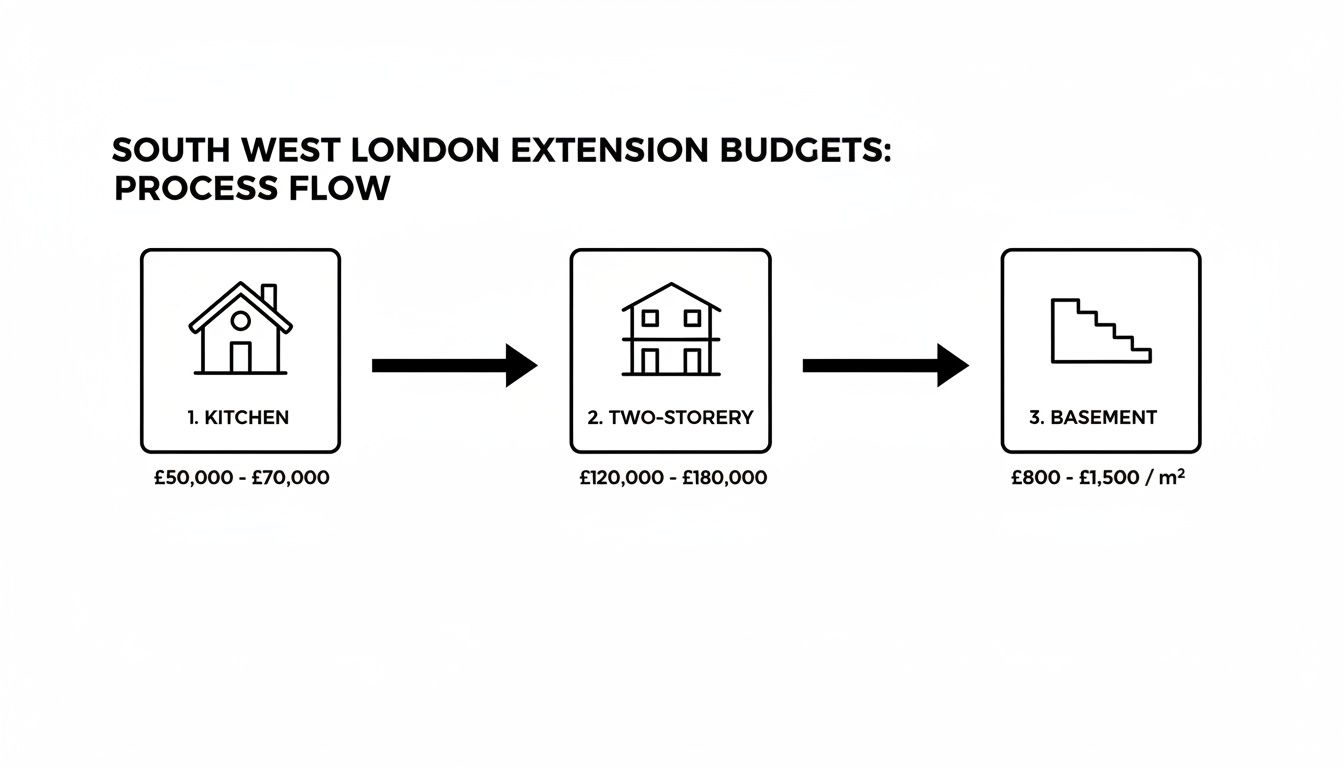
Abstract numbers and percentages don't always paint a clear picture when you're trying to budget for a home extension. To make the cost of an architect for an extension more tangible, let's walk through three realistic scenarios inspired by projects we see across South West London. These examples will help you visualise how a budget breaks down for different levels of ambition and complexity.
Each scenario covers the estimated build cost, architect fees, and other essential professional services you'll need. This gives you a much more holistic view of the total investment required, moving from theory into real-world financial planning.
Case Study 1: The Richmond Kitchen Extension
A single-storey rear kitchen extension is a classic for good reason. It’s the perfect way to open up the back of a Victorian or Edwardian terrace, creating that much-loved open-plan kitchen and dining space that’s at the heart of modern family life. For this example, let's imagine a standard 30m² extension on a terraced house in Richmond.
The goal here is a bright, functional area with bifold doors opening out to the garden. The design is contemporary but still sensitive to the property's character, with a high-quality finish that isn't over-the-top luxury.
Here’s what a potential budget could look like:
Estimated Build Cost: £90,000
Architect Fees (at 10%): £9,000
Structural Engineer: £2,000
Party Wall Surveyor (one neighbour): £1,500
Statutory Fees (Planning & Building Control): £1,200
VAT on Fees: £2,740
Total Estimated Project Cost: £106,440
Case Study 2: The Wimbledon Wraparound Extension
Now, let's step it up in both size and complexity. This scenario is a two-storey side-and-rear 'wraparound' extension on a semi-detached property in Wimbledon. This is a far more ambitious project, adding a large kitchen-diner downstairs and a new master bedroom with an en-suite upstairs, creating around 60m² of new space.
This kind of project involves more intricate structural work, careful thought about the roofline, and detailed planning to ensure it complements the existing house and sits well with the neighbours. As you’d expect, the increased complexity is reflected across all the costs. Kitchen extensions remain a staple for families in South West London, but it's worth noting that costs in premium postcodes can soar. For a 25-30m² project, you could be looking at £62,500-£99,000 for just the shell. You can explore more insights about kitchen extension costs on allwellpropertyservices.co.uk.
A typical budget might look like this:
Estimated Build Cost: £210,000
Architect Fees (at 11%): £23,100
Structural Engineer: £4,500
Party Wall Surveyor (two neighbours): £3,000
Statutory Fees: £1,800
VAT on Fees: £6,480
Total Estimated Project Cost: £248,880
Case Study 3: The Conservation Area Basement Project
Our final example is a high-end basement conversion in a Wandsworth Conservation Area. This project is all about creating 80m² of new subterranean living space, perhaps for a home cinema, gym, and wine cellar. This is highly specialised work, involving extensive excavation, complex structural engineering, and robust waterproofing.
Projects within Conservation Areas or on Listed Buildings demand a higher level of architectural expertise. The fees reflect the additional research, specialist reports, and meticulous design needed to gain heritage consent from the local authority.
The specification here is pure luxury, with bespoke joinery, advanced lighting systems, and high-performance glazing. The property's conservation status adds another layer of complexity, demanding detailed negotiations and a design that’s sensitive to its heritage.
The financial breakdown for a project of this scale is substantially higher:
Estimated Build Cost: £480,000
Architect Fees (at 12%): £57,600
Structural & Waterproofing Engineers: £12,000
Party Wall Surveyors & Other Specialists: £8,000
Statutory & Heritage Fees: £3,500
VAT on Fees: £16,220
Total Estimated Project Cost: £577,320
Navigating Your Project With Our 8-Step Process
Understanding the numbers is one thing; feeling confident in the journey is another entirely. Now that we've covered the general costs, let's talk about how we at Harper Latter Architects bring clarity and control to your project from day one with our proven 8-step process.
We’ve found this transparent framework is the best way to build trust and ensure a smooth, predictable path from your initial idea to the finished build. It connects every stage directly to managing your costs, making sure your budget is respected and every pound spent adds real, lasting value to your home. A clear roadmap is the best defence against unexpected costs and delays.
A Structured Path To Success
It all starts with our free initial consultation. This is where we get to the heart of what you want to achieve and make sure it aligns with your budget right from the outset. Getting this right prevents any major surprises on scope or cost later on.
From there, our design stages are meticulously planned to minimise the risk of expensive on-site changes – one of the most common reasons projects go over budget. Careful planning is the bedrock of financial control. By investing time in detailed design and technical drawings before a builder even steps on site, we solve problems on paper, not with a sledgehammer. Changes on paper cost very little; changes during construction can be eye-wateringly expensive.
Our 8-step process is more than just a workflow; it's our commitment to transparency and partnership. Each stage is a clear checkpoint, giving you the confidence that your project is on track, on budget, and true to your vision.
The image below gives you a glimpse of the clear, sequential stages we guide every single client through.
This visual guide shows how we progress logically from initial chats and concepts right through to managing the tender process and overseeing the construction itself.
From Concept To Completion
Our role doesn't stop once the drawings are done. We extend our oversight right through the construction phase, acting as your advocate on-site. This is crucial for making sure the quality specified in the drawings is the quality the builders deliver, safeguarding your investment. We manage contracts and monitor progress to keep everything aligned with the agreed plan.
This comprehensive management provides real peace of mind and shows why we’re the ideal partner for your extension. It transforms what can be a stressful process into an exciting, collaborative experience with clear communication at every turn. By following this tried-and-tested method, we turn your architectural aspirations into a beautifully realised and cost-effective reality.
Frequently Asked Questions
When you’re planning a home extension, it’s only natural for questions about costs, roles, and processes to pop up. Here, we answer a few of the most common queries we get from clients to give you a clearer picture as you start your journey.
Can I Save Money by Not Using an Architect?
While it might feel like a savvy way to trim the budget, going it alone without an architect is often a false economy. The reality is that an architect's expertise in design, planning rules, and project oversight can prevent eye-wateringly expensive mistakes down the line – think structural miscalculations or designs that don’t meet regulations and need a complete do-over.
More than that, a thoughtfully designed extension by a qualified professional can add significant value to your property, often far more than the initial fee. They also produce the detailed drawings that builders need to give you an accurate quote, which minimises the risk of surprise costs and ensures a much higher quality of finish.
Do Architect Fees Include Planning Application Costs?
No, an architect’s professional fees don't typically cover statutory costs like council planning applications or building control submissions. These are treated as disbursements – essentially, third-party costs that the architect often handles for you but will be listed separately on your invoice.
Always make sure you ask what’s included in your fee proposal. A transparent quote should clearly separate the architect's professional services from any external costs you’ll need to cover.
This helps you see the total architect for extension cost clearly, separating your investment in design from the necessary council fees.
What Is the Difference Between an Architect and an Architectural Technologist?
The main difference comes down to their training and focus. The title 'architect' is legally protected and reserved for professionals registered with the Architects Registration Board (ARB). They complete a long and rigorous training period (usually seven years) that covers everything from creative design and theory to leading a project from the first sketch to the final handover.
An architectural technologist is also a highly skilled professional, but their expertise is geared more towards the technical science of how buildings are put together. They excel in construction methods, materials, and creating the technical drawings required for building regulations, but their core training isn’t as focused on the initial creative and conceptual design process.
How Can I Keep My Architect's Fees Down?
There are a few practical ways to manage your architect's fees without cutting corners on quality:
Prepare a Clear Brief: The more time you spend thinking about what you really want and need at the start, the less time your architect will spend on revisions later. A clear brief is worth its weight in gold.
Be Decisive: Making decisions in a timely manner helps keep the project on track and avoids extra hours being billed for going back to revisit earlier stages.
Choose a Phased Service: You don’t always have to hire an architect for the entire project. You can engage them for specific stages, like producing planning drawings only, instead of the full project management service.
Ready to transform your home with a bespoke extension designed around you? The team at Harper Latter Architects is here to guide you through every step.