
A Homeowner's Guide to Build Over Agreements in London

If you’re planning a renovation in London, the term 'build over agreement' is one you’ll get familiar with very quickly. Simply put, it's a legal contract you must have in place before you can build near or over a public sewer. Think of it as an essential green light from the local water authority, protecting both your home and the city's vital underground network.
What Is a Build Over Agreement and Why Does It Matter?
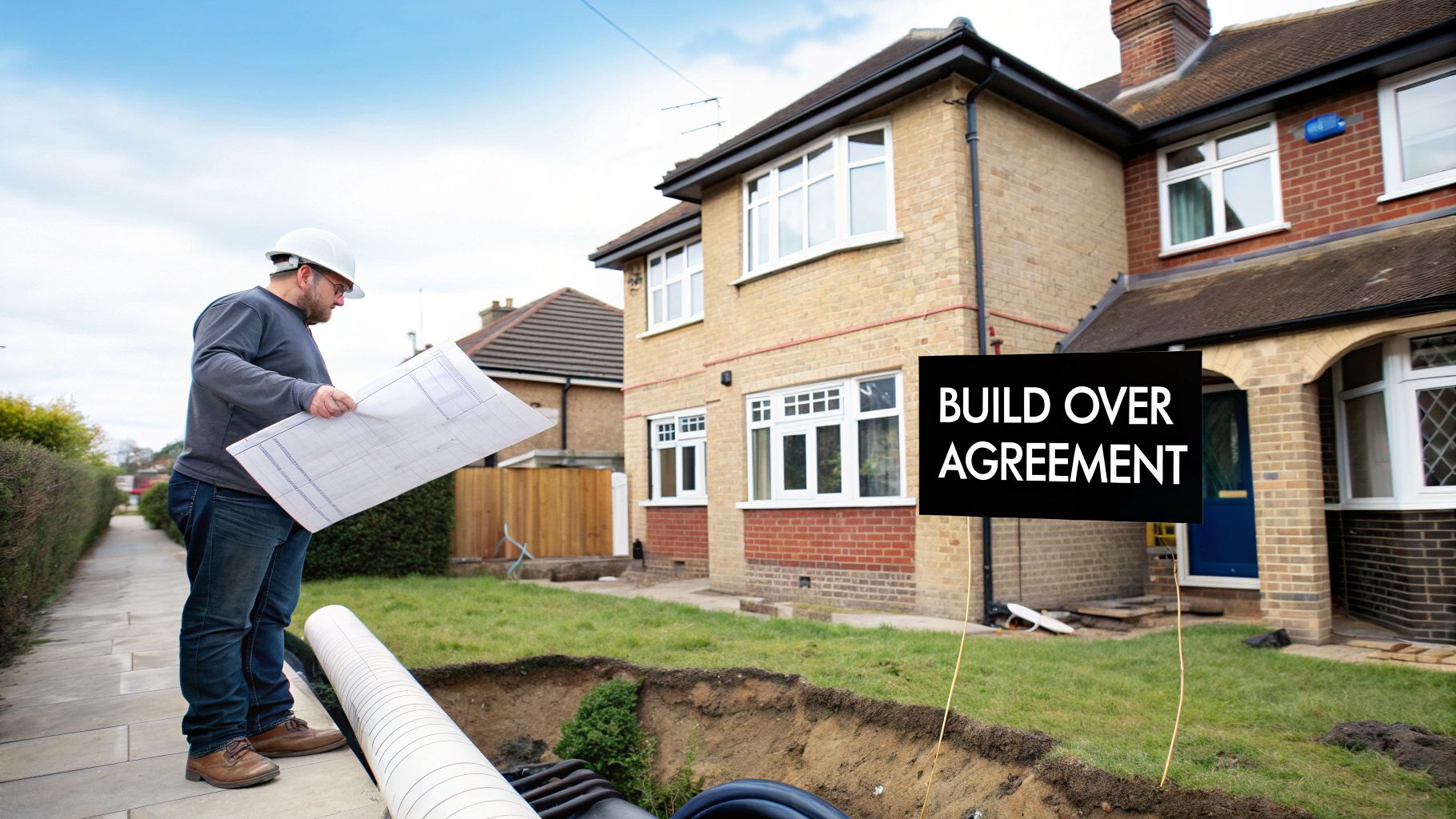
A build over agreement is the formal permission you get from your local water authority—like Thames Water for most Londoners—to construct an extension or new building over or close to their pipes. Imagine the web of public sewers beneath London as the city's hidden arteries; this agreement ensures your project won't accidentally block or damage them.
This isn't just bureaucratic box-ticking. It’s a critical step designed to safeguard two key things: the public sewer system and your own property. Pushing ahead without one could lead to serious damage, flooding, eye-watering repair bills, and a whole lot of legal trouble.
The Core Purpose of the Agreement
The goals of a build over agreement are straightforward but incredibly important for homeowners in areas like Wimbledon, Richmond, and Surrey:
Protecting Infrastructure: It makes sure your proposed foundations won't put too much weight on the sewer pipe, preventing a potential collapse.
Maintaining Access: The water company needs to be able to get to the sewer for maintenance and repairs. The agreement spells out exactly how this access will be preserved.
Ensuring Compliance: It confirms your project meets all the necessary building regulations and technical standards for construction near public assets.
This process is incredibly common in London. In the UK, a build over agreement is required if your construction is within 3 metres of a public sewer or is planned directly on top of it. To give you an idea of scale, recent figures show that over 15,000 applications were processed nationwide in one year, with London projects making up roughly 28% of that total. This is largely down to the sheer density of Victorian-era sewers running under our homes. You can explore more about national housing and planning trends in official government statistics.
By securing this agreement, you gain peace of mind, knowing your extension is built on a secure and compliant foundation. It's an essential step that protects the long-term value and integrity of your property.
It's also worth remembering that this is a separate legal step from other permissions you might need. For example, if your work affects a shared boundary with a neighbour, you’ll also need to get to grips with the Party Wall Act. You can read our detailed guide on the Party Wall Act for homeowners to learn more about what's involved.
When Does Your Project Need a Build Over Agreement?
So, how do you know if your dream extension or basement conversion needs this bit of formal paperwork? The answer is usually buried right under your garden, in the network of public sewers that criss-cross London.
A build over agreement becomes essential the moment your proposed work gets a little too close for comfort to this vital underground infrastructure.
The All-Important 3-Metre Rule
The main trigger you need to know about is the ‘3-metre rule’. Put simply, if any part of your new building – including its foundations – is planned to come within 3 metres of the centre line of a public sewer, you’ll need an agreement. This single guideline catches most residential projects in the capital.
It's also a definite requirement if you plan to build directly over a public sewer, no matter its depth or size. This makes perfect sense when you think about it. The water authority needs assurance that the weight of your new structure won't damage their pipe, and just as importantly, they need to know they can still get to it for repairs or emergencies down the line.
How to Find Out What’s Under Your Property
Before you can even think about the 3-metre rule, you need to know if there’s a public sewer running under or near your home in the first place. You can’t just start digging and hope for the best.
The first, and most crucial, step is to get your hands on a sewer map from your local water authority. For most of us in South West London, that means getting in touch with Thames Water.
Think of this map as an X-ray of your property. It reveals the location, depth, and size of any public sewers crossing your land, giving you a clear picture of the underground landscape. Getting this map sorted early in the design process is one of the smartest moves you can make.
An up-to-date sewer map isn’t just a nice-to-have; it’s a fundamental piece of due diligence. It helps you sidestep expensive surprises and gives your architect the information they need for any conversations with the water company.
To help you quickly gauge your situation, here's a simple checklist outlining common scenarios.
Build Over Agreement Requirement Checklist
Use this quick reference to determine if your planned works will likely require a build over agreement with your local water authority.
Construction Scenario | Distance from Public Sewer/Drain | Agreement Required? |
|---|---|---|
New Extension Foundations | Within 3 metres of the sewer's centre line | Yes |
Building Directly Over a Sewer | 0 metres (directly on top) | Yes, always |
New Conservatory Base | Within 3 metres of the sewer's centre line | Yes |
Garage/Outbuilding Foundations | Within 3 metres of the sewer's centre line | Yes |
Landscaping/Patio Work | More than 3 metres away from the sewer | No (unless deep excavation is involved) |
Internal Non-Structural Changes | Not applicable | No |
This table provides a great starting point, but always confirm the specifics of your site with a professional and the official sewer map.
Common Projects That Often Need an Agreement
Given London's dense, historic sewer network, many of the most popular home improvement projects end up needing a build over agreement. Knowing if your plans are likely to fall into this category can save you a world of time and stress later on.
Here are the usual suspects:
Rear Extensions: This is the big one. Whether single or double-storey, rear extensions are the most common trigger, as public sewers often run along the back of terraced and semi-detached houses.
Side Extensions: Pushing out to the side can easily encroach on a sewer line, especially on corner plots or where the underground pipes don't follow a perfectly straight path.
Basement Conversions: Digging down for a new basement means your foundations will be going deep. You'll need a rock-solid plan to ensure they don't interfere with any nearby sewer pipes.
Conservatories and Orangeries: Even though they feel like lighter structures, their foundations are often substantial enough to fall well within the 3-metre zone.
Outbuildings: A new garage, garden room, or annexe is not exempt. If it needs proper foundations, it needs to be checked against the sewer map.
Navigating the Build Over Agreement Application Process
So, you’ve discovered a build over agreement is on the cards for your project. The next step is to get an application into the local water authority, which for most of us in South West London means Thames Water. This isn’t just a case of filling out one standard form; the path you take is shaped entirely by your plans and the specific sewer you need to work around.
The whole process starts with a choice between two main routes. The first is a simple self-certification, which is perfect for smaller, more straightforward jobs involving standard pipes. The second is a full-blown formal application, which is necessary for anything more complex or involving larger, more critical sewers.
This is where having an experienced architect on your team really pays off. They can measure your plans against the water authority’s rules and point you down the right path from day one, helping you sidestep any unnecessary delays.
The Two Main Application Routes Explained
Figuring out which of the two routes your project fits into is the first crucial step.
Self-Certification: Think of this as the fast-track option. It’s designed for low-risk projects and is usually available if you’re working on a single private home and the public sewer is no wider than 160mm in diameter. To qualify, your plans must follow the water authority’s standard building-over criteria to the letter.
Formal Application: This is the more typical route for London extensions. You’ll need to go this way if the sewer is larger than 160mm, serves multiple properties, or if your foundation design is a bit more complicated. This process triggers a much more detailed technical review by the water authority’s engineers.
Assembling Your Application Package
Whether you’re self-certifying or submitting a formal application, you'll need to pull together a specific set of documents. A well-prepared, complete package is your single best tool for getting a smooth and timely approval.
Here’s what you’ll typically need to include:
Architectural Drawings: These are your detailed site plans and elevations. They need to show your proposed extension in relation to the existing house and, most importantly, the precise location of the sewer.
Structural Calculations: Your structural engineer will need to produce calculations that prove how the new foundations will safely bridge the sewer without putting any weight on it at all.
CCTV Sewer Survey: Most applications now demand a pre-construction CCTV survey of the pipe. This gives everyone a clear, dated record of its condition, protecting you from being blamed for any pre-existing damage.
This handy flowchart breaks down the simple logic your architect will follow.
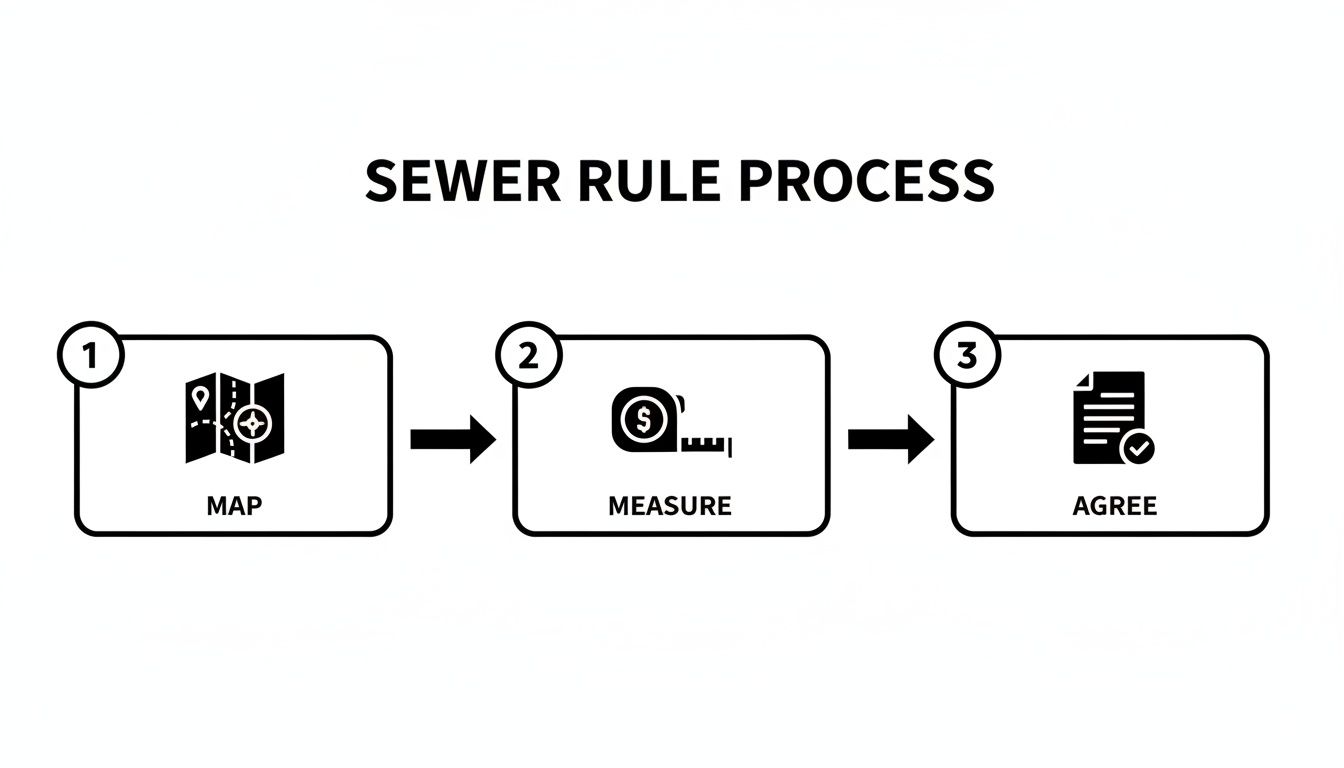
These three steps—mapping where the sewer is, measuring the distance, and getting the agreement sorted—are the bedrock of a successful and compliant project plan.
The need for these formal agreements has ballooned since they were properly set out in the 1991 Water Industry Act. Application numbers across the UK shot up from under 2,000 in 1995 to over 18,000 by 2022. Here in London, approvals jumped by 35% between 2015 and recent years, which lines up neatly with a 22% rise in planning permissions for home extensions in areas like Wimbledon.
Remember, this process runs alongside other permissions you'll need. To see how it all fits together, take a look at our guide on navigating the planning application process.
Understanding the Costs and Timescales Involved
Every home renovation lives and dies by its budget and schedule, and getting a build over agreement sorted is a crucial piece of that financial puzzle. Knowing the likely costs and realistic timescales right from the start is the best way to keep your project on track and dodge any nasty surprises down the line.
It helps to think of these expenses not as a burden, but as a smart investment. You're protecting your property’s value and making sure your project is fully compliant, which pays dividends in the long run. While the final figures will depend on your project's complexity and your local water authority, the costs tend to follow a predictable pattern.
A Breakdown of Typical Expenses
The money you’ll need for a build over agreement can be split into a few key areas. Each one is a vital step towards getting your application signed off.
Application Fees: This is the administrative cost you pay directly to the water company. For a straightforward, self-certified application, you might be looking at less than £100. But for a more complex formal application that needs a full technical review, the fees can easily jump past £500 and sometimes even top £1,000.
CCTV Sewer Survey Costs: Before any work kicks off, you’ll almost certainly need a professional CCTV drain survey. This gives everyone a crystal-clear ‘before’ snapshot of the sewer’s condition. You should budget somewhere between £250 and £450 for a proper survey and report.
Legal or Professional Fees: This isn't always necessary, but if your agreement involves tricky legal clauses or needs some back-and-forth negotiation, you might need a solicitor. Your architect and structural engineer will also bill for their time preparing the detailed drawings and calculations the water company needs to see.
Remember, these are standalone costs that sit within your main project budget. Factoring them in early stops them from becoming a last-minute headache and gives you a much clearer picture of what your extension will really cost.
These specific costs feed into the wider financial plan for your renovation. To see how they fit into the bigger picture, check out our complete homeowner's guide to the average extension costs in the UK.
Realistic Timelines for Approval
Patience is a virtue, especially when you’re dealing with official paperwork. Once you’ve submitted your complete application package, you can typically expect the approval process to take between 8 to 12 weeks.
This window gives their engineers enough time to properly assess your plans and make sure they won’t cause any issues for the public sewer. Delays usually crop up when an application is missing information or the water company has follow-up questions, which is exactly why getting your submission right the first time is so important.
How a Build Over Agreement Influences Your Home's Design
Getting a build over agreement isn't just a bit of paperwork; it directly shapes the architectural and structural plans for your extension. Think of it as a set of non-negotiable ground rules that your design must solve with smart, compliant engineering. This isn't about cutting corners—it’s about turning a potential headache into an opportunity for a much stronger, better-engineered home.
The main challenge is surprisingly simple: your new extension absolutely cannot put any weight on the public sewer running underneath. Picture that sewer as a vital tunnel buried in your garden. If you were to plonk a standard concrete foundation on top, it would be like standing on a cardboard tube. It’s just not going to end well. This single rule is what dictates the most critical part of your extension's design: its foundations.

Specialised Foundation Solutions
To get around this, your architect and structural engineer will need to specify special foundations designed to completely bridge the sewer. They essentially create a protective gap around the pipe, making sure that none of the weight from your new building can ever be transferred onto it. This is where having an expert team really pays off.
For homes in London, we typically see a few common solutions:
Cantilevered Foundations: This works a bit like a diving board. The foundation is anchored firmly on one side of the sewer and then extends over the pipe without actually touching it. All the building's load is safely transferred to the solid ground well away from the sewer's exclusion zone.
Beam and Piled Foundations: With this method, deep concrete columns (piles) are driven into the ground on either side of the sewer. A reinforced concrete beam is then laid across them, creating a solid bridge over the pipe. Your extension is then built on top of this bridge.
Reinforced Concrete Rafts: If you're planning a larger extension or the ground conditions are tricky, a reinforced concrete "raft" might be the answer. This is a large slab that spans the entire area, spreading the weight evenly and well clear of the sewer line.
Whichever solution is chosen, it will require precise calculations from a structural engineer to prove to the water company that their sewer will remain completely safe and untouched.
Maintaining Access to Manholes
It's not just about foundations. A build over agreement also has a big say on your extension's layout, especially when it comes to manholes. If there’s a manhole cover on your property, the water authority needs to be able to get to it for emergencies and maintenance, 24/7. No exceptions.
In practice, this usually means:
Manholes Cannot Be Built Over: Your extension's footprint must be carefully designed to leave the manhole completely clear.
Internal Manholes: If building around the manhole is simply not an option, you'll need a special sealed, double-screw-down access cover installed inside the new room. This has to be approved by the water company to prevent any odours and guarantee it remains accessible.
Clear Access Routes: Your plans must show a clear, unobstructed path for engineers to walk from the street right up to the manhole.
Smart architectural design weaves these technical requirements into the floorplan from day one. An experienced architect can position new walls, doorways, and even kitchen units to work around these fixed points, turning what could be an awkward obstacle into a well-organised, compliant space. This kind of forward-thinking is the secret to a successful project.
Your Next Steps for a Successful London Project
Navigating the world of build over agreements can feel like a maze, but hopefully, you're now armed with the knowledge to see the path forward. With the right preparation and guidance, it’s just a logical, manageable step in your project timeline.
The journey to a successful home extension in South West London doesn’t start with digging foundations; it starts with informed planning. Feeling more prepared? Great. Now it's time to translate that knowledge into action.
The single most important move you can make right now is to engage an experienced architect early in the process.
Find the Right Professional Partner
A seasoned architect doesn’t just draw plans. They foresee challenges before they become expensive problems, manage the entire application process, and weave the water authority's rules into a design that's still beautiful and functional. They're your translator and your advocate, ensuring compliance doesn't kill your vision.
Your architect is the crucial link between your ideas, the structural realities, and the legal obligations of a build over agreement. Investing in this partnership is investing in your project's success.
To get the most out of an initial chat, pull together any property documents you have, especially that sewer map. More importantly, have some key questions ready to help you find the right fit for your project.
What's their direct experience with build over agreements in my specific London borough?
How do they typically manage the application and back-and-forth with Thames Water?
Can they show me examples of past projects where they've tackled similar constraints?
Choosing the right architect means your journey starts on solid ground—both literally and figuratively. They'll ensure your stunning new extension begins with a secure foundation from day one.
Frequently Asked Questions
When you’re planning an extension, the topic of a build over agreement can feel like wading into murky water. To clear things up, here are answers to the most common questions we hear from homeowners.
What Happens If I Build Without an Agreement?
It's tempting to think you can skip this step, but ignoring the need for a build over agreement is a risky gamble with serious consequences. Water authorities have the legal power to take action, which could mean demanding you pay for remedial work or, in a worst-case scenario, ordering the demolition of your brand-new extension at your expense.
Beyond the immediate risk, the real headache comes when you decide to sell your home. The absence of an official agreement is a major red flag that any competent solicitor will spot during the conveyancing process. This can cause sales to fall through or force you to buy a pricey indemnity insurance policy to salvage the deal. Building without permission doesn't just create a structural issue; it fundamentally undermines your property's legal standing and future value.
Can a Build Over Agreement Be Refused?
Yes, an application can be turned down, but it’s not the most common outcome, especially if you have an experienced architect on your side. A flat-out refusal is most likely if your proposed structure is too close to what's known as a strategic public sewer. Think of these as the major motorways of the sewer network – the authorities are understandably protective of them.
If your initial design is rejected, don’t panic. This is where your architect's expertise becomes invaluable. They can open a dialogue directly with the water company’s engineers to explore other options, like more sophisticated foundation designs, that can satisfy their technical requirements and get your project back on track.
A build over agreement is a legal document that is formally registered against your property’s title deeds. It serves as a permanent, official record that the work was carried out with the full authorisation of the water authority.
This formal record provides crucial reassurance for any future buyers and their mortgage lenders. It confirms that your extension was built correctly and poses no risk to the public sewer system, effectively protecting the future saleability of your home.
Planning a renovation in South West London? Navigating the complexities of a build over agreement is our expertise. Contact Harper Latter Architects today for a consultation and let's build your vision on a foundation of confidence and compliance. Start your project with us.
Great explanation of how a build over agreement protects both your project and future property value, especially when dealing with approvals and compliance. Just like working with trusted professionals such as Roofing contractors Eugene OR ensures quality and proper standards, having expert guidance helps keep your renovation on track and stress-free.
Great explanation of how a build over agreement protects both your project and future property value, especially when dealing with approvals and compliance. Just like working with trusted professionals such as Roofing contractors Eugene OR ensures quality and proper standards, having expert guidance helps keep your renovation on track and stress-free.
This is a very informative and well-structured explanation of the importance of proper approvals and legal compliance in construction projects. Clear guidance like this helps homeowners avoid costly issues—much like how services such as Gutter Guard Installation Dayton, OH help prevent future damage and protect long-term property value.
Preventing plumbing issues starts before the concrete is poured. Correctly clad penetrations reduce risks and make sewer drain cleaning less frequent. Planning with professionals ensures long-term drain reliability for new builds and renovations.