
A Guide to Building Your Eco House UK

Updated: Aug 19, 2025
An eco house in the UK is a home designed from the ground up to have a minimal environmental footprint. It achieves this through exceptional energy efficiency, sustainable materials, and a smart approach to resource use. Think of it less as a collection of high-tech gadgets and more like a perfectly insulated flask, built to stay comfortable all year round with very little energy needed.
Understanding the Heart of an Eco House
The term ‘eco house’ often brings to mind images of grass roofs and solar panels. While those can be part of the picture, they aren't the defining features. A true eco house is built on a holistic philosophy that weaves several key principles into its very fabric. It's about creating a home that works in harmony with its surroundings, rather than fighting against them.
This approach goes far beyond simple buzzwords to focus on real, measurable performance. The goal is a building that's not only cheap to run and a joy to live in but also has a light touch on the planet throughout its entire lifecycle—from the day construction starts to its eventual end.
Core Principles of Sustainable Living
At its foundation, an eco house is built on a few fundamental pillars that all work together. Getting to grips with these concepts is the first step to understanding how these remarkable homes perform so well.
Energy Efficiency First: This is the absolute cornerstone. An eco house is designed to slash the need for heating and cooling through superior insulation, airtight construction, and high-performance windows. The real aim is to conserve energy in the first place, not just generate it from a renewable source.
Sustainable Materials: The choice of building materials really matters. An eco-friendly approach prioritises materials that are renewable, recycled, locally sourced, and have low 'embodied carbon'—meaning less energy was used to produce and transport them.
Water Conservation: Using water efficiently is another key part of the puzzle. This can be as simple as fitting water-saving taps and toilets or as sophisticated as installing systems for rainwater harvesting and greywater recycling.
A Healthy Indoor Environment: These homes are designed for the wellbeing of the people inside them. They use natural, non-toxic materials and advanced ventilation systems to ensure excellent indoor air quality, free from the pollutants often found in conventional houses.
An eco house is a system where every component—from the insulation in the walls to the orientation of the windows—is carefully chosen to work together. It’s a purposeful design that prioritises long-term performance and sustainability over short-term convenience.
To truly understand how these elements come together, let's break them down. The table below outlines these foundational principles and shows how they translate into tangible features in a modern UK home.
Principle | Core Concept | Example in a UK Home |
|---|---|---|
Exceptional Energy Efficiency | Reducing energy demand is the primary goal, achieved by creating a highly insulated and airtight building 'envelope'. | A home with 300mm of wall insulation, triple-glazed windows, and a Mechanical Ventilation with Heat Recovery (MVHR) system. |
Sustainable & Low-Impact Materials | Choosing materials with low embodied carbon, from renewable sources, or that are recycled, to minimise environmental impact. | Using locally sourced timber framing instead of steel, sheep's wool insulation, and reclaimed bricks for internal walls. |
Smart Water Management | Minimising mains water consumption through conservation, harvesting, and recycling systems. | A rainwater harvesting tank connected to toilets and the garden tap, combined with low-flow showers and taps. |
Healthy Living Environment | Ensuring excellent indoor air quality by using non-toxic materials and providing constant, filtered fresh air. | Using natural paints with no volatile organic compounds (VOCs) and an MVHR system that removes pollutants and allergens. |
Renewable Energy Integration | Generating its own clean energy on-site to cover the small amount of energy the home still needs. | Installing solar PV panels on the roof to generate electricity or an air source heat pump for efficient hot water. |
These principles are not just theoretical; they are a direct response to a pressing need. In the UK, our homes are responsible for about 20% of total greenhouse gas emissions. The good news is that this is starting to change. Average CO2 emissions from homes for sale fell by around 8% between 2019 and 2023, showing a clear shift in the property market. You can explore more about how sustainable housing is shaping the UK market and why this trend is set to continue.
The Pillars of Eco House Design and Construction
A true eco house isn’t just a standard home with solar panels bolted on. It’s a completely different approach to design, where sustainability is woven into the very fabric of the building from the first sketch. The goal is simple: create a home that works with nature, not against it, to provide year-round comfort with minimal energy.
This thinking starts long before anyone breaks ground. A successful eco house is built on a handful of core principles that work in harmony. Getting these fundamentals right is the secret to creating a high-performing, comfortable, and genuinely sustainable home.
Harnessing the Sun with Passive Solar Design
One of the smartest and most effective tools in our kit is passive solar design. Think of it as the art of positioning your home to capture the sun’s free heat and light in winter while cleverly avoiding it in the summer. It’s a beautifully simple idea that turns the house itself into a solar collector, without any complex tech.
In the UK, this usually comes down to four key things:
Orientation: We site the house so the main living rooms and biggest windows face south, allowing the low winter sun to stream deep into the home and warm it naturally.
Glazing: We use high-performance triple-glazed windows on that southern face. This lets the sun’s warmth in but, crucially, stops it from getting back out.
Thermal Mass: We build with materials like concrete floors or stone walls. These dense materials soak up the sun’s heat during the day and then slowly release it back into the house at night, smoothing out temperature swings.
Shading: We design features like roof overhangs or louvres that are angled to block the high summer sun, preventing the house from overheating when you least want it to.
Getting this right drastically slashes the need for heating and artificial lights, cutting energy bills and creating wonderfully bright, pleasant spaces to live in.
Creating an Airtight Building Envelope
Imagine trying to stay warm on a cold day wearing a coat full of holes. You’d lose heat constantly. Your home’s building envelope—its roof, walls, floors, and windows—is exactly the same. In an eco house, making this envelope incredibly airtight and super-insulated is non-negotiable.
Airtightness stops heat from escaping through draughts, which can be a huge source of energy waste in a typical home. At the same time, a thick blanket of insulation acts as a thermal barrier, keeping precious warmth locked inside during winter and unwanted heat out in the summer. This is what we call a ‘fabric first’ approach, and it’s the bedrock of any eco house UK homeowners will find truly comfortable and cheap to run.
By focusing on an exceptionally well-insulated and airtight building envelope, you reduce the building’s energy demand to a tiny fraction of a standard new build. This is the single most important step in creating a low-energy home.
This obsessive attention to detail means the house performs just as you expect it to, maintaining a stable and cosy temperature inside, whatever the weather is doing outside.
Breathing Smart with Mechanical Ventilation
So, you’ve made your house airtight. That’s great for saving heat, but now how do you get fresh air in without just opening a window and letting all that warmth escape? That would be like unzipping your coat on a frosty morning. The answer is a clever bit of kit called a Mechanical Ventilation with Heat Recovery (MVHR) system.
An MVHR is essentially the lungs of the house. It works around the clock, extracting stale, damp air from kitchens and bathrooms while supplying fresh, filtered air to your living spaces and bedrooms. But here’s the magic part: a heat exchanger inside the unit transfers up to 90% of the heat from the outgoing stale air to the incoming fresh air.
You get a constant supply of clean air without the energy penalty, which is brilliant for both indoor air quality and comfort. For anyone planning a new home, understanding how systems like this are integrated from the start is crucial, which is why working with new build architects to design from the ground up makes such a difference.
Conserving Every Drop of Water
Water is just as precious as energy, and a true eco house design tackles its conservation with the same level of detail. It’s about much more than just fitting a few water-saving taps.
Properly sustainable homes in the UK often include advanced strategies:
Rainwater Harvesting: This involves collecting rainwater from the roof into a large underground tank. After some basic filtering, this water is perfect for flushing toilets, running the washing machine, and watering the garden, dramatically cutting your reliance on treated mains water.
Greywater Recycling: This goes a step further, capturing the 'greywater' from your showers, baths, and sinks. It’s then treated on-site and reused for things like toilet flushing, saving even more.
These systems help turn a home from a resource consumer into a more self-sufficient ecosystem, reducing its footprint and saving the homeowner money on utility bills.
Choosing Sustainable Materials for Your Project
The foundations, walls, and roof of an eco-house are so much more than structural elements; they are a statement of intent. Picking the right materials is fundamental to creating a home that’s truly sustainable, influencing everything from its performance and health to its environmental footprint for decades to come.
This isn't just about choosing materials that look 'natural'. It's about understanding the full story of a material—its journey to your building site and its impact long after the house is built. This is where the concept of embodied carbon becomes so important.
Understanding Embodied Carbon
Think of embodied carbon as a material's 'carbon rucksack'. It’s the grand total of all the greenhouse gas emissions created during its entire life, from extracting the raw resources and manufacturing to transport and its eventual reuse or disposal. A material like steel has a very heavy rucksack, while locally sourced timber carries a much lighter one.
For a true eco-house in the UK, minimising this embodied carbon is just as crucial as maximising energy efficiency. Choosing low-carbon materials is one of the most powerful ways to reduce your home’s environmental debt before you’ve even moved in.
A building can be incredibly energy-efficient once occupied, but if it was built with high-carbon materials, a significant environmental cost has already been paid. The goal is to tackle both operational and embodied carbon to create a genuinely low-impact home.
This chart really brings home how much of a difference the 'fabric first' approach makes. It shows a clear link between design choices, like insulation levels, and real-world savings.
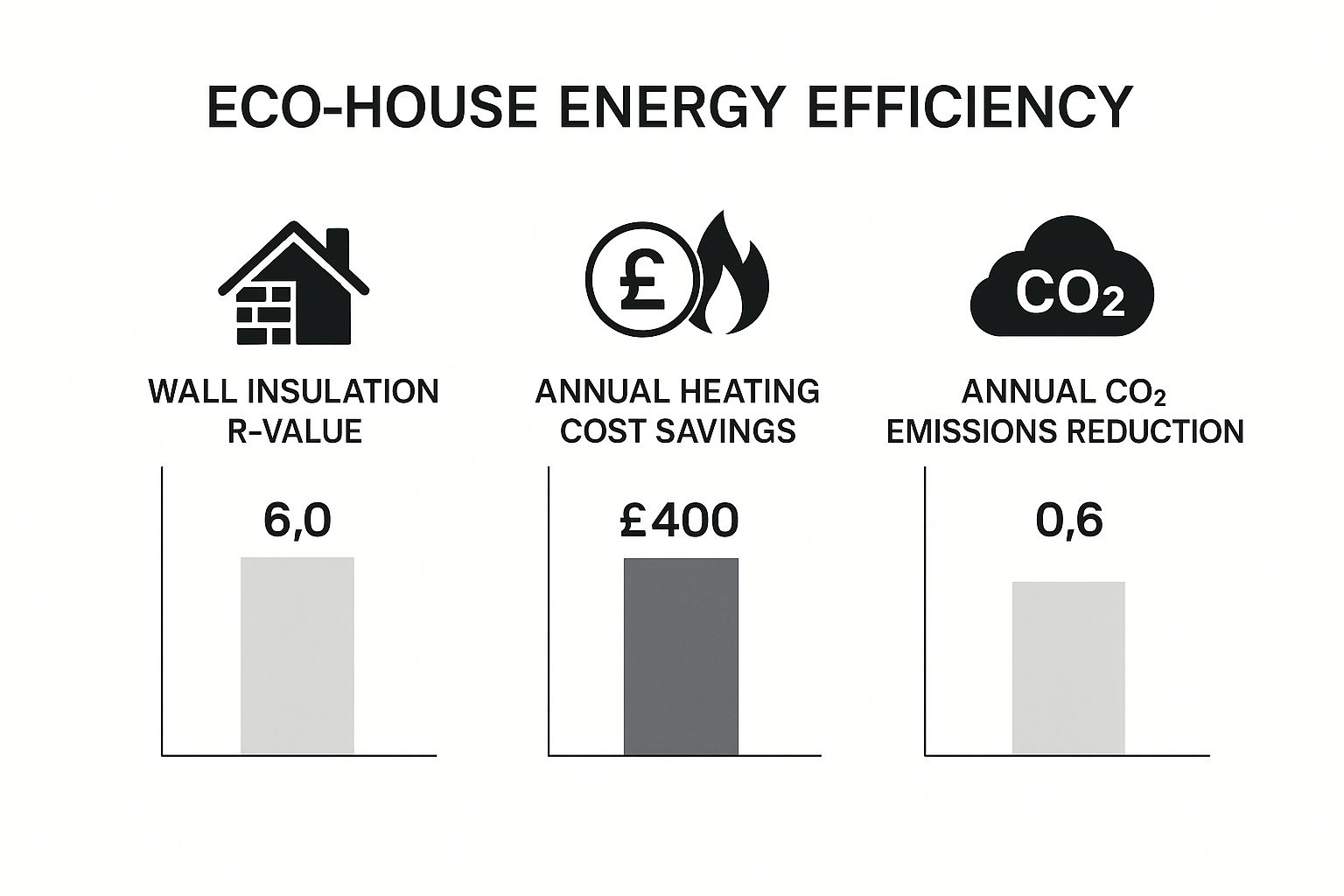
As you can see, higher insulation values don't just lead to small tweaks; they result in substantial cuts to both heating bills and CO2 emissions. It’s a powerful reminder of where to focus your efforts.
Exploring Natural and Recycled Materials
Fortunately, we’re now spoilt for choice with a growing range of excellent sustainable materials. These options not only have low embodied carbon but often create healthier indoor air and offer superb performance.
Here are a few popular choices:
Timber: Sourced from sustainably managed forests, timber is a fantastic structural material. It’s strong, versatile, and actually acts as a carbon store, locking away CO2 for the life of the building.
Straw Bale: Far from being just an agricultural by-product, straw is an incredible insulator. When used in thick bales within a timber frame, it creates super-insulated walls with exceptionally low embodied carbon.
Cork: Harvested from the bark of cork oak trees without harming them, cork is a brilliant all-rounder. It offers excellent thermal and acoustic insulation and is naturally resistant to water and fire.
Sheep's Wool: A completely natural and renewable fibre, sheep's wool insulation is highly effective at trapping heat. It's also breathable, which helps regulate humidity and improve indoor air quality.
Recycled Materials: Innovative products made from recycled newspaper (cellulose insulation) or plastic bottles give waste materials a new, high-value purpose, diverting them from landfill.
Finding the right combination is a key part of the design dialogue. To see how these choices fit into the bigger picture, you can learn more about the latest sustainable design trends for new build family homes and see how they differ from renovation projects.
Comparing Common Eco-Friendly Insulation Materials
Insulation is arguably the most critical material choice you’ll make for thermal performance. While modern foam boards like PIR offer great R-values for their thickness, natural alternatives bring compelling environmental benefits to the table. The table below gives a quick comparison of some popular eco-friendly options to help you see how they stack up.
Insulation Material | Key Benefit | Embodied Carbon | Suitability |
|---|---|---|---|
Sheep's Wool | Breathable and moisture-regulating, improving indoor air quality. | Very Low | Ideal for timber frame walls, lofts, and between floors. |
Wood Fibre | Provides both thermal mass and insulation, preventing summer overheating. | Low (Carbon Negative) | Excellent for external wall insulation and roof systems. |
Cork | Excellent thermal and acoustic properties; naturally resistant to moisture. | Very Low | Suited for external and internal walls, floors, and roofs. |
Cellulose (Recycled Paper) | Fills gaps effectively, creating a very airtight installation. | Very Low | Blown into timber frame cavities for walls, floors, and lofts. |
Ultimately, the best material for your project will depend on your specific goals, budget, and design. By carefully weighing up embodied carbon alongside performance, you can build a home that is not just efficient and comfortable, but truly light on the earth.
Navigating UK Building Regulations and Standards
Building an eco-house in the UK isn't just about good intentions; it’s about meeting, and more often, far exceeding official standards. This regulatory landscape provides the essential framework that ensures all new homes are safe, efficient, and genuinely fit for the future. Getting to grips with these rules is the first step in creating a project that is both compliant and truly high-performing.
The primary set of rules you'll encounter is the UK Building Regulations. Think of these as the absolute minimum legal standard your home must achieve. For anyone with an eye on sustainability, the most important section is Part L, which deals specifically with the conservation of fuel and power.
This regulation sets the baseline for energy efficiency, dictating minimum levels for insulation, airtightness, and the performance of your heating and hot water systems. It's the government's way of ensuring every new home built contributes something towards national carbon reduction targets. But for a true eco-house, meeting Part L is merely the starting line.
Beyond the Baseline Building Regulations
Let’s be clear: simply meeting the minimum requirements of Part L won't result in a top-tier eco-house. To achieve the exceptional performance, year-round comfort, and tiny running costs that define a modern sustainable home, many self-builders and architects look to more ambitious, voluntary standards.
Aiming for these higher benchmarks transforms a project from simply ‘compliant’ to ‘exemplary’. They provide a clear, proven roadmap for creating homes that are decades ahead of the curve.
Two of the most respected standards in the UK are:
Passivhaus: Often considered the gold standard in low-energy building, the Passivhaus standard originated in Germany and is famously rigorous. It focuses relentlessly on a 'fabric first' approach to create buildings so airtight and well-insulated that they require very little active heating or cooling at all. Achieving the official certification is a demanding process, but the result is a home with unparalleled comfort and energy bills that can be up to 90% lower than a standard new build.
AECB Building Standard: Developed by the Association for Environment Conscious Building, this UK-based standard offers a more flexible yet still highly ambitious alternative to Passivhaus. It provides a robust framework for achieving excellent energy efficiency without the strict certification demands, making it a popular choice for self-builders who want a proven, high-performance home without the final hurdle of formal accreditation.
Measuring Success with Energy Performance Certificates
So, how do you measure and prove your home’s energy efficiency? This is where the Energy Performance Certificate (EPC) comes in. An EPC is like the multicoloured energy label you see on a new fridge, but for your entire house. It rates a property's energy efficiency from A (most efficient) to G (least efficient).
For any new build, achieving a high EPC rating is a key goal and a legal requirement. It provides a clear, standardised benchmark of your home's performance, which is vital for its future value. As of early 2024, the average home in England and Wales sits at a 'D' rating. A genuinely sustainable project should be aiming for an 'A', putting it in the top tier of performance nationwide. You can see more data on UK housing energy ratings at Statista.com.
An EPC is more than just a certificate; it's the final scorecard for your project's energy design. A top rating is tangible proof that your investment in superior insulation, high-performance windows, and smart design has paid off.
Navigating this landscape of regulations and aspirational standards is a core part of the architectural process. Expert guidance is essential to integrate these requirements seamlessly from day one, ensuring the final building is a testament to both quality and performance. To understand how this fits into the bigger picture, explore our detailed approach to delivering sustainable architecture. This strategic planning is what makes an eco-house project successful, compliant, and ready for the future.
Understanding the Costs and Financial Benefits
Let's start with an honest conversation about money. When you're planning to build an eco house in the UK, the finances are always front and centre. There's a common belief that these homes come with a huge price tag, and it's true that the initial outlay is often higher than a conventional build.
But this isn't about spending more for the sake of it. Think of it as a strategic, upfront investment in the quality and performance of your home.
The initial premium is often around 5-15% more than a standard new build. That extra money goes directly into the components that deliver genuine, long-term value: triple-glazed windows, advanced airtightness membranes, high-spec insulation, and sophisticated ventilation systems. These aren't luxury add-ons; they're the fundamental building blocks of a home designed to run with exceptional efficiency. You’re investing in the very fabric of the building, creating an asset that starts paying you back from day one.
The Upfront Investment Breakdown
It helps to see where that extra money actually goes. It reframes the cost from a simple expense into a calculated investment in your home’s building envelope, which is designed to be as robust and efficient as possible. This drastically reduces its energy needs for decades to come.
Key areas of investment usually include:
High-Performance Glazing: Triple-glazed windows can cost a fair bit more than standard double-glazing, but they are absolutely critical for stopping heat from escaping.
Superior Insulation: Using thicker, higher-quality insulation in the walls, floors, and roof is essential for keeping the indoor temperature stable all year round.
Airtightness Detailing: This is a big one. Achieving a high level of airtightness requires specialist tapes, membranes, and skilled labour to meticulously seal every gap, eliminating drafts and energy leaks.
Advanced Ventilation: A Mechanical Ventilation with Heat Recovery (MVHR) system is a vital piece of kit. It brings in fresh air without losing the heat you’ve already generated, but it does represent a significant upfront cost.
Reaping the Long-Term Financial Rewards
This is where building an eco house really starts to make financial sense. The initial investment unlocks a lifetime of savings and benefits that quickly start to outweigh the upfront costs, delivering a powerful return.
The most immediate reward? A massive drop in your energy bills. Because an eco house is designed to hold onto heat so well, it barely needs any active heating. It’s not uncommon for owners of certified Passivhaus homes to see their heating bills slashed by as much as 90% compared to a standard new build. Over the years, that adds up to tens of thousands of pounds in savings.
Government support can also help make these projects more accessible. Programmes under the UK government’s Energy Company Obligation (ECO) framework are always pushing for better home energy efficiency. Initiatives like these show a clear commitment to rewarding sustainable building. To date, bill savings from ECO4 measures are estimated at £138.5 million annually, which highlights just how big an impact these upgrades can have. You can read the full government statistics on household energy efficiency to see the national picture.
Increased Property Value and Future-Proofing
Beyond just saving on bills, an eco house is a fundamentally more valuable asset. With energy costs on the rise and a growing awareness of environmental issues, properties with proven low running costs and high Energy Performance Certificate (EPC) ratings are becoming more and more desirable. They fetch a premium on the property market, making your investment a secure one.
Building an eco house is one of the most effective ways to future-proof your home. You are creating a property that is resilient to volatile energy prices, exceeds current and future building regulations, and offers a superior standard of comfort and health.
Ultimately, choosing to build an eco house is a financial decision that puts long-term gain ahead of short-term savings. It’s an investment not just in a building, but in a smarter, more resilient, and financially sustainable way of life.
Inspiring Eco House Examples in the UK
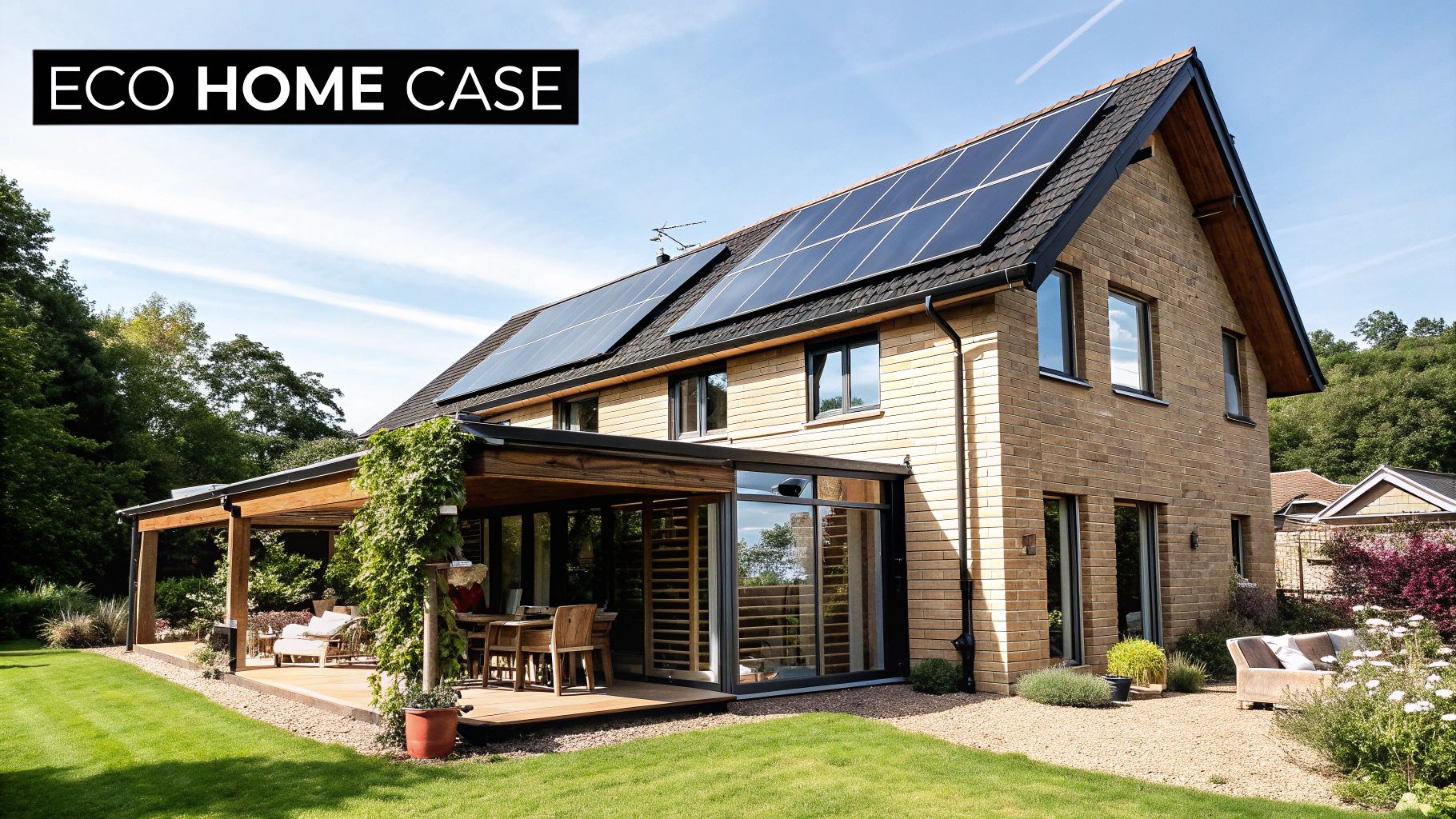
Standards and principles are one thing, but to really grasp what an eco house in the UK can be, you need to see them in the wild. Stepping inside these homes moves the conversation from abstract theory to tangible, inspiring reality.
These case studies prove that sustainable living isn’t a rigid formula. It's an adaptable philosophy that works across different locations, budgets, and architectural styles. From the windswept Scottish Highlands to the bustling streets of Manchester, homeowners are showing how exceptional energy efficiency can be beautifully woven into stunning design.
A Rural Passivhaus in Scotland
Imagine a home nestled in the Scottish countryside, built to shrug off harsh winters with almost no central heating. That’s the reality for certified Passivhaus projects, which are widely seen as the gold standard in energy-efficient design. One perfect example is a timber-clad home that blends a traditional rural look with seriously cutting-edge performance.
The owners’ brief was simple: create a comfortable family home with a minimal environmental footprint and next-to-nothing running costs. They achieved it by focusing on a few key features:
Triple-Glazed Windows: Placed strategically to capture as much free heat as possible from the low winter sun.
Airtight Construction: Every joint and seal was meticulously detailed to ensure virtually no heat escapes through draughts.
Super-Insulated Timber Frame: The walls, floor, and roof are packed with insulation, wrapping the home in a thermal cocoon.
The result? A home that stays at a constant, comfortable temperature all year round, powered mainly by the sun, its occupants, and waste heat from appliances.
An Urban Eco-Retrofit in Manchester
You don't always have to build from scratch. Transforming an existing property with a deep "eco-retrofit" can be just as powerful. A terraced house in Manchester shows how older Victorian building stock can be brought firmly into the 21st century with sustainability at its heart.
The biggest challenge was tackling the home's dreadful thermal performance without stripping it of its original character. The owners did this by adopting a 'fabric first' approach, sorting out the building's outer shell before touching anything else.
This project proves that you don't need a blank canvas to create a high-performance eco home. With careful planning, even older, energy-hungry properties can be transformed into comfortable, low-carbon havens.
Key upgrades included adding internal wall insulation to the original brickwork, fitting high-performance windows, and making the entire structure as airtight as possible. An MVHR system was also installed to supply constant fresh air, making the home healthier and more efficient.
These examples, whether new-build or retrofit, urban or rural, show just what’s possible when the principles of eco-friendly design are used to create truly exceptional homes.
Frequently Asked Questions About UK Eco Houses
Stepping into the world of sustainable home building naturally brings up a few questions. To help you plan your project with confidence, we’ve put together some straightforward answers to the queries we hear most often about creating a genuine eco house in the UK.
How Much More Does It Cost to Build an Eco House in the UK?
It’s best to think of the extra cost as a long-term investment rather than an expense. While there’s often an upfront premium of around 5-15% compared to a standard build, this figure can vary hugely depending on how ambitious your project is.
So, where does that extra money go? It’s channelled directly into the high-performance bones of the building—things like superior insulation, triple-glazed windows, and advanced ventilation systems that are key to making the home efficient for decades to come.
But the story doesn't end there. That initial outlay is offset by massive long-term savings. You could see your energy bills fall by as much as 90%. When you factor in potential government incentives, green mortgages, and the significantly higher resale value of an energy-efficient home, the financial case becomes very compelling.
Can I Turn My Existing UK House into an Eco House?
Absolutely. The process is known as ‘retrofitting’, and it can make a dramatic difference to the performance and comfort of an older property. While you might not achieve the flawless airtightness of a brand-new build, the improvements are well worth it.
A successful retrofit usually focuses on a few key steps:
Upgrading Insulation: This is your number one priority. Focus on the loft and cavity walls first, or consider adding external or internal wall insulation if that’s not possible.
Installing High-Performance Windows: Swapping old, draughty windows for modern double or triple-glazed units makes a huge difference to heat retention.
Switching to an Efficient Heating System: An air source heat pump is an incredibly popular and efficient alternative to a conventional gas boiler.
The best way to start any retrofit is with a professional energy audit. It’s like a health check for your home, pinpointing exactly where heat is escaping and showing you where your investment will deliver the biggest impact.
Do I Need Planning Permission for Eco-Friendly Features?
This really depends on what you’re planning to do and where your property is. Many internal upgrades, like adding loft or cavity wall insulation, are usually considered ‘permitted development’, which means you won’t need to apply for permission.
However, once you start making changes to the outside of your home, the rules can change. Installing solar panels, applying external wall insulation, or changing the look of your windows might need approval, especially if your home is in a conservation area or is a listed building. Even air source heat pumps have specific regulations regarding their placement and noise levels.
The golden rule is to always check with your local planning authority before starting any work. It’s a simple step that ensures you’re fully compliant and helps you avoid any costly mistakes down the line.
At Harper Latter Architects, we specialise in creating beautiful, bespoke homes that are designed for the future. Our expert team is here to guide you through every stage, from navigating the complexities of planning permission to choosing the perfect sustainable materials for your vision.
Explore our architectural services and see how we can help you build the home you’ve always dreamed of.
Article created using [Outrank](https://outrank.so)
Building an eco house in the UK requires thoughtful planning, sustainable materials, and the right expertise to bring your vision to life. From energy efficiency to modern design, every detail matters. Many homeowners find that visiting this helps them connect with reliable general contractors service providers who can guide the project smoothly from concept to completion.