
A Guide to Basement Conversion London Costs and Design

Going underground is one of the smartest ways to add serious living space and value to a London home. By excavating and transforming the area beneath your house, you can carve out anything from a family room or home gym to a fully self-contained flat. Done right, it can add a hefty 15-25% to your property's value. This guide is your roadmap to getting it right.
Unlocking Your London Home's Hidden Potential
In a city where space is the ultimate luxury, expanding downwards is a game-changing solution. A basement conversion in London isn't just a simple renovation; it’s about creating entirely new, high-quality living areas designed around your lifestyle, right in the heart of the capital.
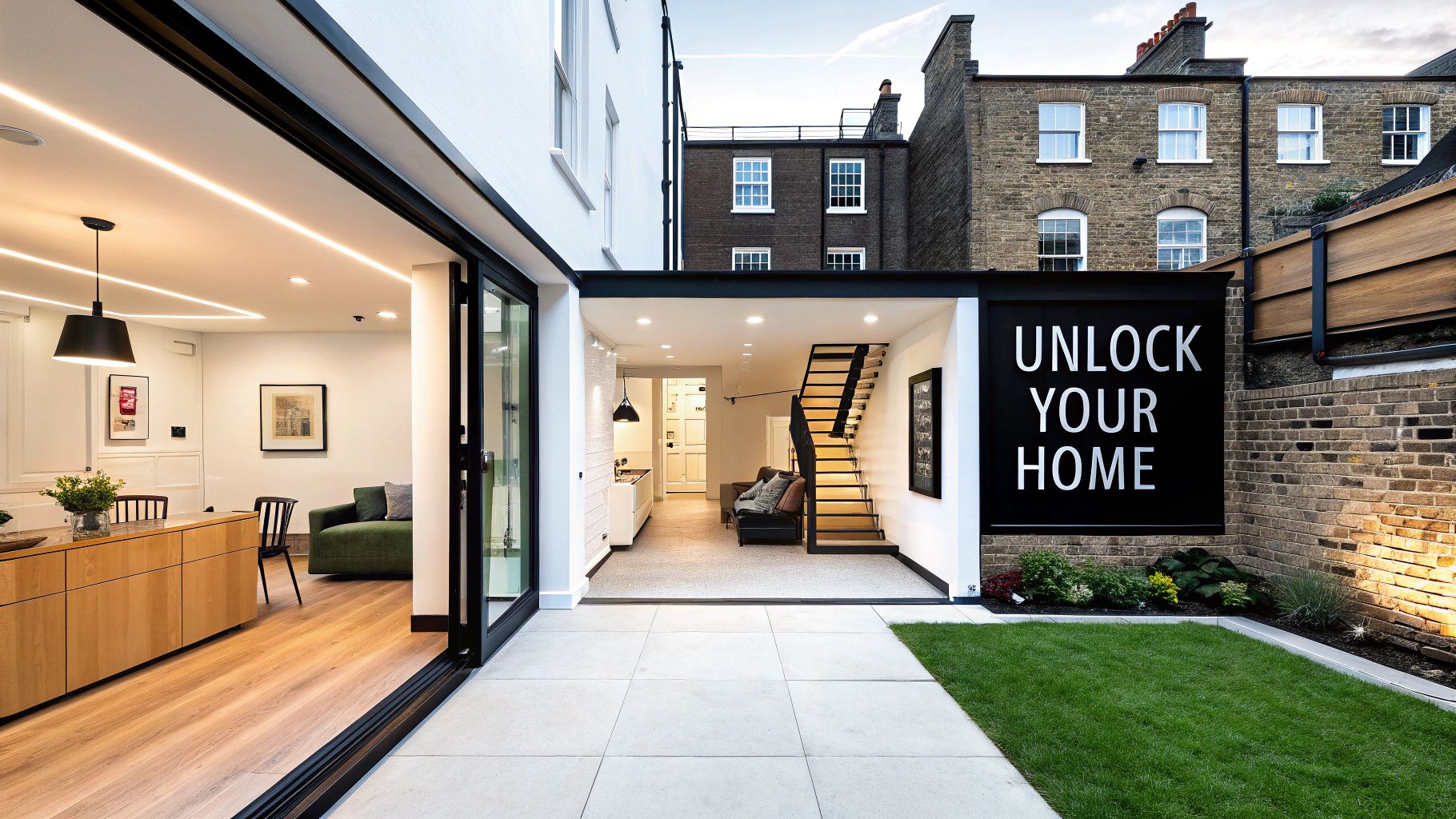
Think of this guide as your blueprint. We’ll walk you through every critical stage, from the first spark of an idea to the final handover, ensuring you create a stunning subterranean space that enhances both your daily life and your home's long-term worth.
The Rise of Subterranean Living
For years, Londoners looked up, adding loft conversions to gain extra room. Now, digging down has become just as popular, particularly in the city's most densely packed boroughs. It’s a trend driven by a simple desire: more space without the upheaval and immense cost of moving house.
Between 2008 and 2019, London boroughs gave the green light to a staggering 7,328 basement conversions, transforming dusty, forgotten cellars into vibrant hubs of family life. This boom shows just how much subterranean extensions have become the modern answer for space-starved Londoners. You can explore more data on this trend and its architectural impact.
What This Guide Covers
We know that undertaking a basement project can feel daunting. That’s why we’ve broken the entire journey down into clear, manageable sections, equipping you with the knowledge to make smart decisions every step of the way.
A well-designed basement should never feel like a compromise. With clever architectural planning, it can become the most exciting and functional part of your home, filled with natural light and designed for modern living.
Throughout this guide, we'll dive deep into the critical aspects of your project:
Feasibility and Planning: First things first—is your property suitable? We'll cover how to find out, plus how to navigate the complexities of local council regulations.
Structural and Design Considerations: This is where we get technical. We’ll look at excavation, waterproofing, and the clever design tricks needed to create a light, airy environment underground.
Costs and Timelines: A realistic look at the investment required and a practical timeline for how long the whole process typically takes from start to finish.
Assembling Your Team: Choosing the right architect, structural engineer, and contractors is crucial. We’ll explain why and what to look for.
Navigating Planning Permissions and Regulations
Before the first shovel breaks ground on your London basement conversion, it’s essential to get your head around the web of legal and regulatory requirements. This isn’t just about ticking boxes; it's about laying a solid, compliant foundation for the entire project. Getting this phase right ensures your build is lawful, safe, and avoids costly headaches down the line.
The journey starts with a proper feasibility study. This isn't a quick glance—it involves detailed surveys to assess ground conditions, the local water table, and existing drainage routes. These technical reports are critical. They inform everything from the structural design to the waterproofing strategy and are often a non-negotiable part of your planning application.
Differentiating Planning Permission and Building Regulations
Homeowners often get Planning Permission and Building Regulations confused, but they are two very different hurdles serving different purposes. For a new or extended basement in London, you will almost certainly need both.
Planning Permission is all about the principle of the development. The council looks at the impact of your project on the local area, considering things like:
The overall size and scale of the proposed basement.
Any external changes, such as the addition of lightwells.
The effect on neighbouring properties and the general streetscape.
Whether your property is in a designated Conservation Area or is a Listed Building.
On the other hand, Building Regulations are purely about the technical side of the construction. They exist to make sure the new structure is safe, structurally sound, and meets standards for energy efficiency, ventilation, and fire safety. An approved inspector will need to sign off on your project at key stages of the build.
Understanding this distinction is vital: Planning Permission gives you the right to build, while Building Regulations approval confirms how you build is safe and compliant. An experienced architect will manage both processes at the same time to keep your project moving forward.
Local Authority Policies and Conservation Areas
Every London borough has its own set of policies for subterranean developments, and they can vary quite a bit. For instance, boroughs like Wandsworth or the Royal Borough of Kensington & Chelsea have very strict rules about how much of a garden you can excavate. Some councils also restrict basements to a single storey in depth.
These rules get even tighter in Conservation Areas. Any external features, like lightwells or alterations to the front garden, will face intense scrutiny to ensure they don’t harm the character of the area. This is where an architect with strong local expertise becomes invaluable. They can design a scheme that gives you what you want while respecting council policy.
For a deeper dive, you can check out our ultimate guide to navigating basement extension planning permission.
The Importance of the Party Wall Act
If your property is terraced or semi-detached, the Party Wall etc. Act 1996 will almost certainly come into play. This legislation is there to protect both you and your neighbours when you’re doing construction work that affects a shared wall or is close to a boundary.
You are legally required to serve a formal notice on your neighbours before any work starts. They can either consent to the works or appoint their own surveyor—at your expense—to agree on a Party Wall Award. This is a legal document that sets out the specifics of the work and includes a schedule of condition for the neighbouring property to protect everyone involved.
The best approach is to engage with your neighbours early and transparently. A clear explanation of the plans, managed by your architect, can foster goodwill and often leads to a much smoother, quicker agreement. It’s the best way to prevent potential disputes that could otherwise stall your project for months.
A Realistic Breakdown of Basement Conversion Costs
Let's talk numbers. Understanding the finances behind a basement conversion in London is the first step toward a successful project. It's easy to get fixated on a simple per-square-metre figure, but the reality is far more complex. The final cost is a sum of many distinct parts, each shaped by your property's unique challenges and your personal vision for the space.
The budget isn't just about digging a hole and pouring concrete. It covers a huge range of services and materials. You have the initial excavation and complex structural engineering, the absolutely critical waterproofing, and finally, the interior finishes that bring the space to life. Every decision, from the type of staircase to the lighting design, has a price tag attached.
On top of the physical construction, professional fees are a significant slice of the pie. You'll need to account for the expertise of architects, structural engineers, and party wall surveyors, not to mention council fees for planning and building control inspections. And, of course, VAT at 20% must be factored into the total investment.
Core Cost Components Unpacked
Before you can pull together a meaningful budget, you need to know where the money actually goes. The main costs fall into two broad categories: the shell-and-core construction and the fit-out.
The shell-and-core is the heavy-duty structural phase. This is where we create the waterproof concrete box that forms the foundation of your new space. It’s the most disruptive and technically demanding part of the build.
The fit-out stage is where that empty shell gets transformed into a liveable part of your home. This includes everything from putting up internal walls, running plumbing and electrics, laying floors, and decorating. The specification here is the biggest variable; a simple playroom will cost far less to fit out than a luxury home cinema with integrated sound systems and custom joinery.
A common mistake is underestimating the cost of the fit-out and professional fees. While the structural work is the single largest expense, the combined cost of high-quality finishes and essential expert services can easily climb to match it.
Waterproofing Your Investment
In any subterranean construction, waterproofing is completely non-negotiable and a critical cost factor. You simply cannot cut corners here.
The industry standard, which complies with BS 8102, is a Type C Cavity Drain Membrane system. This clever method doesn't try to form an impenetrable barrier against water. Instead, it intelligently manages it, channelling any moisture that finds its way in to a sump pump system that safely removes it from the property.
While older methods like 'tanking' (applying a waterproof coating) still exist, they are far less reliable for new-build basements. Investing in a robust, professionally installed cavity drain system—complete with an insurance-backed guarantee—is the only way to ensure your new space remains perfectly dry and usable for decades to come.
Estimated Basement Conversion Costs in London
To give you a clearer idea, here's a look at how costs can vary depending on the scope of the project. Remember, these are guide prices, and a detailed quote from a professional is the only way to get a precise figure for your home.
Project Scope | Estimated Cost per Square Metre (inc. VAT) | Typical Project Total (for 50m²) |
|---|---|---|
Shell & Core Only | £3,000 - £4,500 | £150,000 - £225,000 |
Basic Fit-Out | £4,500 - £6,000 | £225,000 - £300,000 |
High-End Fit-Out | £6,000+ | £300,000+ |
These figures show that while the structural shell forms the base cost, the level of finish you choose for the fit-out has a massive impact on the final investment.
The Return on Your Investment
While the initial outlay for a London basement conversion is significant, the financial returns can be exceptional. In a city where space is at an absolute premium, it's one of the most effective ways to add valuable square footage.
The numbers really do speak for themselves.
In fact, analysis has shown that London basement conversions can increase property values by as much as 54%. For a typical 56-square-metre extension, this could add around £460,000 to your home's value. Even after factoring in average construction costs, the net gain often reaches nearly £300,000, making it a very smart move.
For a more detailed look at project finances, you can check out our essential 2024 guide to basement conversion costs.
Designing Your Dream Subterranean Space
A successful basement conversion in London is about much more than just carving out extra square metres. It’s a chance to design the most exciting and personal space in your home. This is where you can break free from the constraints of a traditional floor plan and create something truly special, built around your lifestyle. The key is to challenge the old idea of basements as dark, secondary spaces and see them for what they are: a blank canvas for brilliant architecture.
The single most critical element to get right is light. A well-lit basement feels expansive, welcoming, and properly connected to the rest of the house. Without good light, even the most luxurious fit-out will feel compromised. This is where clever architectural strategies are essential to flood your new space with natural daylight.
Letting the Sunshine In
Maximising natural light is both an art and a science. It’s all about strategically puncturing the boundary between your new basement and the outside world, drawing light down into the very heart of the space.
Your architect will likely have several tricks up their sleeve to achieve this, including:
Generous Lightwells: These are excavated areas next to the basement, often with glazed doors or large windows, which create a sunken courtyard effect. They provide direct daylight and a vital visual link to the garden or sky.
Walk-On Glazed Panels: Integrated into a ground-floor patio or garden, these toughened glass floors allow daylight to pour directly into the room below while keeping your outdoor space usable.
Open-Tread Staircases: A beautifully crafted open-tread or floating staircase allows light to filter down from the ground floor, stopping the stairwell from feeling dark and enclosed.
Double-Height Voids: For the ultimate sense of drama and light, creating a double-height space connecting the basement and ground floor is transformative. It makes both levels feel larger and more integrated.
A common misconception is that basements are inherently dark. With thoughtful design, including large lightwells and strategically placed glazing, a new basement can often be the brightest and most inviting room in a London home.
Creating a Space That Works for You
Once you’ve solved the challenge of light, you can turn your attention to how the space will function. The beauty of a basement is its sheer versatility. Freed from the typical demands of a residential layout, you can create rooms that are purpose-built for leisure, work, or wellness.
For many London homeowners, this means creating amenity-rich spaces that would be impossible to squeeze in anywhere else in the property.
Popular Uses for a Modern Basement Conversion:
Home Cinema or Media Room: With fantastic natural acoustics and controlled lighting, basements are the perfect spot for an immersive cinematic experience.
State-of-the-Art Gym: You can create a private wellness suite with proper space for cardio equipment, weights, and a dedicated yoga or Pilates area.
Bespoke Wine Cellar: A climate-controlled wine room provides the ideal conditions for storing a prized collection, often with an adjoining tasting area.
Tranquil Spa or Sauna: Design your own personal sanctuary for relaxation, complete with a sauna, steam room, or even a plunge pool.
The possibilities are practically endless. You can explore even more concepts in our guide to 12 luxury basement conversion ideas for London homes.
Integrating Technology and Sustainability
A high-quality basement conversion should feel modern, comfortable, and efficient. Integrating smart home technology allows you to control lighting, climate, and audio-visual systems from a single device, adding a layer of convenience and luxury.
From a sustainability perspective, a Mechanical Ventilation with Heat Recovery (MVHR) system is a must-have. These systems provide a constant supply of fresh, filtered air while retaining most of the energy already used to heat the space. This guarantees excellent air quality—which is vital in a subterranean environment—and significantly improves the energy efficiency of your entire home.
When you pair an MVHR system with high-performance insulation and glazing, your new basement can easily become one of the most comfortable and eco-friendly parts of your property.
Bringing the Designs to Life: The Construction Process
This is where the architectural drawings start becoming a real, tangible structure beneath your home. The construction phase isn't just digging a hole; it's a highly organised sequence of events that turns a patch of earth into a beautiful, functional living space. Understanding this journey helps demystify the build and lets you appreciate the skill involved at every stage.
The entire process is meticulously planned out, focusing on structural integrity, safety, and a perfect finish. From the first day on site to the final coat of paint, each step logically builds on the last, creating a robust and elegant extension to your home.
The Build Sequence from Start to Finish
Constructing a London basement follows a phased approach that, while tweaked for each project's unique challenges, holds a consistent core sequence. It always starts with the heavy, messy structural work before progressing to the finer, more detailed finishes.
This process has to be managed with military precision, especially in dense London neighbourhoods where logistics and keeping the neighbours happy are just as important as the engineering.
Key Construction Stages:
Site Setup and Preparation: First things first, the site is secured. This means setting up welfare facilities for the team and, crucially, putting robust protections in place for your home and your neighbours' properties.
Excavation and Underpinning: Now the dig begins. Soil is carefully removed in stages while the foundations of your house are systematically strengthened in a process called underpinning. This is what creates the solid structural support for the new space below.
Waterproofing and the Structural Shell: Once the hole is dug, the most critical element is installed: the waterproofing system. A reinforced concrete shell (floor, walls, and ceiling) is then built, forming a completely dry and stable box. This phase must meet the stringent BS 8102 standards to guarantee it performs flawlessly.
First Fix (The Internal Skeleton): With the main structure in place, work moves inside. This stage is all about installing the things you won't see later – internal stud walls, floor joists, plumbing pipework, and electrical wiring. It's the hidden skeleton of your new rooms.
Second Fix and Finishes: This is the exciting part where the space starts to feel like a home. Plastering is done, doors are hung, bathroom and kitchen fittings go in, and tiling and flooring are laid. The final decorative touches, like painting and fitting bespoke joinery, complete the transformation.
This simple diagram shows the key design thinking that happens alongside the build itself, centring on light, function, and technology.

It’s a great reminder of how getting the light right, defining the function, and integrating the right tech from the outset leads to a successful basement.
How Long Will It All Take?
The big question everyone asks is: "How long will my home be a building site?" For a typical London basement conversion, you should realistically plan for the on-site construction to take 6 to 12 months.
Of course, several factors can influence that timeline. The size and complexity of the dig are the main drivers. Converting an existing cellar is much quicker than a deep, multi-level excavation under the whole house and garden. Tricky ground conditions, tight site access, and the intricacy of the interior fit-out also play a major part in the schedule.
The secret to keeping a basement build on schedule is effective project management. A skilled project manager or lead architect is the central point of coordination, making sure materials arrive on time, trades are booked efficiently, and any problems are solved quickly before they cause a domino effect of delays.
Why Professional Project Management is Non-Negotiable
Trying to build a basement in a city like London throws up some unique challenges. The disruption to your life and maintaining good relationships with your neighbours are just as vital as the technical side of things. This is where professional project management really earns its keep.
An experienced manager handles all the day-to-day logistics, from coordinating deliveries on narrow residential streets to ensuring the team sticks to the working hours agreed with the council. They act as your single point of contact, giving you regular progress updates and keeping a firm grip on the budget to prevent costs from spiralling.
Even with stabilised construction costs of £2,500-£4,000 per square metre, the high planning approval rates and potential value uplift of 15-25% mean it’s a brilliant time to build. With projects taking 6-12 months, homeowners are seeing fantastic returns, especially when adding high-demand features like home spas or smart waterproofing systems in boroughs from Wimbledon to Hackney. You can read more about why now is a great time to build your basement on basementstructures.co.uk.
Ultimately, having a pro overseeing the build ensures a smoother, less stressful journey. It protects your investment, preserves harmony on your street, and delivers a stunning, high-quality space that meets all your expectations—on time and on budget.
Your Basement Conversion Questions Answered
Even with the best-laid plans, a London basement conversion is a big undertaking and it’s natural to have questions. To offer a bit of clarity, here are our answers to some of the most common queries we hear from homeowners.
How Much Value Does a Basement Conversion Add to a London Property?
A well-designed, beautifully finished basement is one of the smartest investments you can make in a London home. In most cases, you can expect to see a value boost of 15-25%.
In high-value areas like Wimbledon or Richmond, the return can be even more significant. Property specialists such as Foxtons consistently find that the value added per square metre outstrips the build cost, meaning you don’t just recoup your outlay—you make a tangible profit. The final figure always comes down to the quality of the fit-out, the kind of space you create, and the local market, but the principle is sound.
The surest way to increase a London property's value is to add high-quality, usable square footage. A basement does this without changing the building's footprint, making it a uniquely powerful home improvement.
Do I Always Need Planning Permission for a Basement Conversion?
Not always, but it’s highly likely. For any significant basement project in London, the short answer is yes.
If you’re lucky enough to have an existing cellar that you simply want to convert into a habitable room—without any digging or external changes—you may be able to proceed without full planning permission. However, you will always need Building Regulations approval to ensure the new space is safe, warm, and properly ventilated.
For any project that involves excavation—whether you’re digging a new basement from scratch, lowering the floor of an existing one, or adding a lightwell—planning permission is almost certainly required. It's safest to assume you’ll need it. Most London councils now have their own specific, often quite strict, policies for subterranean developments, which makes getting an architect involved from day one absolutely essential.
How Can I Make Sure My New Basement Won't Be Damp?
This is probably the biggest concern for most homeowners, and rightly so. The answer lies in a professionally designed and installed waterproofing system. Modern basements are protected by what’s known as a ‘Type C’ cavity drain membrane system, which is the gold standard recommended by British Standard BS 8102.
Forget old-school 'tanking' which tries to create an impermeable barrier. The modern approach is far more intelligent. The membrane system creates a cavity that manages any water ingress, channelling it discreetly to a sump pump, which then pumps it safely away from your home.
It’s a robust, reliable solution, but it has to be done right. That’s why using a specialist waterproofing contractor who provides a long-term, insurance-backed guarantee is non-negotiable. Your architect will specify the correct system and ensure it’s seamlessly integrated with the structural design, giving you total peace of mind.
How Long Does a Typical Basement Conversion in London Take?
A typical project breaks down into two distinct phases: the planning stage and the actual build.
Pre-Construction Phase: This is all the crucial groundwork before a spade hits the ground. It covers initial designs, submitting planning applications, detailed structural engineering, and sorting out Party Wall Agreements with your neighbours. This part of the process usually takes 4 to 8 months.
Construction Phase: This is when the builders are on-site. For most projects, the build itself will take between 6 and 12 months. A straightforward conversion might be on the shorter end of that scale, whereas digging a large new basement with a complex layout and a high-end finish will naturally take longer.
Your architect should give you a realistic project schedule right at the start, mapping out the key milestones for both phases. This ensures everyone is on the same page from the get-go and you know exactly what to expect.
At Harper Latter Architects, we specialise in designing and delivering exceptional basement conversions across Wimbledon and South West London. Our expert team navigates every stage of the process, from initial feasibility studies to the final, stunning handover. If you're ready to unlock the hidden potential beneath your home, get in touch with us today to schedule your initial consultation.
Comments