
Your Guide to New Builds in Wimbledon

Updated: Oct 17, 2025
When people think of Wimbledon, world-class tennis is usually the first thing that comes to mind. But beyond the courts, it’s an exceptional location for creating a bespoke new build in wimbledon, offering a rare blend of village charm and superb access to the city. It’s no wonder discerning buyers and developers are drawn to the SW19 postcode, looking to craft one-of-a-kind homes that promise both luxury and an unrivalled lifestyle.
Why Wimbledon is a Prime Location for New Homes

Wimbledon holds a unique position in the London property market. It’s a place of two halves—the bustling, well-connected town centre and the quintessential English village—creating an atmosphere that appeals to a huge range of people. You get the green spaces and community feel without sacrificing urban convenience.
This dual character is exactly what drives so much demand. While professionals and young families love the fast transport links into central London, others are drawn to the close-knit community and slower pace of Wimbledon Village. This enduring appeal means that building a new home here isn’t just a lifestyle decision; it’s a sound long-term investment.
A Market Driven by Lifestyle and Scarcity
The hunger for new builds in Wimbledon stems from a desire for modern, high-specification living that older properties just can't offer without a major overhaul. Today’s buyers are looking for homes designed for contemporary life, complete with open-plan layouts, energy-efficient tech, and finishes tailored to their tastes.
This demand runs up against a market where available land is scarce, making every new build opportunity incredibly valuable. Projects here tend to fall into a few key categories:
Bespoke Family Residences: Often replacing older, less efficient houses, these are large, detached properties with spacious gardens and luxury features.
High-Specification Apartments: Smaller-scale developments that offer secure, modern living right near the transport and shopping hubs of the town centre.
Contemporary Townhouses: Stylish homes that cleverly maximise space on smaller plots, providing a modern take on the traditional Victorian terrace.
For anyone considering this path, the journey of creating a home from the ground up offers unparalleled control. It’s your chance to craft a space that perfectly aligns with your vision and lifestyle—something that’s almost impossible to find in existing housing stock.
This guide is your roadmap to navigating this exciting process. We’ll cover everything from the first step of finding a plot and securing planning permission to the finer points of architectural design and the luxury finishes that make a house a home. By understanding both the opportunities and the challenges of creating new build homes, you can confidently turn your vision for the perfect Wimbledon property into a reality.
Finding a Plot and Navigating Planning
The dream of a new build in Wimbledon doesn’t start with bricks and mortar. It starts with a patch of land and a solid plan. This first stage is, without a doubt, the most critical part of the entire journey, setting the tone for everything that follows. It’s a two-part challenge: first, you have to find a suitable plot in one of London’s most sought-after postcodes, and then you have to successfully navigate the complex local planning system.
It’s a bit like playing a strategic game of chess. Your opening move is securing the right space on the board—the plot. Every move after that involves understanding the rules, anticipating the planning authority’s strategy, and presenting your case so convincingly that you get the green light. Success here demands foresight, deep local knowledge, and expert guidance.
Identifying Viable Plots in SW19
Let’s be realistic: in a place as established and desirable as Wimbledon, empty plots of land are like gold dust. The real opportunity for new builds in Wimbledon comes from spotting sites with hidden potential. This means looking beyond the obvious and seeing where value can be created from what’s already there.
The most successful plot-finding strategies usually involve one of these approaches:
Underdeveloped Properties: Keep an eye out for older, smaller houses sitting on surprisingly generous plots. These are often prime candidates for a replacement dwelling—a modern, more spacious home that makes far better use of the land (subject to planning, of course).
Backland Development: These are the hidden gems. Sites tucked away behind existing properties, often with their own private access, can be perfect for creating wonderfully secluded new homes.
Off-Market Opportunities: Building good relationships with local estate agents and property insiders can open doors to plots before they ever appear on the open market. A well-connected architect often has their ear to the ground for these discreet sales.
A key realisation for anyone looking to build here is that you are often buying the potential of a site, not just the land itself. The true value is unlocked through intelligent design and a successful planning application.
The diagram below shows how this process works, moving logically from the initial search for land to preparing a planning application that’s built to succeed.
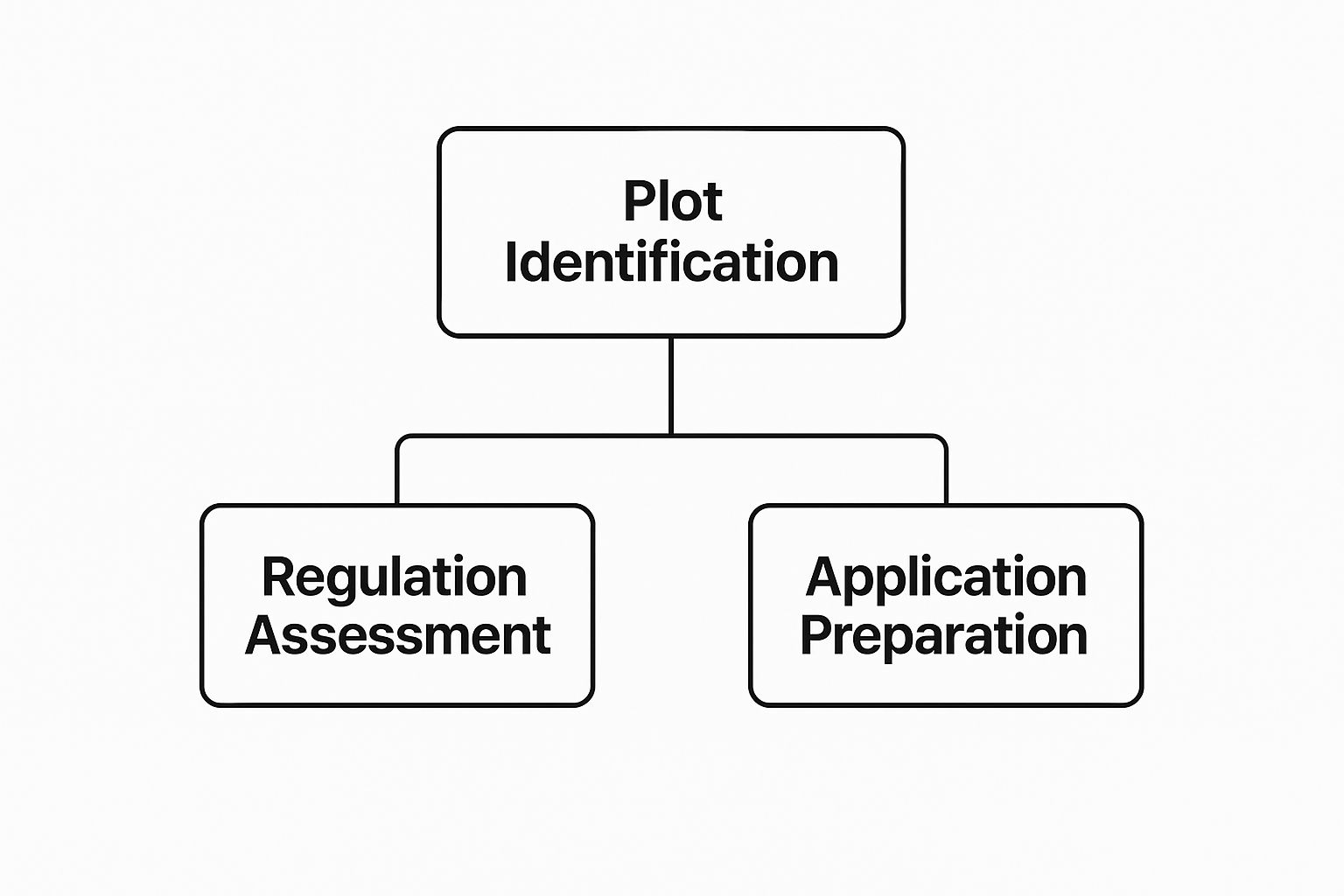
As you can see, each stage builds on the one before it, turning a simple land search into a concrete, approvable plan.
Demystifying Merton's Planning Regulations
Once you’ve found a promising site, the focus shifts to the intricate world of planning policy. Any new build project in Wimbledon falls under the authority of the London Borough of Merton, which has its own very specific rulebook designed to protect the area's unique character.
Getting your head around this bureaucratic landscape is essential. For instance, large parts of Wimbledon are designated as Conservation Areas, which adds a whole other layer of scrutiny to any new proposal. In these zones, the council is laser-focused on preserving or enhancing the local aesthetic. Your design must be sympathetic to its historical surroundings, using appropriate materials and respecting the scale and feel of neighbouring properties.
A successful application isn't just about what you want to build. It’s about proving that your proposal is a positive addition to the area and meticulously follows the established guidelines.
Crafting a Successful Planning Application
Submitting a planning application is so much more than filling out forms. It’s the art of telling a compelling story—presenting your vision in a way that planning officers can understand and support. A weak application is easily refused, costing you precious time and money. A strong one, however, is backed by meticulous preparation and expert input.
Here are the key elements of an application that gets results:
Pre-Application Advice: This is a vital strategic move. Engaging with Merton's planning department before you formally submit is your chance to get early feedback, flag potential issues, and demonstrate a collaborative, professional approach.
Detailed Architectural Drawings: Professional plans, elevations, and 3D visuals are non-negotiable. They need to clearly and accurately communicate every aspect of your design, from the building’s overall shape down to the specific brick or timber you plan to use.
Supporting Documentation: Depending on the site, your application might need a Design and Access Statement, a Heritage Statement (a must for conservation areas), tree surveys, or flood risk assessments. Each document helps build a comprehensive, watertight case for your project.
Ultimately, getting planning permission is a delicate dance between creative design, technical know-how, and an intimate understanding of Wimbledon's specific planning environment. Partnering with an architect who has this localised knowledge can be the difference between a frustrating delay and a smooth path to finally breaking ground on your new home.
The Architectural Journey for Your Home
Once you’ve secured a plot and worked through the maze of planning permission, the real design journey begins. This is where your ideas, sketches, and daydreams start their transformation into a detailed, buildable blueprint for your new home. It’s a creative partnership, balancing your ambitions with the practical realities of the site, your budget, and the way you want to live.
Think of your architect as a Savile Row tailor, but for your house. Every measurement, material, and detail is meticulously considered to create something that isn’t just beautiful, but fits you perfectly. This bespoke approach is what ensures your new build in Wimbledon will be a true reflection of your vision.
The first step is always turning your brief into something tangible. This involves deep conversations about how you live your life—what you value, what you need, and the kind of atmosphere you want to create. Are you picturing big, open-plan spaces for entertaining, or quiet, cosy nooks for reading and relaxing? A seamless flow into the garden?
From Concept to Detailed Design
With a clear vision established, your architect will start developing initial sketches and 3D models. These conceptual designs explore different layouts, shapes, and styles, helping you see the possibilities for your plot long before a single brick is laid. This phase is all about dialogue, giving you the space to refine ideas and make those big decisions early on.
This conceptual stage is where creativity and pragmatism meet. The architect’s skill lies in pushing design boundaries while respecting the constraints of the site, local planning policies, and, most importantly, your budget.
This back-and-forth process ensures the final design is both inspiring and achievable. Your architect will consider everything from how the sun moves across your home during the day to the natural flow between rooms, ensuring the house functions as beautifully as it looks. You can get a better sense of this specialised process by understanding why you should choose new build architects for a ground-up project.
To help you visualise this process, we’ve broken down the key architectural stages into a simple table.
Key Stages of a Bespoke Architectural Project
Phase | Key Activities | Primary Outcome |
|---|---|---|
Concept Design | Initial client meetings, site analysis, brief development, creating initial sketches and 3D models to explore layouts and aesthetics. | A clear design direction and a set of conceptual drawings that capture the client's vision. |
Developed Design | Refining the approved concept, selecting key materials and finishes, and preparing a more detailed set of drawings for planning submission. | A comprehensive planning application package and a solid design foundation. |
Technical Design | Creating detailed construction drawings, specifying all materials, and coordinating with engineers. This is the "how-to" guide for the builder. | A complete set of construction-ready drawings and specifications for tender and building control. |
Construction Phase | Architect oversees the build, answers contractor queries, carries out site inspections, and ensures the design is being executed correctly. | The finished, high-quality home, built according to the agreed-upon design and standards. |
This structured approach is what transforms a great idea into a successfully built home, ensuring nothing is left to chance.
The Technical Phase and Specialist Collaboration
Once the concept is signed off, the project gets serious, moving into the technical design phase. Here, the broad strokes are filled in with precise, construction-ready details. Your architect produces a comprehensive pack of technical drawings and specifications that will tell the builders exactly what to do.
These documents are incredibly detailed, covering every aspect of the build, including:
Detailed Floor Plans and Elevations: Pinpointing the exact dimensions of every room, wall, door, and window.
Construction Details: Specifying how different parts of the building join together to guarantee structural integrity and keep the weather out.
Material Specifications: Outlining the exact products to be used, from the type of brick and roof tile to the window frames and insulation.
This is also the point where other specialists join the team. A structural engineer is essential for designing the building’s skeleton—the foundations, beams, and frame—to ensure it’s safe, stable, and meets all building regulations. Depending on the complexity, you might also bring in mechanical and electrical engineers.
While new builds are a key focus for local planners, they still represent a tiny fraction of property sales in Wimbledon. This rarity means new developments are watched closely by investors. Recent data shows that while average property prices saw a slight dip in early 2024, strong rental demand has pushed gross yields for new buy-to-let investments to 5.5%—a significant jump from 4.3% in 2019. This dynamic makes a well-designed, high-quality new build a particularly valuable asset. The meticulous work done during the technical design phase is what guarantees this quality, laying the foundation for a smooth build and an exceptional home.
Integrating Sustainable and Smart Technology
In today's Wimbledon, a luxury new build is about much more than just beautiful materials and a flawless finish. It’s defined by intelligent, forward-thinking design. Weaving in sustainability and smart technology isn't an optional extra anymore; it’s a fundamental part of creating a truly exceptional modern home. This approach doesn't just elevate comfort and convenience—it future-proofs your investment and dramatically shrinks its environmental footprint.
It’s about building a home that works smarter, not harder. Think of it as a property with both a conscience and a high IQ. A home that learns your habits, optimises its own energy use, and ultimately provides a healthier environment for your family.

Building for Efficiency and Environmental Responsibility
Sustainable design isn't something you tack on at the end. It starts right at the beginning, long before the first spade hits the ground. It begins with a deep commitment to using materials and systems that minimise environmental impact while maximising long-term performance. The aim is to create a building that’s not only cheap to run but adds real, tangible value from day one.
Here are a few key elements you'll find in a truly sustainable build:
High-Performance Energy Systems: Technologies that were once niche are now becoming standard. Things like air-source heat pumps, which cleverly pull warmth from the outside air, and solar panels are essential. They slash your reliance on fossil fuels and lead to much lower energy bills.
Sustainable Building Materials: Using locally sourced timber, reclaimed bricks, or recycled steel significantly reduces a project's carbon footprint. Paired with modern insulation, these materials create a highly efficient thermal envelope that keeps your home warm in winter and cool in summer without cranking up the thermostat.
Water Conservation Techniques: Simple but effective systems like rainwater harvesting for the garden and low-flow fixtures in bathrooms can dramatically cut water consumption—a vital consideration for any environmentally conscious homeowner.
A key goal for many luxury new builds is achieving a high BREEAM (Building Research Establishment Environmental Assessment Method) rating. This isn't just a certificate; it's a clear, respected benchmark of a property's sustainability credentials. A strong rating makes it far more attractive to future buyers and adds demonstrable value to your asset.
This focus on sustainability is more important than ever, especially as the demand for high-quality housing in London continues to rise. While there’s a national push to increase housing stock, London itself is grappling with a significant deficit. In fact, the capital is seeing its lowest number of new homes under construction since 2010. This makes every single high-quality, sustainable new build in Wimbledon an especially valuable addition to the local property market. You can explore the data yourself by reading the full government housebuilding statistics.
The Rise of the Smart Wimbledon Home
Alongside sustainability, smart home technology is completely changing how we interact with our living spaces. A properly integrated system is so much more than just a few voice-activated speakers. It’s about creating a single, seamless ecosystem where your lighting, security, climate, and entertainment all work in harmony to make life easier and more enjoyable.
This becomes the central nervous system for your home, offering incredible control and automation. Imagine your house automatically adjusting the blinds based on the position of the sun, setting the perfect temperature just before you get home, or creating custom lighting scenes for a dinner party at the touch of a button.
Smart technology also plays a massive role in boosting energy efficiency. By intelligently managing heating and lighting, these systems make sure no energy is wasted, perfectly complementing the home's sustainable design features. To see how these ideas come together in practice, it’s worth understanding the core principles laid out in this UK energy-efficient home design guide. By weaving these technologies into the very fabric of your home's architecture, you create a space that isn't just luxurious, but exceptionally intelligent and responsible too.
Crafting Luxury Interiors and Finishes
With the architectural blueprint finalised and the structure taking shape, the focus shifts to the soul of your new home—its interiors. This is where a house becomes a home, where well-designed spaces are transformed into personal sanctuaries. This stage is all about selecting the high-end finishes and developing a cohesive design that brings your unique vision to life.
It's here that the personality of your new build in Wimbledon truly begins to emerge. This goes far beyond simple decoration; it’s about creating a distinct atmosphere through the careful curation of materials, textures, and light. Every choice, from the flooring underfoot to the joinery lining a room, contributes to the overall story of your home.

Defining Spaces with Bespoke Joinery and Gourmet Kitchens
Standard, off-the-shelf solutions just don’t cut it in a bespoke new build. Commissioning custom joinery—from fitted wardrobes and libraries to intricate media units—ensures every inch of your home is both beautiful and practical. This allows you to create storage that disappears seamlessly into the architecture and display pieces that become features in their own right.
Nowhere is this more critical than in the kitchen. As the heart of the modern home, a gourmet kitchen is designed for far more than just cooking; it’s a space for gathering, entertaining, and daily life. Key considerations include:
Ergonomic Layout: Designing a workflow that feels intuitive and efficient, whether you're making a quick breakfast or hosting a large dinner party.
High-End Appliances: Specifying professional-grade ovens, hobs, and integrated technology that blend high performance with sleek aesthetics.
Durable and Beautiful Materials: Selecting worktops like natural stone or high-performance composites, paired with cabinetry that will stand the test of time.
Designing Spa-Like Bathrooms and Sophisticated Lighting
That sense of luxury should extend into the most private areas of the home. Modern bathrooms are evolving into spa-like retreats, designed purely for relaxation and rejuvenation. This means thinking beyond basic fixtures to create a holistic experience with features like walk-in rain showers, freestanding baths, and custom vanity units. Material choices, such as large-format porcelain tiles and warm woods, help create a serene and calming atmosphere.
Lighting is another crucial layer, often underestimated but with the power to completely transform a space. A sophisticated lighting scheme isn’t just about illumination; it’s about creating mood and highlighting architectural details.
A well-designed lighting plan uses a combination of ambient, task, and accent lighting. This layered approach adds depth and warmth, allowing you to tailor the atmosphere of a room for any occasion, from bright and functional to soft and intimate.
Extending Luxury into Outdoor Spaces
For a new build in Wimbledon, the connection between indoor and outdoor living is everything. Creating elegant external spaces effectively extends the footprint of your home, providing new areas for dining, relaxing, and entertaining. This involves more than just laying a simple patio; it requires a considered approach to landscape architecture.
This might mean designing a seamless transition from the living area to a stone terrace, installing an outdoor kitchen for alfresco dining, or creating a tranquil garden room that serves as a home office or gym. Thoughtful planting, outdoor lighting, and high-quality materials ensure the garden becomes a true extension of the interior’s luxury and style, making the entire property feel cohesive and complete.
Managing Your Project Budget and Timeline
Bringing an ambitious architectural vision to life is exhilarating, but it’s the solid financial and logistical planning that ultimately guarantees success. A new build is a complex machine with many moving parts. Getting a firm grip on the budget and schedule is what makes the difference between a smooth, predictable construction phase and one plagued by stress and spiralling costs.
Think of your architect or project manager as the conductor of an orchestra. Their job is to make sure every specialist—from the groundworkers laying the foundations to the electricians wiring the sockets—plays their part at exactly the right time. A single missed cue can cause a cascade of delays, and in construction, delays always mean extra expense.
Choosing Your Project Management Approach
How you decide to manage the build itself will have a huge impact on your stress levels and your bottom line. Broadly speaking, there are two main routes you can take, each with its own clear pros and cons.
Appointing a Main Contractor: This is by far the most common path for a bespoke new build in Wimbledon. You hire a single company to oversee the entire build from start to finish. They manage all the individual trades, order materials, and take full responsibility for delivering the project on schedule and on budget. It’s a much less hands-on approach for you, giving you one point of contact and far greater certainty over the final cost.
Managing Individual Trades: If you have plenty of time and experience in construction, you could hire and coordinate each trade yourself—the bricklayers, plumbers, plasterers, and so on. This can potentially save you money by cutting out the main contractor’s management fee, but it also means all the risk and organisational headache lands squarely on your shoulders.
For most people undertaking a high-value, bespoke project, the security and expertise offered by a good main contractor are invaluable. It provides a crucial buffer, letting you focus on the bigger picture while they wrestle with the day-to-day complexities of the site.
Unpacking the True Cost of a New Build
A realistic budget needs to go much further than the builder's initial quote. This is a classic trap for first-time developers: they forget about the significant costs that aren't directly tied to bricks and mortar. To be truly prepared, your budget has to account for everything.
These often-overlooked costs include:
Professional Fees: This covers your architect, structural engineer, planning consultants, and any other specialists your project needs.
Surveys and Reports: All the essential preliminary work, like soil tests, topographical surveys, and tree reports.
Statutory Fees: The money paid to the local authority for planning applications, building control inspections, and legal agreements.
Utility Connections: The often surprisingly high cost of bringing services like water, gas, and electricity to your new property.
Landscaping and External Works: Don't leave out the budget for driveways, patios, fencing, and planting.
A Contingency Fund: This is absolutely non-negotiable. You should set aside a buffer of 10-15% of the total build cost to cover any unexpected issues or delays that crop up along the way.
It’s also wise to understand the local market context. While the outlook for Wimbledon’s property market looks positive for 2025, the pace of new development across London is cautious. In fact, new construction starts have hit their lowest point since 2010, with experts predicting a significant housing shortfall by 2027. This squeeze on new supply helps to underpin the value of well-executed, high-quality projects. You can discover more about Wimbledon's market trends to get a better feel for the landscape. This kind of careful financial planning is what protects your investment from start to finish.
Your Wimbledon New Build Questions Answered
Starting a bespoke new build is a huge commitment, so it's only natural to have a few questions swirling around. To finish up our guide, we've put together some straightforward answers to the most common queries we get about building a new home in Wimbledon.
How Long Does a New Build Project Take?
Realistically, you should plan for anywhere between 18 to 24 months from the first design chat to the day you're handed the keys. This isn't a process you can rush, and the final timeline really depends on the complexity of your design and how smoothly the planning stage goes.
It generally breaks down like this:
Design & Planning: This part takes up a good chunk of time, usually around 6-9 months. It involves everything from pre-application chats with Merton Council to creating detailed architectural drawings and then waiting for the final decision.
The Build Itself: Once you get the green light, the on-site construction of a high-end home typically lasts between 12 and 15 months. This can vary based on the size, design complexity, and any tricky site conditions.
Cutting corners in the planning phase is always a false economy. A well-thought-out application is far more likely to sail through without the kind of costly delays that can throw the whole project off track.
It's worth remembering this is just a guide. Things like protected trees, a complex basement dig, or sourcing highly specialised materials can easily add to the schedule. A good architect will give you a detailed programme right from the start so there are no surprises.
What Are the Main Costs I Need to Factor In?
The plot of land is just the beginning. Your total budget will be split between the build itself, professional fees, and various statutory charges.
As a rule of thumb for a high-specification new home in Wimbledon, you can expect construction costs to start from £3,500 to £5,000+ per square metre. Of course, this number is heavily influenced by the level of finish, the intricacy of the structure, and what the site throws at you.
Beyond the main build cost, don't forget to budget for:
Architect & Engineer Fees: These typically come in at 8-15% of the total construction cost.
Council Fees: This covers your planning application and Building Control inspections.
A Contingency Fund: This is absolutely essential. Set aside 10-15% of your build cost as a buffer for any unforeseen issues that crop up along the way.
Are There Any Specific Local Rules I Should Know About?
Yes, absolutely. Wimbledon has a very distinct character, and the local planning rules are there to protect it. A large part of the area is covered by Conservation Areas, which means any new design has to preserve or, ideally, enhance the local feel. Forget generic designs; your new home will need to be exceptionally well-considered and sympathetic to its neighbours.
On top of that, many properties have Tree Preservation Orders (TPOs) on mature trees. This means you can't simply remove them to make way for the build; the design has to work around them. This is exactly why it pays to work with an architect who knows the London Borough of Merton inside out. Their local experience is key to navigating the rules and creating a design that planners will actually approve.
Ready to bring your vision for a new home in Wimbledon to life? The team at Harper Latter Architects specialises in creating bespoke, high-end residential properties that blend timeless design with modern luxury. Explore our portfolio of architectural services to see how we can guide you through every stage of your project.

Comments