
UK Whole House Renovation Costs Guide

Updated: Oct 13, 2025
Taking on a full-house renovation is a massive, exciting step. But before you get lost in paint swatches and kitchen catalogues, the first, most critical task is getting a firm grip on the numbers. The cost of renovating an entire house in the UK can swing wildly, from around £75,000 for a cosmetic refresh in a smaller property to well over £500,000 for a high-end, structural transformation of a larger family home.
So much of that final figure comes down to your property’s size, its current condition, where it is in the country, and, of course, the quality of finish you're dreaming of.
What Does a Full House Renovation Cost in the UK?

Before we start drilling down into the details, it’s vital to have a realistic financial picture from the outset. Think of your budget as the foundation for your project; it’s what gives every other decision its shape and direction. The final bill is a mosaic of countless different costs, from the builder’s quote right down to the last light fitting.
It's clear we're a nation obsessed with improving our homes. The UK renovation market is buzzing, with its value set to climb from £11.2 billion in 2024 to a predicted £16.67 billion by 2033. That's a huge jump of nearly 48.8%. For homeowners like you, this signals a really active market where smart, careful planning is more important than ever. If you're interested in the data, you can see more in the full home renovation statistics report.
Setting a Realistic Starting Point
The single biggest driver of your budget? The scope of the work. It’s one thing to give your home a cosmetic facelift with new paint, flooring, and fixtures. It's another thing entirely to start moving walls, extending rooms, and completely re-thinking the layout. These two paths come with very different price tags.
To give you a clearer idea of where your project might land, we've put together a table with some general cost estimates. This should help you establish a sensible starting point for your own financial planning.
Estimated Renovation Costs by Property Size and Specification
This table gives you a quick snapshot of what you might expect to spend on a renovation in the UK, based on the size of your home and the level of finish you're aiming for.
Property Size | Basic Renovation (Estimate) | Mid-Range Renovation (Estimate) | High-End Renovation (Estimate) |
|---|---|---|---|
2-Bed Terrace | £45,000 - £70,000 | £75,000 - £120,000 | £130,000+ |
3-Bed Semi | £60,000 - £90,000 | £95,000 - £160,000 | £170,000+ |
4-Bed Detached | £80,000 - £125,000 | £130,000 - £250,000 | £260,000+ |
5-Bed+ Detached | £110,000 - £180,000 | £190,000 - £400,000 | £450,000+ |
Please Note: These are ballpark figures to be used as a guide. Costs can and will vary, sometimes significantly, depending on your location (especially in London), the age and condition of the property, and just how complex the work gets.
Beyond the Ballpark Figures
These initial numbers give you a financial starting line, but a truly successful renovation is built on thorough preparation. Getting organised and thinking ahead is what keeps a project running smoothly and, crucially, on budget. For a much more detailed look at these early stages, we’ve put together a complete guide on [how to plan a home renovation in the UK](https://www.harperlatterarchitects.co.uk/post/how-to-plan-a-home-renovation-a-uk-guide).
In the next sections, we'll dig deeper into the specific things that push these numbers up or down. We'll break down everything from labour and material costs to professional fees, giving you the knowledge you need to build a budget that's tailored to your dream home.
The Key Factors Driving Your Renovation Budget
While the size of your property gives you a decent starting point, the real drivers of your final renovation bill go much deeper. Think of that initial per-square-metre figure as a baseline; from here, several key factors come into play, each with the power to push your budget up or down.
Getting a handle on these variables is the difference between a project that runs like clockwork and one that spirals out of control. Every renovation has its own story, and the main characters are always the age and condition of your home, its location, the scope of work, and your taste in materials.
Property Age and Structural Condition
Older properties, especially the charming period homes you find all over South West London, are beautiful but can hide some expensive secrets. A 1930s semi will throw up different challenges to an 1890s Victorian terrace. We’re talking about things like ancient wiring, crumbling plaster, or hidden damp that must be sorted before any of the exciting cosmetic work can even begin.
Here’s a good analogy: renovating a newer home is like customising a new car – you’re mostly adding features. Restoring an older home is more like rebuilding a classic car; you might have to strip it back and fix the chassis before you even think about a new paint job. These fundamental repairs, what we call ensuring structural integrity, are a non-negotiable cost.
Location and Its London Premium
It’s no secret that where you live has a huge impact on your budget. Labour rates, skip hire, and even the cost of getting materials delivered can vary wildly across the country. London, particularly sought-after boroughs in the South West, sits right at the top of the price scale.
The cost to renovate a three-bedroom house, for example, can be about 9% more in Inner London than elsewhere. With average renovation costs already sitting between £1,200 and £2,800 per square metre, that London premium adds up fast. If you want to see how this plays out across the country, it's worth exploring a detailed UK guide to see how these factors interact.
This infographic breaks down just how much of a difference your location, home’s condition, and material choices can make.
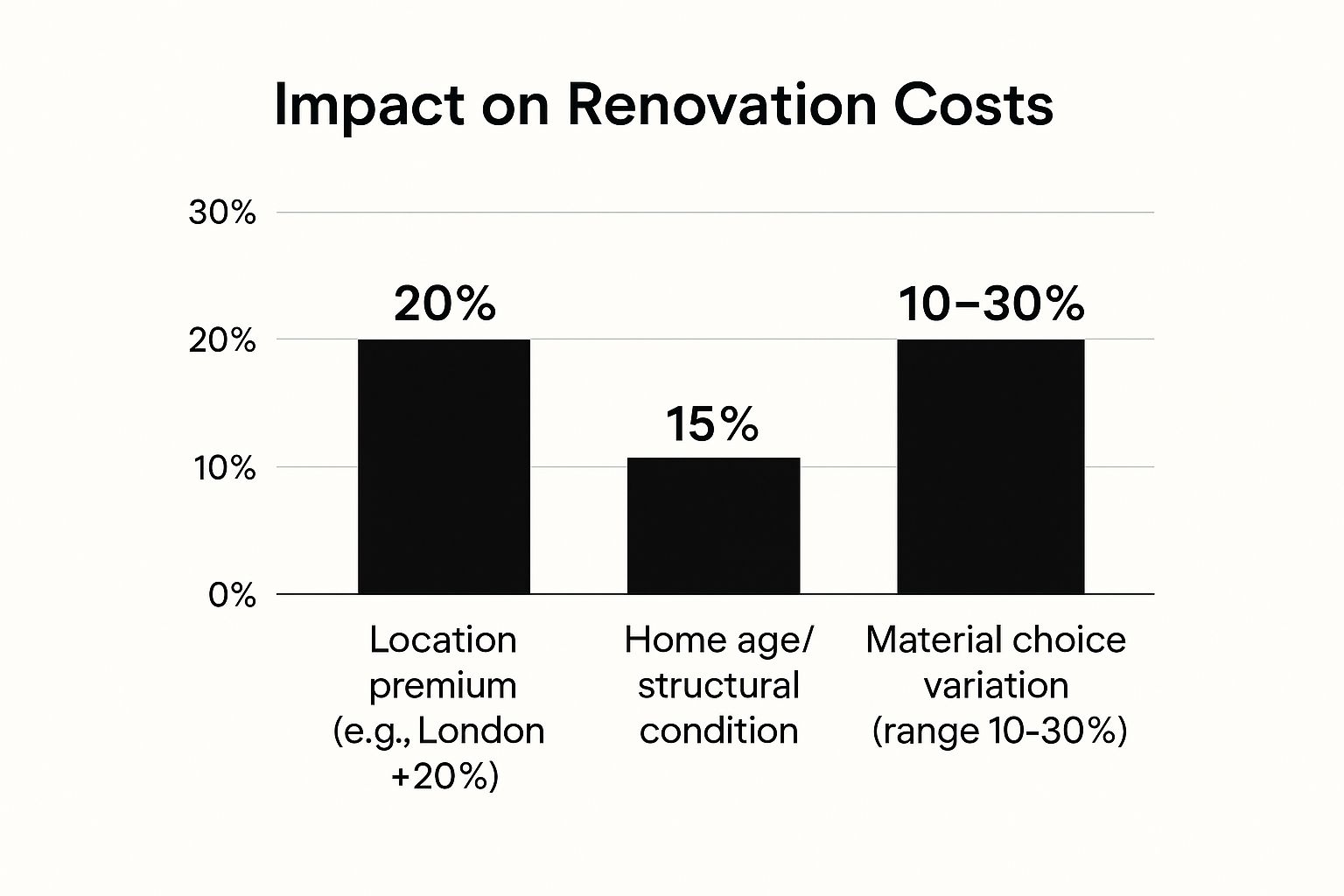
As you can see, your postcode alone can add a hefty slice to the total bill before a single hammer has been swung.
The Scope of Work Complexity
Just how ambitious is your plan? This is a massive cost driver. It's vital to know the difference between simple cosmetic updates and major structural alterations – they live in completely different financial universes.
Cosmetic Updates: This is stuff like painting, laying new floors, swapping out light fittings, or giving kitchen cabinets a facelift. They’re relatively straightforward and much easier to budget for.
Structural Changes: Now we’re talking about moving walls, building extensions, converting the loft, or digging out a basement. These are big jobs that need architects, structural engineers, and planning permission, sending costs soaring.
To put it simply, replastering an existing wall might set you back a few hundred pounds. Taking that same wall down, installing a steel beam (RSJ), and making good the surrounding area could easily run into several thousand.
Your Choice of Materials and Finishes
Finally, we get to the fun part: your personal taste. The level of quality and finish you choose will define the final look of your home and a huge chunk of your budget. For every single item, there’s a vast spectrum of quality and price.
Just think about a few examples:
Kitchen Worktops: You can go for budget-friendly laminate or make a serious investment in quartz, marble, or granite.
Flooring: A good quality laminate might be around £25 per square metre, but if you’ve got your heart set on bespoke engineered oak, you could be looking at over £100 per square metre.
Taps and Fittings: A standard basin tap can be had for under £50. A designer model from a high-end brand? That could easily top £500.
It’s these choices, repeated in every room, that create the difference between a standard, functional renovation and a truly high-end, luxury finish. Understanding these four factors is your key to making smart decisions, helping you strike the perfect balance between your grand vision and a budget that actually works.
Breaking Down The Costs Of A Major Renovation

To get a real grip on your whole house renovation costs, you have to look past the big, intimidating total. A full renovation isn't one single job; it's a collection of smaller, interconnected projects, each with its own price tag for labour and materials. Pulling these individual costs apart is the secret to staying in control of your budget and deciding where your money will make the biggest difference.
Think of it like putting together a giant puzzle. Your kitchen is one piece, the loft conversion another, and the new plumbing yet another. You can only see the full picture and make sure everything fits together when you understand the cost and shape of each individual piece. This detailed view lets you make smart choices, like whether to splash out on that dream kitchen now or phase the project over time.
Kitchen And Bathroom Renovations
The kitchen is often called the heart of the home for good reason, but it’s also usually the most expensive room to get right. A complete overhaul means taking everything back to the bare walls, potentially rerouting pipes and wires, and then fitting brand-new everything.
For a solid, mid-range kitchen renovation in the UK, you should expect to budget somewhere between £15,000 and £30,000. This figure typically covers new cabinetry, worktops, appliances, tiling, flooring, and all the labour involved. Of course, that number can easily soar past £50,000 if you’re aiming for a high-end, bespoke design with premium appliances and luxury finishes like quartz or marble.
Bathrooms might be smaller, but they pack a similar punch in terms of complexity. A full bathroom fit-out, including all the new sanitary ware, tiling, plumbing, and electrical work, will generally land between £7,000 and £15,000. If you're planning a wet room or want top-of-the-line fixtures and extensive tiling, you’ll be looking at the upper end of that scale.
Structural Work And Extensions
The moment you start moving walls or adding space, you step up a level in both complexity and cost. This is no longer just a cosmetic refresh; it’s major construction that calls for the expertise of architects, structural engineers, and a highly skilled building team.
Loft Conversions: A brilliant way to gain an extra bedroom and bathroom. A standard dormer loft conversion will typically set you back between £45,000 and £75,000, with the final cost depending on the size, complexity, and quality of finish.
Single-Storey Extensions: Pushing outwards to expand your living space is a hugely popular option. A simple rear extension might start from around £40,000, but a larger, more ambitious build with features like bi-fold doors and skylights is more likely to be in the £60,000 to £100,000+ ballpark.
Basement Conversions: This is a serious, specialist undertaking, particularly in a city like London. Carving out new living space beneath your home is incredibly rewarding but represents a major investment. To get into the nitty-gritty, you can read our detailed [guide to basement conversion costs in the UK](https://www.harperlatterarchitects.co.uk/post/your-guide-to-basement-conversion-costs-uk).
It’s important to remember that with these big projects, a huge chunk of the budget is eaten up by things you don't see. Foundational work, structural steels, insulation, and damp-proofing are all critical elements that ensure your new space is safe, warm, and built to last.
Essential Services And Finishing Touches
Behind the beautiful new plaster and paint are the vital services that make a house a home. These are the costs that often get forgotten in the excitement of initial planning, but they are absolutely essential, especially if you’re working on an older property.
A complete electrical rewire for a standard three-bedroom house can cost between £5,000 and £8,000. This isn't just a recommendation; it's about making sure your home is safe and can handle all our modern gadgets. In the same vein, a full plumbing overhaul with a new boiler and radiators can range from £8,000 to £15,000.
Finally, it's the finishing touches that truly bring a project to life. Plastering typically costs around £60-£90 per square metre, while painting and decorating will add another several thousand pounds to the final bill, all depending on the size of your home and the quality of finish you're after.
To help you visualise these costs more clearly, here’s a table breaking down some common projects.
Typical Costs for Common Renovation Projects in the UK
This table provides an itemised breakdown of estimated costs for various renovation jobs, giving you a clearer idea of how to budget for both labour and materials.
Renovation Project | Estimated Labour Cost (£) | Estimated Material Cost (£) | Total Estimated Cost (£) |
|---|---|---|---|
Mid-Range Kitchen | £4,000 - £8,000 | £11,000 - £22,000 | £15,000 - £30,000 |
Mid-Range Bathroom | £3,000 - £6,000 | £4,000 - £9,000 | £7,000 - £15,000 |
Electrical Rewire (3-bed house) | £3,500 - £5,500 | £1,500 - £2,500 | £5,000 - £8,000 |
New Central Heating System | £4,000 - £7,000 | £4,000 - £8,000 | £8,000 - £15,000 |
Dormer Loft Conversion | £20,000 - £35,000 | £25,000 - £40,000 | £45,000 - £75,000 |
Single-Storey Extension (per m²) | £1,500 - £2,500 | £1,000 - £1,500 | £2,500 - £4,000 |
Remember, these are just estimates. The final figure will always depend on your specific project, location, and choice of materials. Each of these itemised costs adds up, which is why a detailed, project-by-project breakdown is the only way to accurately calculate your total renovation costs.
Navigating Rising Material and Labour Prices
Anyone planning a renovation right now is stepping into a new reality. Costs are up across the board, and it’s a tough climate out there. Between global supply chain chaos, a real shortage of skilled trades, and inflation hitting everyone, the final figure on your whole-house renovation costs can be a bit of a shock. But understanding these market forces isn’t about scaremongering; it's about giving you the knowledge to build a realistic, solid budget that can weather the storm.
The numbers don’t lie. Since 2020, the cost of building materials has jumped by a staggering 37%. And for certain key items, it’s even more dramatic – essentials like insulation and pre-cast concrete have rocketed by more than 60%. This isn’t just about materials, either. Skilled labour costs have crept up, too, with electricians' rates increasing by 14.4% and scaffolders' by 9.3%. It's a challenging time for homeowners, and you can explore the full analysis of UK renovation challenges to get a deeper insight into why.
With costs escalating like this, just getting a single quote and hoping for the best simply won't cut it anymore. Meticulous financial planning has become absolutely essential.
So, Why Are Costs Increasing So Sharply?
It's really a perfect storm of factors driving this surge. The huge post-pandemic demand for home improvements kicked things off, but ongoing global events have kept the pressure on, disrupting supply chains for timber, steel, and other critical imports. It creates a classic bottleneck: massive demand meets limited supply, and prices inevitably go up for everyone.
At the same time, here in the UK, we're dealing with a serious shortage of skilled tradespeople. An older generation of brilliant builders is starting to hang up their tools, and there just aren't enough new apprentices coming through to fill their boots. This scarcity means that the best plumbers, electricians, and joiners are in high demand and can rightly charge more for their expertise.
A robust contingency fund has always been a cornerstone of smart renovation budgeting. In today's volatile market, it's no longer just a recommendation—it's an absolute necessity. A buffer of 15-20% is now the sensible standard for managing unexpected price hikes.
The Impact on Specific Materials
While the general trend is upwards, some materials have been hit much harder than others. Knowing where the pain points are can help you make smarter decisions about where to spend your money or look for clever alternatives.
Timber: Prices have been all over the place due to international supply issues, affecting everything from the structural frame of your extension to the beautiful bespoke joinery you had planned.
Insulation: With everyone rightly focused on energy efficiency, the demand for high-performance insulation has gone through the roof, pushing prices up with it.
Cement and Concrete: Making cement is an energy-hungry process, so its cost is directly linked to soaring energy prices.
Metals: The price of copper for wiring and steel for structural beams has seen major increases, impacting both the electrical and construction phases of a project.
Adapting Your Budgeting Strategy
This new economic landscape calls for a more flexible and proactive approach to budgeting. You have to build these potential price rises into your spreadsheets from day one to avoid your project grinding to a halt halfway through. This means getting multiple, highly detailed quotes from contractors and asking them directly how their contracts handle potential material price increases.
Getting your architect and builder around a table early on is also a game-changer. They're the experts and can suggest high-quality, cost-effective alternatives for certain finishes or propose small design tweaks that reduce your reliance on the most volatile materials. By facing these market realities head-on, you can navigate the challenges and keep your project on a stable financial footing from start to finish.
Budgeting for Professional Fees and Hidden Expenses
The builder’s quote might be the headline act, but it's the supporting cast of professional fees and easily missed expenses that really shapes your final renovation cost. A proper, realistic budget for your whole house renovation costs has to account for these from day one.
Ignoring them is a bit like planning a road trip but only budgeting for petrol. You've completely forgotten about the insurance, breakdown cover, and somewhere to sleep along the way. These costs aren't optional extras; they're the foundations that make sure your project is beautifully designed, structurally sound, and legally watertight. Cutting corners here almost always leads to bigger, more expensive problems later on.
Assembling Your Professional Team
Long before a hammer is swung, you need a team of experts to turn your ideas into a buildable reality. Each one plays a critical role, and their fees are a non-negotiable part of the budget.
Architects: An architect does so much more than just draw up plans. They are your creative partner, navigating the maze of planning permission, crafting the detailed technical drawings builders rely on, and often helping to manage the whole process. Their fees usually land somewhere between 8% to 15% of the total construction cost. For a much closer look at this, our guide on the [cost of an architect in the UK](https://www.harperlatterarchitects.co.uk/post/cost-of-an-architect-uk-fees-budgeting-guide) breaks it all down.
Structural Engineers: If you're knocking down walls, adding an extension, or converting the loft, a structural engineer is essential. They’re the ones who do the crucial calculations to make sure your home remains standing, specifying the right steel beams (RSJs) and supports. You should expect to pay from £500 to £2,500+, depending on how complex the work is.
Surveyors: Getting a detailed building survey is vital, particularly with older properties. A surveyor will sniff out any existing problems like damp, subsidence, or dodgy roofing that need sorting, costing anywhere from £600 to £1,500. You might also need a Party Wall Surveyor if your work affects a shared wall with your neighbours, which is another cost to factor in.
Uncovering the Hidden Costs
Beyond the main professional fees, there’s a whole host of other costs that are easy to forget but can quickly pile up. A smart budget sees these coming from the very start.
A classic mistake is to focus all your attention on the exciting, visible things like kitchens and bathrooms, while totally forgetting the invisible costs that make it all happen. A successful budget covers everything from the initial paperwork right through to waste disposal.
These are the costs people often overlook:
Statutory Fees: Your local council will need its cut. This includes fees for Planning Permission applications (around £206 in England for a typical home extension) and for Building Regulations approval, which can add several hundred pounds more.
Site Costs: Think about the practicalities. Hiring skips (£200 - £450 a pop), putting up scaffolding, and setting up temporary water and electricity all add to the final invoice.
Alternative Accommodation: If the work is massive – like taking out floors or the entire kitchen – you’ll probably need to move out. Factoring in a few months of rent can be a huge, but unavoidable, expense.
Insurance: Your standard home insurance policy won't cover you for a major building site. You'll need to get specialist renovation insurance to protect your property and the works while they’re underway.
The All-Important Contingency Fund
And finally, we get to the most crucial part of any renovation budget: the contingency fund. No matter how perfectly you plan, older homes especially have a habit of revealing nasty surprises once the walls are opened up.
This fund, usually 10-20% of your total project cost, is your financial safety net. It’s there for the unexpected rotten joists or ancient wiring, ensuring a grim discovery doesn't bring your entire project to a grinding halt.
Smart Ways to Save Money on Your Renovation

Keeping a lid on your whole house renovation costs doesn't mean you have to compromise on your vision. Not at all. With a bit of smart planning and some savvy decisions, you can achieve that high-end look on a much more manageable budget. The goal is a project that not only looks incredible but feels financially comfortable, too.
Think of your renovation budget as a suitcase for a long holiday. You can't just throw everything in and hope it closes. You have to be deliberate. This kind of strategic thinking is the difference between an overflowing mess and a perfectly packed case with everything you need.
Plan Meticulously Upfront
In my experience, the most expensive words in any renovation are "while you're at it..." It's these mid-project changes that cause budgets to spiral, as they throw schedules into disarray and inevitably lead to extra labour and material costs. The more decisions you can lock in before a single tool is lifted, the tighter your grip on the final bill will be.
Committing to a detailed, finalised plan before the first hammer swings is the single most effective way to protect your budget. It transforms your project from a reactive scramble into a well-orchestrated process.
Source Materials Intelligently
Don't just accept the first price you're given for materials. It sounds simple, but taking the time to shop around and get quotes from different suppliers can lead to massive savings, especially on the big-ticket items like kitchen units, flooring, and tiles.
Here are a few tricks of the trade for smart sourcing:
Look at Ex-Display Items: Kitchen and bathroom showrooms are your friend here. They often sell off their display models at a huge discount to make room for new stock. You can get nearly-new quality for a fraction of the price.
Consider Quality Alternatives: You might have your heart set on solid oak flooring, but a high-quality engineered wood or a top-end luxury vinyl tile (LVT) can give you a very similar look and feel for much less money.
Buy in Bulk Where Possible: If you're tiling a few bathrooms, always ask your supplier for a bulk discount. Every little helps, and these small savings really do add up.
Consider Phasing the Project
A whole house renovation doesn't have to be an all-or-nothing sprint. If the budget is tight, think about breaking the work down into phases. This approach lets you spread the cost over a longer period, focusing on the essential structural work first and leaving the more cosmetic jobs for later.
For instance, you could get the loft conversion and extension built first to create the bones of the space. Then, you can hold off on the final finishing of a spare bedroom or the full garden landscaping until your funds have had a chance to recover.
Be Selective with DIY
While getting your hands dirty can be a brilliant way to save on labour costs, you have to be honest about your skills. Things like painting, simple tiling, or putting together flat-pack furniture are usually manageable for a keen DIYer.
But please, leave the complex stuff like electrics, plumbing, and any structural work to the qualified professionals. A botched DIY job will almost always cost you far more to put right than it would have to just hire an expert in the first place. It’s all about finding that sweet spot between professional expertise and your own hard work to make your budget stretch further.
Common Questions About UK Renovation Costs
As you get closer to committing to a project, it's completely normal for a few practical questions to bubble up. Let's tackle some of the most common ones we hear from clients. Getting these sorted will give you a much clearer picture of the journey ahead and help you move forward with real confidence.
How Much Should I Set Aside for a Contingency Fund?
Think of a contingency fund as your project's safety net, not a slush fund for fancy upgrades. For any renovation, we strongly recommend putting aside 10-20% of your total project budget to cover the unexpected.
If you’re working on an older property—especially the beautiful but often surprising Victorian or Edwardian homes in South West London—aiming for the 20% mark is just plain smart. You never know what you'll find behind old plasterboard. For newer builds or simpler cosmetic jobs where the risks are lower, a 10% fund should be enough to see you through.
Is It Cheaper to Renovate or Move House?
This is the big one, isn't it? The honest answer is: it completely depends on your local property market and what you're planning to do. The only way to know for sure is to sit down and do the maths.
First, work out your total renovation cost, making sure to include all professional fees and that all-important contingency fund. Add that number to your home's current market value. Now, compare that total to the cost of buying a new home you'd be happy with, factoring in all the extra expenses like stamp duty, legal fees, and moving costs. More often than not, renovating is the more cost-effective route to a home that's perfectly tailored to you, but you need to run the numbers to be certain.
A well-planned renovation can add serious value to your property, but it's vital to compare this potential gain against the hefty costs of moving. Always check the ceiling prices on your street to make sure you don't over-invest.
How Long Does a Whole House Renovation Take?
The timeline for a full renovation can swing wildly depending on how complex the project is. A purely cosmetic update on a three-bedroom house—think new kitchen, bathrooms, and decorating throughout—might take somewhere between 2 to 4 months.
But if you're getting into major structural changes, building extensions, or doing a full electrical rewire, you could easily be looking at 6 to 12 months, sometimes even longer. Your timeline will be shaped by things like the planning permission process, the complexity of the build itself, and the availability of good tradespeople. It's absolutely crucial to get a detailed schedule of works from your main contractor before a single hammer is swung.
At Harper Latter Architects, we specialise in turning your vision into a beautifully crafted, functional home. If you're planning a high-end refurbishment or new build in South West London, we guide our clients through every stage with clarity and expertise. Explore our architectural services to see how we can help bring your project to life.
Comments