
Practical Completion Definition: A Homeowner's UK Guide
You've just been told the house is “basically done”, the joiner's still touching up a run of cabinetry, and the builder wants to talk about handover next week. On a South West London project, that's often the moment when the whole room starts using the phrase practical completion as if everyone means the same thing. They usually don't.
For a homeowner, this is the week when risk, possession, payment, and paperwork start shifting at once. If you're building or refurbishing a Wimbledon, Richmond, Cobham, or Kensington home, you need to know who is judging the milestone, what they're judging against, and why a few remaining defects might still be acceptable while a missing commissioning certificate might stop the certificate altogether.
What Happens the Week Your Build Is Called Practically Complete
The week practical completion is raised on site has a very particular feel to it. The contractor is keen to close out the job, the architect or contract administrator is walking through with a marked-up list, and you're suddenly being asked to think about keys, insurance, and move-in dates instead of tiles and sockets. On a high-spec home, that handover week can be calm on the surface and tense underneath.
The practical issue is simple. Someone has to decide whether the works are complete for all practical purposes, with only minor defects left. In real residential projects, that judgment is rarely about one dramatic fault. It is more often about whether the house is ready for occupation, while a handful of small items stay on a snagging list.
Practical rule: if you wouldn't sensibly move in, the certifier should be asking why not.
What the site looks like when the milestone is near
You'll often see the same pattern. Decoration is finished, fittings are in, and the site starts looking “done”, but the last decisions are about details that matter to living in the house. A basement plant room may still need commissioning, a heritage cornice may still be waiting for local repair, or a shower screen may be missing a seal.
That's why the week matters. The certifier is not just checking aesthetics, they're deciding whether the building has crossed from active works into a condition where the owner can take possession and use it. In a family home, that change is practical and contractual at the same time.
For the homeowner, the risk is misunderstanding the handover as a soft handshake rather than a formal milestone. Once practical completion is certified, the contract usually changes character. Payment consequences, insurance responsibilities, and the defects period all start moving on a different clock.
Practical Completion Definition in Plain English
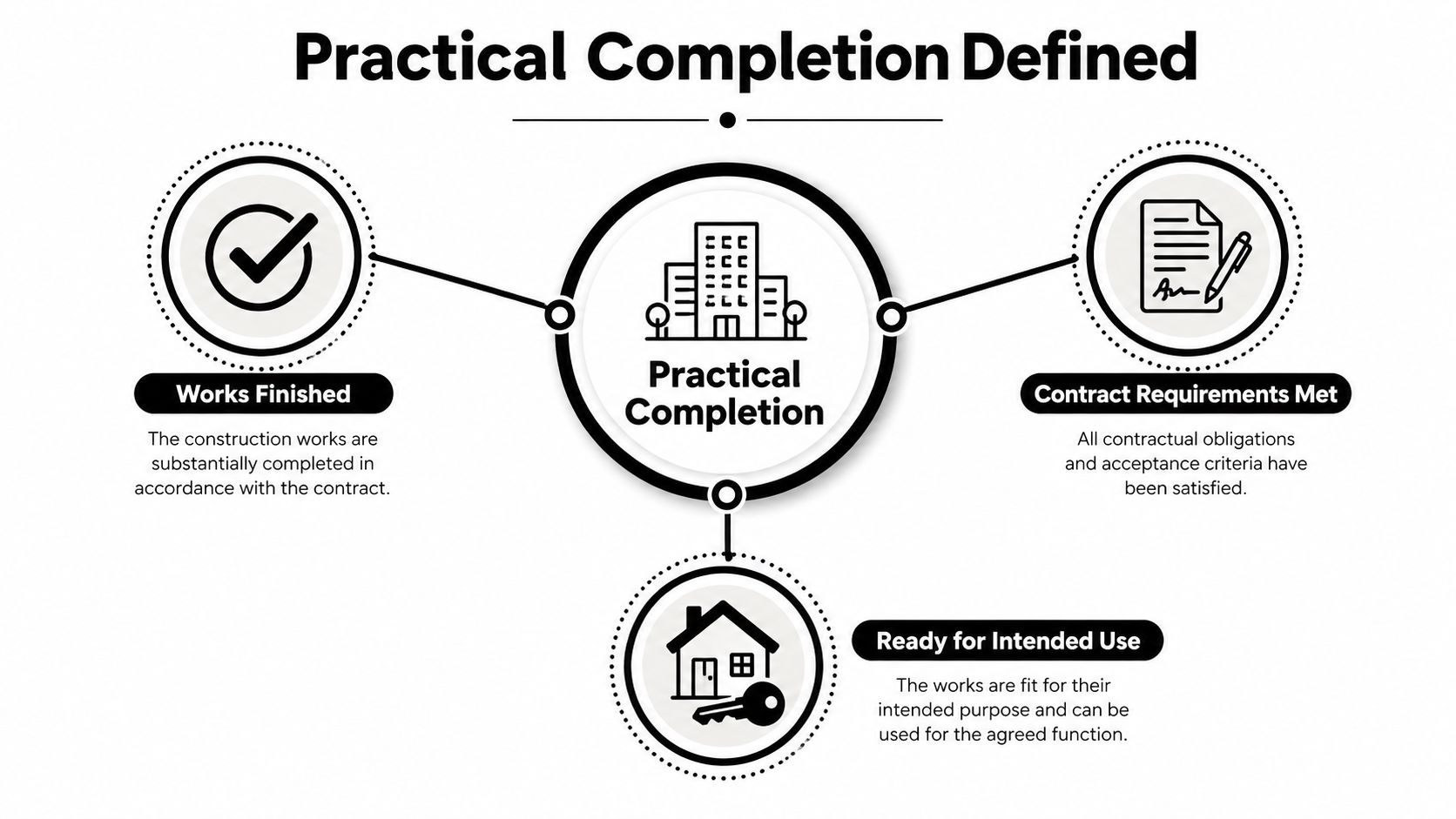
The clearest practical completion definition is this, the works are finished for all practical purposes, and only minor or trivial defects or omissions remain. That idea sits behind the English authorities and practitioner guidance, including the Court of Appeal position in Mears Ltd v Costplan Services (South East) Ltd, which confirmed that practical completion is achieved when the works are free from patent defects that are more than de minimis, and the older authority in City of Westminster v J. Jarvis & Sons Ltd, which linked the milestone to completion of the construction work that had to be done (Westlaw Practical Law summary)).
The key point is that perfection is not the test. A home can be practically complete even if there are snags, provided those items are minor and do not stop beneficial occupation. That is why the standard is so different from the everyday meaning of “finished”.
The working test I use on residential projects
A sensible homeowner's test looks like this:
Can the house be occupied safely and usefully? If not, practical completion is premature.
Are the remaining items genuinely minor? A missing door stop is not the same as unfinished plant commissioning.
Would a reasonable certifier say the building is ready for its intended use? That is closer to the legal question than the snagging sheet alone.
The RIBA Plan of Work 2020 gives the term a project-management meaning too, describing practical completion as the point when construction work is certified as practically complete under the building contract, and the client may take possession and use the building (Designing Buildings Wiki). In practice, that definition matters because it converts a legal concept into a live site milestone.
JCT standard forms still do not define practical completion expressly, which means the certifier's opinion carries real weight. On a residential job, that can feel uncomfortable because the judgment is not mechanical. It is professional, contextual, and tied to the actual building in front of them.
Who Issues the Certificate and Why Their Discretion Matters
Practical completion is not something a contractor declares unilaterally. Under UK residential contract practice, the certificate is usually issued by the architect or contract administrator, depending on the form of contract. Under the RIBA Plan of Work 2020, practical completion is the point at which the work is certified as complete enough for the client to take possession, which is a formal administrative act, not a casual site note (Designing Buildings Wiki).
That discretion matters because it sits at the intersection of construction quality and professional judgement. The certifier isn't asking whether every item on a snagging list is closed out. They're asking whether the outstanding matters are still minor enough not to prevent occupation or beneficial use. On a straightforward extension, that can be a clear call. On a basement cinema, a conservation-led rebuild, or a home packed with mechanical and electrical systems, it can be much harder.
Where judgement becomes the whole issue
In high-spec residential work, the line is usually drawn by function rather than surface finish. If the heating controls are live, the ventilation is balanced, and the essential test certificates are in place, a few cosmetic defects may not matter. If critical plant, safety systems, or approvals are still incomplete, certification becomes much harder to justify. Practitioner guidance on complex residential projects makes the same point, especially where commissioning, testing, and handover documentation are still outstanding (Quigg Golden practical completion guidance).
That is why I tell clients to ask early: who is certifying, what will they inspect, and what will they want to see before they are comfortable issuing the certificate? If your contract administrator is vague about that process at tender stage, you'll feel it later on site.
A useful sign of professionalism is a certifier who explains the threshold before the final week arrives. A poor sign is someone who treats practical completion like a surprise outcome, with no visible method behind it. On bespoke homes, that ambiguity can delay move-in, final payment, and possession even when the building looks almost finished.
Practical Completion Versus Final Completion and the Defects Period
Homeowners often think practical completion is the end of the project. It isn't. It is usually the point where the building becomes usable and the contractor's obligations shift into a different phase, with the defects period running after certification rather than before it.
The distinction matters because the builder does not vanish once practical completion is issued. They generally remain responsible for remedying notified defects during the defects liability period, and final completion comes later, after those items have been dealt with and that later stage has been certified. If you want a clear overview of that later phase, the defects liability period is set out well in this defects liability period guide.
Milestones compared side by side
Milestone | What it means | Typical trigger | Consequence for homeowner |
|---|---|---|---|
Practical completion | Works are complete for all practical purposes | Certifier judges only minor defects remain | Possession, payment and contractual clocks change |
Defects period | Time for the contractor to return and fix notified defects | Practical completion certificate is issued | Snags are logged and remedied |
Final completion | The later close-out stage after rectification | Defects work is done and certified | Contract moves towards full close-out |
The problem on site is that people use “snagging”, “defects”, and “unfinished work” as if they're interchangeable. They're not. A bad paint finish is a snag. An uncommissioned heating system is closer to an unresolved completion issue. A latent defect is different again, because it may not be visible at handover at all.
That's why practical completion is best treated as a handover point, not a finish line. If you expect the builder to be gone forever the same day the certificate is issued, you'll be disappointed. The better expectation is that the live works stop, then the remedy period begins.
What Practical Completion Switches On for the Homeowner
Once practical completion is certified, several contractual consequences usually switch on together. The most obvious is financial. Depending on the contract, practical completion often triggers release of the final retention or a staged payment, which is why builders care about the date and homeowners should care about the paperwork.
Possession is the other big change. The client may be allowed to take the building over, move in, and start using it as intended. Insurance responsibilities can also shift at this point, with the contractor's site cover and ongoing site security obligations usually falling away or changing character, while the homeowner's buildings insurance becomes the relevant policy to review.
Watch the insurance handover carefully. If you're moving into a nearly finished house, don't assume every policy changes automatically on the date everyone expects.
The milestone also starts the defects liability clock. That means you should have a clear route for reporting issues, and you should know whether your contract requires notices to be in writing, by email, or through a contract administration system. If the process is unclear, defects can get lost in casual WhatsApp messages and site chat.
The building control angle matters too, especially where a completion certificate depends on statutory compliance and formal sign-off. If you want a homeowner-friendly overview of that relationship, this building control guide is worth reading before handover.
A practical sequence to expect
Certificate issued first. That date is the pivot point.
Retention or staged sums may follow. Check the payment schedule in your contract.
Possession transfers. You can usually occupy, subject to the contract terms.
The defects period begins. Snags should be reported promptly and clearly.
On a well-run South West London project, that sequence is calm and documented. On a poorly run one, everyone argues about whether the house was “really” ready, which is exactly why the definition has to be understood before the argument starts.
A Homeowner's Snagging and Certification Checklist
The cleanest way to protect yourself is to treat practical completion as a checklist exercise, not a mood. On a luxury refurbishment or new build, I'd want the site walk to cover finishes, services, approvals, and handover material in one pass, because missing paperwork often becomes the reason a certifier hesitates.
What to check before the certificate is signed
Walk every key space with the certifier. Look at floors, joinery, decoration, doors, glazing, and visible trim, not just the showstopper rooms.
Test the living systems. Heating, ventilation, hot water, lighting, alarms, AV, and any specialist plant should be working as intended.
Check the paperwork. O&M manuals, as-built drawings, warranties, certificates, and statutory approvals should be gathered and handed over.
Review the snagging list methodically. Each item should be recorded clearly, assigned, and tracked, not left as a vague promise.
In a basement extension, I'd be especially alert to water management, plant access, ventilation, and safe egress. In a listed-building project, I'd check that conservation-sensitive elements have been finished in line with the approved details and that any specialist repair documentation is in place. In a home with extensive MEP systems, commissioning evidence matters as much as the visible finish.
If you want a practical reference point for the sort of handover material that should be gathered, Harper Latter Architects publishes a Practical Completion Checklist for Bespoke Homes, which includes as-built drawings and certificates or approvals needed at practical completion. That kind of document is useful because it turns a tense handover into a structured review.
The biggest mistake homeowners make is accepting “we'll sort it after handover” without a written list. Minor items can wait, but unresolved commissioning or missing compliance documents are different. If those are still open, the certifier may be right to hold back.
Contract Variations, Disputes and How to Protect Yourself
Practical completion is often the point where disagreement surfaces, because late variations and unfinished items collide with everyone's wish to close the job. A contractor may argue that a few outstanding items are only snags, while the certifier may decide they're enough to block certification. That gap is where many residential disputes begin.
The older English position in City of Westminster v J. Jarvis & Sons Ltd linked practical completion to completion of the construction work that had to be done, and that wording still matters in negotiation when someone tries to blur the line between “nearly there” and “done enough”. Later summaries, including practitioner commentary, often express the test more flexibly as work being finished except for defects that are trivial or insignificant (FOD introduction to practical completion). The practical point is unchanged. The remaining work has to be minor enough not to prevent use or occupation.
If you're worried about a certificate being withheld unfairly, ask for three things in writing. First, a list of the items that are blocking certification. Second, the reason each item is material rather than minor. Third, the contract clause or professional basis the certifier is relying on. That approach keeps the dispute factual instead of emotional.
How homeowners protect themselves
Keep variation orders tidy. Late changes should be documented clearly, because they can affect the perceived state of completion.
Ask for reasons, not just decisions. A certificate withheld without explanation invites confusion.
Separate snags from fundamental completion issues. Not every defect should delay handover.
Escalate through the contract. The contract administrator's judgment should be challenged through the agreed process, not by shouting on site.
A disciplined contract administrator helps here, and if the project feels hard to manage, our contract administration guide gives a useful sense of how that role shapes the close-out stage. For homeowners, the protection is simple: keep records, keep the conversation professional, and don't let anyone pretend that practical completion is either a legal fiction or a casual thumbs-up.
If you're planning a new build, basement extension, or major refurbishment in South West London, Harper Latter Architects can help you structure the project so practical completion is clear, documented, and defensible. Visit Harper Latter Architects to see how we handle residential design, contract coordination, and handover on bespoke homes.