
Architect's Portfolio Development: Win Affluent Clients
Most portfolio advice for architects is pointed at universities, hiring panels, or award submissions. That's the wrong model if you're trying to win private residential work in South West London. Affluent clients aren't leafing through your portfolio to verify that you can produce a drawing set. They're deciding whether you understand how they want to live.
That distinction changes everything. A portfolio for client persuasion has to do more than document competence. It has to make a future home feel plausible, desirable, and safe in the hands of the practice presenting it.
Moving Beyond the Blueprint a New Portfolio Approach
The standard architectural portfolio is often built like a technical archive. Elevations. Sections. Planning packs. Accreditation references. A few polished photographs at the end. It might satisfy another architect, but it often leaves a homeowner cold.
That matters because 68% of affluent homeowners in South West London prioritise emotional resonance and lifestyle vision over technical drawings when selecting architects, according to Prospects' guidance on portfolio thinking and presentation. If your portfolio leads with compliance language and drawing packages, you're answering a question many of your best clients aren't asking first.
What affluent clients are really looking for
Private clients at the top end of the market usually want three things from a portfolio.
Reassurance: They want to see that you've handled complexity before, especially where planning pressure, conservation constraints, or major structural intervention are involved.
Identification: They want to recognise their own ambitions in the work. Family living, calm interiors, discreet luxury, better light, stronger connection to the garden, or space for leisure amenities.
Judgement: They want evidence that you can balance taste, technical rigour, and commercial realism without turning the process into a battle.
A portfolio development process built for persuasion starts with those needs, not with your internal filing system.
Practical rule: Don't ask, “What should we show?” Ask, “What would make the right client feel understood?”
Why the technical-first model underperforms
Technical content still matters. It just shouldn't dominate the first impression. Clients expect competence as a baseline. They appoint on trust, judgement, and fit.
In practice, that means the strongest portfolios don't merely show a completed house. They show a problem clarified, a brief interpreted, and a way of living improved. A basement extension isn't only a structural feat. It becomes a quieter family zone, a gym, a cinema, or a wine room that changes how the house works. A conservation project isn't only a set of planning constraints. It becomes proof that historic character and modern comfort can coexist.
That same client-centred logic should carry through your wider communication, including how you explain your architectural design process from first brief to completion. The portfolio and the process page should feel like parts of the same conversation.
A portfolio should sell a future, not just a past
The UK architectural market is projected to reach £9.5 billion in 2026, with 16,278 businesses operating in the sector and a -0.4% CAGR between 2021 and 2026, according to IBISWorld's UK Architectural Activities industry analysis. In a market with that level of competition, portfolio development isn't housekeeping. It's market positioning.
A strong portfolio tells a private client, “We know how to shape the kind of home you want, and we know how to get it built properly.” That's a very different document from a technical showcase assembled for peer approval.
Curating Your Projects for a Niche Audience
The quickest way to weaken a portfolio is to treat it as a complete record. Clients don't need a catalogue. They need a point of view.
The best project selection is deliberate. If your ideal commission is a listed townhouse refurbishment, a Wimbledon basement with leisure space, or a bespoke family new build, every project in the portfolio should strengthen that story. Anything that muddies it should be cut, no matter how much work went into it.
Select for relevance, not nostalgia
UK academic guidance is clear that portfolios should be “selective and curated with care”, highlighting at least one key project in depth while maintaining a diverse range of skills in a logical and visually appealing sequence, as set out in the University of York portfolio guide.
That principle applies just as strongly in practice as it does in education. For a high-end residential architect, curation usually works best when each project earns its place by answering one of these questions:
Does it show the kind of work we want more of?
Does it demonstrate judgement under constraint?
Does it strengthen our specialism without making the portfolio repetitive?
Breadth and depth need different jobs
A persuasive portfolio should show breadth and depth, but not in equal measure.
Breadth tells the client you can think holistically across a home. Depth proves that you can control complexity. Used together, they create confidence.
Portfolio role | What to show |
|---|---|
Breadth | A small range of relevant work across new builds, refurbishments, basement extensions, interior architecture, landscape design, and conservation where applicable |
Depth | One flagship project with concept development, design iterations, planning response, technical coordination, and final spatial outcome |
Credibility | Clear indication of your role, the brief, the constraints, and the design decisions that shaped the result |
Tone | Consistent visual language so the work reads as one practice with a clear standard |
Build around the niche you actually want
Generic residential portfolios often fail because they try to appeal to everyone. That usually produces a blur of nice rooms and competent drawings without a memorable position.
A niche portfolio development strategy is sharper.
For conservation work: Show projects where restraint, detailing, and planning sensitivity mattered.
For basement-led schemes: Show how light, circulation, acoustics, and amenity were handled, not just excavation.
For sustainable luxury homes: Show where low-carbon thinking, fabric upgrades, and long-term performance shaped the design.
For architectural and garden integration: Show how staircase design, joinery, terraces, and garden rooms formed one coherent living environment.
A project can be beautiful and still be the wrong project for your portfolio if it attracts the wrong enquiries.
Edit with a client's patience in mind
A common mistake is assuming that more pages signal more authority. In fact, excess weakens focus. If a project doesn't advance the argument of the portfolio, remove it.
Use this simple editing test:
Keep it if it adds a distinct capability.
Condense it if it repeats something stronger elsewhere.
Cut it if you're only including it because it was hard won, expensive, or once published.
A curated portfolio feels intentional. That's what affluent clients notice. They're not just judging the projects. They're judging your ability to make decisions.
Crafting Compelling Project Case Studies
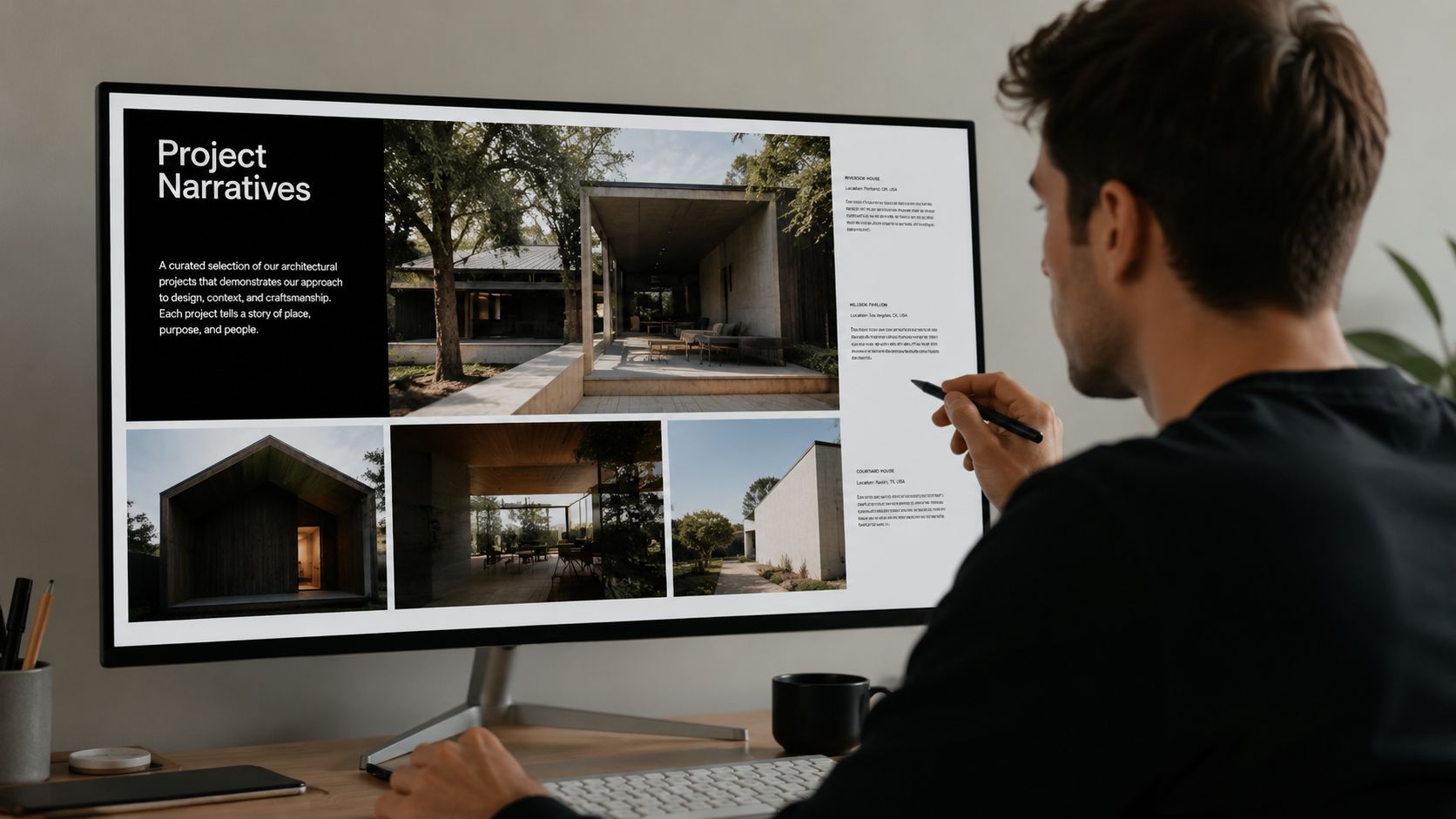
The heart of portfolio development isn't project selection. It's turning selected work into case studies that persuade. Many architects still present a scheme as a sequence of images with minimal explanation, then wonder why enquiries stay vague or price-led.
That gap is expensive. 57% of architectural portfolios fail due to storytelling gaps, especially where they omit the problem-solving narrative behind constraints such as listed-building zoning, according to architecture.co.uk's portfolio guidance. The same source notes that award-winning UK portfolios often include project cost data of £1.2M to £4.5M for Wimbledon new builds and phase-specific deliverables such as sun-path diagrams and 3D renders.
Start with the client problem, not the final photograph
A strong case study opens with tension. Not drama for its own sake, but a real design problem the client cared about.
In Wimbledon and the wider South West London market, that might be a family needing more usable area without losing garden quality. It might be a detached house with generous floor area but poor internal flow. It might be a heritage property where the client wants contemporary comfort without harming character.
The opening should establish four things quickly:
The brief: What the client wanted from the house and how they wanted to live.
The constraint: Site limits, heritage restrictions, light issues, access problems, neighbour sensitivity, or planning pressure.
The opportunity: What the house could become if the problem was solved properly.
Your role: What the practice did.
Show the middle, because that's where trust is built
Clients don't appoint on before-and-after images alone. They appoint when they can see how you think.
That means including working material. Sketches. Massing studies. Option comparisons. Sun-path diagrams. Interior views that explain light and movement. Revit, Rhino, and AutoCAD outputs where they clarify process rather than solely demonstrating software fluency.
The persuasive part of a case study is often the unresolved middle, where the client sees that you can navigate uncertainty without losing design quality.
A useful structure looks like this:
Case study element | What it needs to prove |
|---|---|
Brief summary | You listened properly |
Site and planning constraints | You understand risk |
Design development | You can test options and make decisions |
Technical evidence | You can deliver, not just imagine |
Final outcome | You improve daily life, not just appearances |
Write the outcome in lifestyle terms
The final section of the case study should not read like a completion certificate. It should explain what changed in lived terms.
For example, don't stop at “new basement level added with leisure facilities”. Explain how that level reorganised the rest of the house, improved family privacy, absorbed entertainment use, or connected to garden living more effectively. Don't stop at “rear extension with glazing”. Explain how daylight now reaches the centre of the plan and why that matters at breakfast, homework time, or evening entertaining.
This is also the right place to include cost positioning where appropriate. On the right project, a range such as £1.2M to £4.5M for a Wimbledon new build helps affluent clients calibrate scale and seriousness. It can deter misaligned enquiries and build confidence with the right ones.
Later in the client journey, a short video can reinforce the same narrative through movement and sequence.
A useful example framework
When reviewing a case study draft, check whether it answers these points:
Why this client came to you
What was difficult about the brief
Which design decisions changed the project
How drawings and models informed those decisions
What the finished home now allows the client to do
If any of those pieces are missing, the project may still look polished, but it won't do enough persuasive work.
Perfecting Your Visual and Physical Presentation
Presentation changes how the work is perceived. A mediocre scheme can look overconfident in a glossy format. An excellent scheme can lose authority through weak photography, crowded layouts, or careless printing.
That's why portfolio development doesn't end with content. The object itself, whether digital or printed, has to reflect the level of architecture you're asking a client to commission.
Photography and layout do most of the heavy lifting
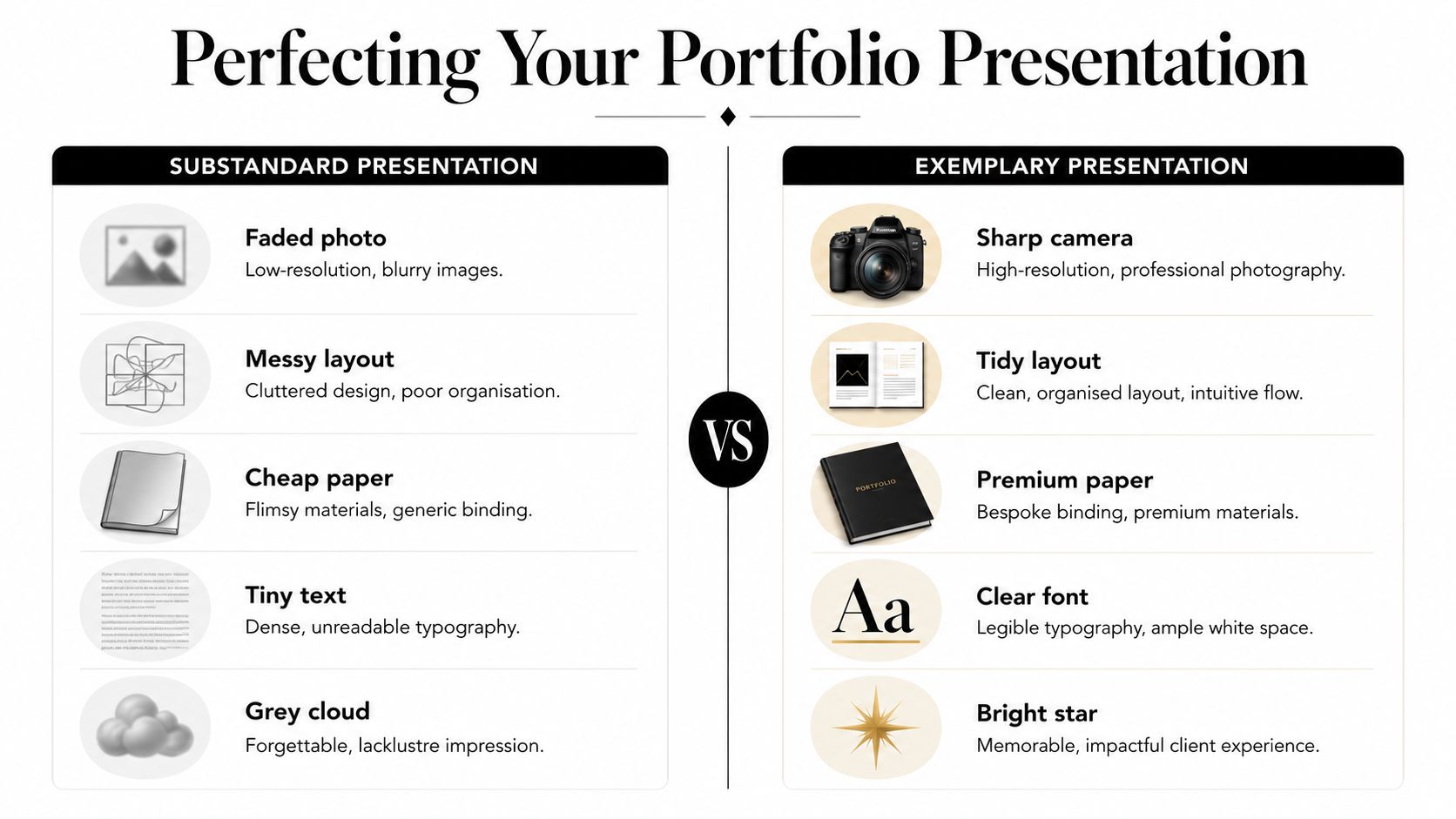
Professional photography is essential for high-end residential work. Clients are buying atmosphere, materiality, proportion, and light as much as square metres and planning success. Grainy site snaps and dim interior images undermine the architecture before a word is read.
Layout matters just as much. Luxury is often communicated through restraint.
Use white space: It slows the pace and gives the work room to breathe.
Control typography: Keep typefaces consistent, legible, and understated.
Sequence carefully: Alternate wide visual moments with tighter technical or narrative spreads.
Avoid clutter: If every page tries to prove everything, none of it lands.
Digital and print serve different moments
A digital portfolio and a printed portfolio shouldn't be identical. They serve different client interactions.
Attribute | Digital Portfolio (e.g., Website, iPad) | Print Portfolio (e.g., Bespoke Bound Book) |
|---|---|---|
First impression | Best for discovery, search visibility, and fast sharing | Best for face-to-face meetings and slower review |
Navigation | Flexible, clickable, easy to update | Linear, tactile, more controlled |
Image behaviour | Strong for zoom, galleries, and embedded media | Strong for scale, paper quality, and presence |
Client setting | Ideal before enquiry and early qualification | Ideal during formal presentations |
Weakness | Can feel transient if badly designed | Can date quickly if not refreshed |
The printed version benefits from the same care you'd give bespoke interior detailing. Paper stock, binding, cover material, and trim size all signal seriousness. The principle isn't unlike thoughtful bespoke joinery design in residential interiors. Precision and restraint are what make the end result feel expensive.
Key takeaway: If the architecture is about quality, the portfolio presentation has to embody quality before the client reads a sentence.
What usually goes wrong
Poor presentation typically comes from one of three habits.
First, the team overpacks the document because it's afraid to leave anything out. Second, photography and drawings compete instead of supporting one another. Third, the portfolio borrows the visual language of a planning submission when it should feel closer to a private client presentation.
A high-end portfolio should feel calm, controlled, and expensive. That impression is built through many small decisions rather than one dramatic graphic move.
Integrating Your Portfolio with Your Website for SEO
A polished PDF rarely wins a high-value residential commission on its own. Affluent homeowners in South West London will usually encounter the practice through search, referral follow-up, or a shared project link long before a formal presentation. The portfolio has to work in that setting. It needs to bring in the right visitor, make the practice feel credible within minutes, and give a private client enough confidence to enquire.
That changes how portfolio development should be handled online. Generic advice treats SEO as a traffic exercise. In a high-end residential practice, it is a qualification exercise. The aim is not more clicks. The aim is better-fit enquiries from clients who already recognise the level of service and design thinking they are buying.
Turn every strong project into a landing page
Each good project deserves its own page because each page can do three jobs at once. It can persuade a client, rank for a specific service and area, and lead the visitor to a sensible next step.
For private residential work, broad project galleries are usually too blunt. A homeowner searching for a townhouse refurbishment in Chelsea or a conservation-led extension in Wimbledon is looking for evidence that you understand that exact brief, budget level, and planning context. A focused page gives you room to show that.
A reliable structure looks like this:
Project title with location and project type
Short opening paragraph that states the client brief and property context
Case study narrative covering constraints, design decisions, and built outcome
Edited images with descriptive alt text
Internal links to related services and relevant journal articles
A clear enquiry route
Write for search like a practitioner, not a marketer
Private clients can spot formulaic SEO copy quickly. It reads as generic, and generic is expensive in the wrong way.
The better method is to write a serious project story, then shape the page so search engines can read it properly. Include the details that matter to a discerning client. Planning constraints, listed building status, daylight strategy, material choices, joinery, energy performance, and how the design improved daily use of the home. If embodied carbon formed part of the brief, link that thinking to related expertise such as low embodied carbon material choices for residential projects.
Use a simple editorial checklist:
Headline: State the place and the nature of the commission clearly.
Body copy: Refer to site conditions, planning context, materials, and the client brief in natural language.
Image alt text: Describe the room, element, or architectural feature shown.
Internal links: Connect the project to service pages such as conservation, interiors, exterior spaces, or the design process.
Metadata: Keep page titles and descriptions specific to the actual project.
A well-run project journal supports this. Studying how practice websites organise project and blog content for ongoing visibility is often more instructive than generic SEO advice written for online retailers.
Match the website to the work you want more of
Website portfolios often fail because they mix ambition with convenience. The practice wants affluent refurbishment clients, but the site is filled with whatever was easiest to upload. Search visibility weakens. So does positioning.
If the goal is high-end residential work, publish pages that prove command of that market. Show period properties handled with care. Show contemporary interventions that respect context. Show sustainability decisions with measurable intent. Breadth still matters, but it should show that the practice can think about the entire home as a single system, not that it will take any domestic job available.
A strong website portfolio behaves like a library of proof. Each page should help a prospective client quickly conclude that the practice is the right fit for their house, their standards, and their level of investment.
Addressing Client Confidentiality and Sustainability
High-end residential work brings two pressures that generic portfolio advice often ignores. The first is privacy. The second is proof.
Private clients want discretion. Increasingly, they also want credible evidence that a design will future-proof the home. If your portfolio development process handles both issues well, it immediately feels more polished.
Protect privacy without draining the story
Confidentiality doesn't mean stripping a project of all identity. That's where many portfolios lose force. They anonymise so heavily that the scheme becomes abstract and forgettable.
A better approach is selective disclosure.
Remove personal identifiers: Exclude names, addresses, family details, and anything that exposes occupancy patterns.
Crop intelligently: Show spatial quality, light, joinery, and material junctions without revealing more than necessary.
Generalise location where needed: Use an area reference rather than a precise address if that protects the client.
Anonymise drawings carefully: Keep enough information for the design logic to remain legible.
The point is to preserve the narrative while respecting GDPR and the expectations of private homeowners.
Sustainability needs evidence, not aspiration
Only 23% of high-end residential portfolios in London include post-completion energy performance data, even though 71% of affluent South West London homeowners cite sustainability as a top decision criterion, according to this UK-focused discussion of strategic portfolio planning and sustainability proof.
That gap creates a real opening. Most portfolios still talk about sustainable intent in broad terms. Few show measured outcomes.
Where you have permission and reliable data, include evidence such as:
Sustainability proof point | Why it matters to the client |
|---|---|
Post-completion energy data | Shows the house performs, not just promises |
Fabric upgrade strategy | Demonstrates substance behind heritage and refurbishment decisions |
Material selection rationale | Links aesthetics with lower embodied carbon thinking |
Building systems summary | Shows how comfort and efficiency were handled together |
Thoughtful specification also helps frame the wider conversation. A project page or case study can link sustainability to material decisions, especially where low embodied carbon materials in residential architecture support both design quality and long-term performance.
Private clients respond well when sustainability is presented as better comfort, lower waste, longer life, and more resilient value. They switch off when it's presented as a sermon.
A well-developed portfolio proves that discretion and evidence can coexist. That combination is persuasive because it reflects how serious private residential projects are commissioned.
If you're planning a bespoke new build, heritage renovation, basement extension, or sustainable refurbishment in South West London, Harper Latter Architects brings that client-focused approach to every stage of design. The practice creates homes that are custom-designed, buildable, and carefully resolved, with expertise spanning conservation, interiors, outdoor environments, and future-proof residential architecture.