
New House Planning: Your South West London Guide
A lot of clients begin in the same place. They have a clear picture of the life they want, a calmer daily routine, better light, proper storage, a kitchen that works for entertaining, bedrooms with privacy, and a garden that feels designed rather than leftover. What they don't yet have is certainty about how that vision survives contact with planning policy, conservation controls, site constraints, and the sheer number of decisions a bespoke home demands.
That uncertainty is even sharper in South West London. A plot may look straightforward until a conservation area appraisal, the setting of a listed building, protected trees, awkward level changes, or drainage limitations start dictating what is and isn't realistic. In these boroughs, new house planning isn't merely about drawing an attractive house. It's about proving that the proposal belongs where it sits, performs well technically, and can move from consent to construction without costly reversals.
The encouraging part is that the process becomes far more manageable once it is treated as a sequence of strategic decisions rather than one giant leap. The clients who feel most in control are rarely the ones who rush. They are the ones who define the brief properly, test the site early, front-load planning work, and understand that design quality and planning logic need to support each other from the start.
Embarking on Your New House Planning Journey
Planning a bespoke new home should feel exciting. It often does, right up until the first conversation about local policy, heritage setting, ecology, drainage, or whether a basement plus full-width glazing is likely to be welcomed on your site. That's usually the moment clients realise that a new build is both a design project and a planning strategy.
In South West London, that distinction matters. A house in Wimbledon, Richmond, Putney or one of the surrounding conservation-led neighbourhoods is rarely judged in isolation. Officers will look at scale, rhythm, overlooking, street character, roof form, mature plantings, and the effect on neighbouring amenity. If a listed building is nearby, or if your site forms part of its setting, the scrutiny becomes more exacting.
Why bespoke homes need a different planning mindset
Generic advice tends to assume a clear plot with straightforward policy context. That isn't how many high-value London sites behave. Existing garages, infill plots, replacement dwellings, subdivided gardens, and corner sites each come with very different planning risks.
A successful approach usually starts with three questions:
What is the authority likely to accept in principle? This is about policy fit, character, and precedent.
What can the site physically support? Levels, access, trees, utilities and drainage often narrow the options.
What kind of house is worth pursuing? There's no merit in securing consent for a compromised scheme that won't deliver the life you want.
A beautiful concept that ignores planning context usually becomes an expensive redraft.
That's why new house planning works best when ambition is channelled early, not dampened. The point isn't to design timidly. It's to know where boldness will be rewarded and where it will trigger resistance.
What good decision-making looks like early on
At this stage, clients don't need every answer. They do need a sensible order of work. First establish the constraints. Then test the brief against them. Then develop a proposal that has a strong chance of consent and a credible route to construction.
In practice, that means resisting two common instincts. One is to fall in love with a form before the site has been properly assessed. The other is to assume that planning approval, once obtained, means the difficult part is over. It rarely is.
Laying the Groundwork Your Brief Budget and Site
A client buys a promising plot in South West London, sees room for a generous new house, and assumes the main question is style. On many high-value sites, the harder question is whether the brief, the budget and the planning context can support the same ambition. In conservation areas, and particularly where a listed building sits nearby or forms part of the wider setting, that alignment matters from day one.
Your brief needs to describe a way of living
A strong brief does more than list accommodation. It sets priorities. How private should the principal suite feel from family spaces? Does the kitchen need to handle large gatherings, or mainly daily family life? Should a basement be considered, or would that add cost and planning sensitivity without giving you the right quality of space?
These decisions become sharper on constrained London sites. Views into neighbouring gardens, pressure to protect mature boundaries, and scrutiny of bulk and roof form can all affect what is realistic. A house of the right size on paper can still feel compromised if circulation is poor, storage is an afterthought, or the best rooms are forced into the wrong part of the plot.
Household patterns continue to change, which is one reason clients increasingly want homes that can adapt over time. The Office for National Statistics records 27.8 million households in the UK in 2021, up from 27.1 million in 2011, in its Families and households dataset. For a bespoke new build, that usually translates into more flexible guest accommodation, better provision for working from home, and spaces that can change use without major alteration.
If you are still organising priorities, this new home planner guide is a useful starting point before design decisions begin to harden.
Budget for consent, quality and risk
Clients often arrive with a build figure in mind and little allowance for what it takes to get a difficult site ready for construction. On a bespoke house, especially in South West London, the total budget needs to cover far more than the contract sum. Heritage advice, planning consultancy, surveys, technical design, specialist structure, party wall matters, utility work and outdoor area design all sit outside the headline construction figure, and all can materially affect the outcome.
I usually advise clients to test the budget against three questions:
Does it allow for the site's planning and heritage burden? Conservation area scrutiny, neighbour impact and listed setting issues can increase the amount of design and consultant input needed before an application is ready.
Does it protect the parts of the project you will notice every day? Ceiling heights, natural light, stair design, joinery, glazing proportions and landscaping usually do more for long-term satisfaction than adding sheer floor area.
Does it carry sensible contingency? Ground conditions, drainage connections and authority feedback can all alter scope, even on well-managed projects.
A budget that works only if there are no surprises is too tight.
Read the site with discipline
Every site comes with a story. In this part of London, that story often includes historic plot patterns, protected trees, rear garden character, local rooflines, and a planning authority that will test whether a new house improves its setting.
Early site reading should cover planning history, conservation area appraisal documents, neighbouring listed buildings, access constraints, overlooking, levels and the likely effect of construction on adjoining owners. These are not academic points. They shape whether a contemporary response will be welcomed, whether a replacement dwelling can exceed the previous envelope, and whether features such as basements, roof terraces or large areas of glazing are likely to become contentious.
The aim at this stage is not to shrink ambition. It is to direct it towards a scheme that can win consent and still feel exceptional to live in.
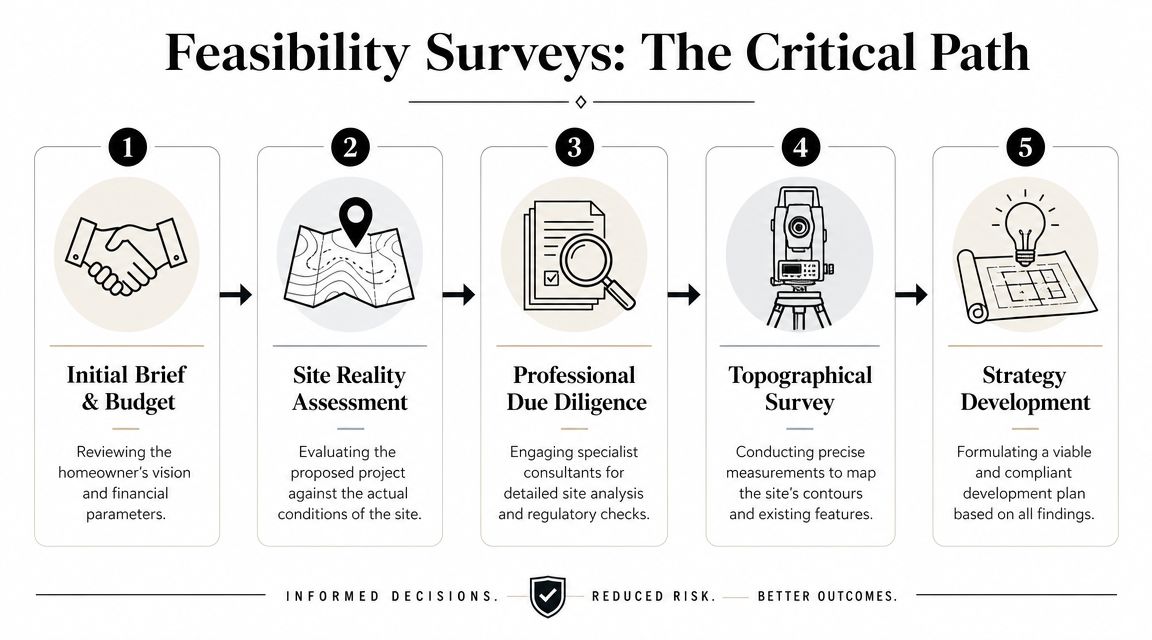
The Critical Path Feasibility Surveys and Strategy
A scheme can look convincing on paper and still fail at the first serious technical test. In South West London, that usually happens where early design ambition runs ahead of realities of levels, trees, drainage, neighbouring heritage assets, or the physical limits of a tight urban plot.
The surveys that change the design
Technical due diligence needs to happen before the design settles into a preferred option. Once a family has become attached to a particular arrangement of rooms, roof form or frontage, changing course becomes slower, more expensive, and harder emotionally as well as professionally.
On bespoke replacement houses and infill sites, the early surveys usually have the greatest effect on the shape of the project:
Topographical survey. This establishes levels, boundaries, existing structures, retaining elements, trees and the geometry of the plot. Small discrepancies here can have a direct effect on ridge height, overlooking, and whether lower-ground accommodation is sensible.
Arboricultural input. In conservation areas, mature trees often influence far more than the garden plan. They can dictate footprint position, access for construction, drainage runs, and how much excavation is realistic.
Utilities and drainage review. Existing services and viable outfalls need testing early. If foul and surface water cannot be resolved cleanly, the design may need to move or reduce before an application is prepared.
Measured survey work where existing fabric matters. This is often needed for replacement dwellings, sites with retained walls or structures, and any heritage-sensitive context where accuracy matters. A measured building survey for existing structures is particularly useful where the relationship between old and new will be closely examined.
On heritage-sensitive sites, these surveys do more than answer technical questions. They help establish what the planning authority is likely to regard as respectful, proportionate and credible in context. That is a different exercise from proving that a house fits on the site.
Why feasibility is a strategy exercise
A proper feasibility stage brings separate pieces of evidence into one planning and design position. That is the point clients are really paying for. The surveys themselves matter, but the judgement applied to them matters more.
In practice, the pressure points often overlap:
Feasibility issue | What it influences |
|---|---|
Access and visibility | Whether the house can operate safely and gain support in principle |
Site levels | Storey relationships, retaining works, entrance sequence, and basement value |
Trees and root protection | Buildable area, hard landscaping, excavation limits, and construction logistics |
Drainage outfalls | Footprint location, SuDS approach, and validation material for the application |
Existing services | Cost exposure, programme risk, and design coordination |
On a constrained London site, one finding rarely stays in its own lane. Levels affect threshold design and privacy. Trees affect drainage and foundation strategy. A neighbouring listed building can alter where bulk is acceptable, even if your own plot is not listed.
Good feasibility work prevents the wrong design from becoming the scheme everyone tries to defend.
By the end of this stage, the objective is clear. You should know which version of the house stands the best chance of consent, what technical issues will need budget allowance, and where a design can be ambitious without becoming vulnerable.
Navigating Planning Permission and Heritage Consent
A fine house can still fail at planning.
In South West London, that usually happens because the proposal has been designed in isolation from the policy context around it. On a high-value bespoke site in Barnes, Richmond, Wimbledon or Putney, the planning case often turns on questions of character, setting and cumulative impact long before anyone debates interior quality or finish.
Why pre-application work matters so much here
For a bespoke new house, pre-application advice is less about formality and more about testing risk early. On sensitive sites, it gives the design team a chance to understand how officers are likely to read the proposal before the application is fixed, costed and submitted.
That matters particularly in conservation areas, where the same house can be viewed very differently depending on its street presence, roof form, boundary treatment and effect on established townscape. It matters even more where a listed building sits next door or within the wider setting. In those cases, the authority is not only assessing whether the house is attractive. It is assessing whether the proposal preserves or enhances the character of the area and avoids harm to heritage significance.
If your site falls within one of these designations, it helps to understand the planning framework around conservation area consent and related controls.
Pre-application discussions also help define the right level of ambition. Some sites will support a contemporary intervention with confidence. Others need a quieter approach, where proportion, materials and garden boundaries do more of the work than overt architectural gestures.
Heritage settings require more than stylistic sensitivity
Clients often assume heritage acceptance is mainly a matter of choosing brick, sash-like proportions or a more traditional frontage. In practice, officers and conservation specialists look much harder at massing, hierarchy and siting.
A house beside a listed villa, for example, may be acceptable in a contemporary language if its bulk is held back, the ridge line is carefully controlled, and the landscaping protects the primacy of the historic building. The reverse is also true. A classically dressed scheme can still attract objection if it crowds the plot, interrupts important views, or introduces basement and lightwell works that alter the setting in a conspicuous way.
Judgement becomes apparent.
The application needs to explain why this building belongs on this site, in this borough, on this particular stretch of street. General statements about quality are not enough. The strongest submissions tie the design to local grain, plot rhythm, neighbouring scale, material precedent and the degree of architectural variety the conservation area already contains.
A well-supported planning submission for this type of site usually includes:
A clear design and access statement explaining the form, layout and material choices in relation to the site and its context.
A heritage statement that addresses significance, setting and the effect of the proposal on designated and non-designated assets where relevant.
Technical reports matched to the actual planning risks, such as arboricultural information, drainage strategy, daylight analysis or transport input.
Drawings that answer predictable concerns early, particularly around overlooking, bulk, roofscape, frontage treatment and boundary design.
Planning officers are judging whether the proposal is justified in policy and place, not whether the house would photograph well.
What tends to fail
The vulnerable schemes are usually the ones that mistake expense for credibility. Large glazed elevations, deep basements, prominent roof terraces and assertive entrance sequences are not automatically unacceptable. On the right site, they may be entirely reasonable. They run into difficulty when their effect on neighbours, trees, street character or nearby heritage assets has not been properly argued.
Another common problem is overclaiming. If the design statement says a scheme is subordinate, but the drawings show a dominant ridge height and a widened frontage, the application loses trust quickly. Consistency matters.
On constrained South West London plots, planning and heritage consent are rarely won by rhetoric. They are won by making disciplined choices early, presenting them clearly, and giving the case officer enough evidence to support approval with confidence.
Assembling Your Expert Team Architects and Consultants
On a bespoke new build, the team structure shapes the outcome long before construction starts. In South West London, that matters even more. A house in or near a conservation area, with mature trees, tight boundaries or a listed neighbour, needs consultants who understand how design decisions will be tested by planners, heritage officers and building control from the outset.
The architect usually leads the process, but the main task is coordination. A well-chosen team protects design quality, keeps the budget under control and reduces late changes that waste time and money. On high-value homes, the costly mistakes are rarely dramatic. More often, they come from small gaps between disciplines that were left unresolved for too long.
The core appointments usually include:
Architect to develop the brief into a coherent design, coordinate the wider consultant team and keep planning, technical design and procurement aligned.
Structural engineer to advise on structural form, foundation approach, retaining walls, transfer beams and any basement or level-change complications.
Building services or M&E consultant to plan heating, cooling, ventilation, lighting, controls and plant space before those requirements start distorting the architecture.
Quantity surveyor to test cost at each stage, review tenders and keep specification choices consistent with the agreed budget.
Planning consultant or heritage consultant where local policy, conservation area appraisal or nearby listed fabric calls for a more specialised planning case.
External environment designer or arboricultural consultant where trees, front boundary treatment, drainage, biodiversity and garden setting are likely to influence consent.
On constrained London plots, sequence matters as much as selection. A simpler site may allow some consultants to join later. A sensitive replacement dwelling in Wimbledon, Richmond, Putney or another conservation-led part of South West London often benefits from earlier heritage, tree and drainage input, because those issues can alter the footprint, levels and massing before the design has settled.
I often advise clients to judge appointments by two questions. Will this consultant reduce planning risk on this site? Will they help prevent redesign later? If the answer to both is no, the appointment may be premature.
Coordination is where value is protected. Plant space that has not been allowed for will steal area from dressing rooms or utility space. Structural transfers can thicken floors and upset proportion. Drainage runs can affect tree roots or force awkward level changes across the garden. These are ordinary project problems, but on bespoke houses they have expensive consequences because every late adjustment affects several parts of the design at once.
Harper Latter Architects is one example of a Wimbledon-based practice working on bespoke new builds, heritage-sensitive homes, interiors and residential projects with a strong focus on external environment design across South West London and Surrey.
The best team is not the largest one. It is the one that fits the site, the planning context and the level of ambition, with each consultant brought in at the point they can add real value.
From Concept to Construction The Design Stages
A client secures planning for a substantial new house in South West London and assumes the hard part is over. On a straightforward site, that can be an understandable reaction. On a bespoke house in or near a conservation area, or on a plot affected by the setting of a listed building, planning consent is only one gate in a much longer process.
How the design typically evolves
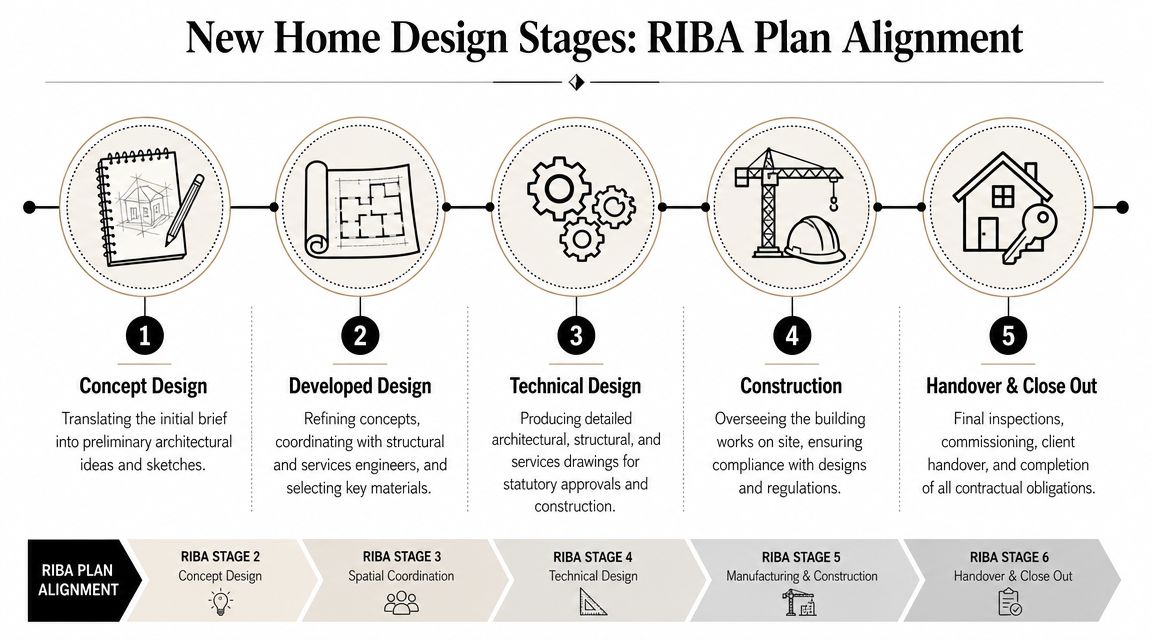
Concept design tests the fundamentals. The architect studies how the house sits on the plot, how rooms relate to light and garden, how privacy is handled, and what scale is likely to be accepted by the local authority. In places such as Wimbledon, Richmond and Putney, that early work often has to do two jobs at once. It must create a compelling home for the client and establish a form that respects local character, mature planting, neighbouring outlook and any heritage sensitivities.
Developed design narrows the options. By that point, the preferred arrangement is clear and the project starts to harden into a coherent scheme. Plans become more precise, elevations are resolved with greater discipline, and materials are chosen not only for appearance but for planning logic. In conservation-led contexts, details such as roof profile, brick tone, window proportions and boundary treatment can influence whether a proposal is seen as well-judged or overreaching.
The distinction between consent and delivery matters. The UK Government publishes separate data on planning permissions and housing completions in its live tables on house building, which is a useful reminder that an approved scheme still has to be technically resolved, priced properly and built well, as shown in the GOV.UK house building data tables.
The technical stage turns an approved design into a buildable one
After planning, the design has to become exact. Structure, drainage, insulation build-ups, junctions, plant, lighting, ventilation and construction tolerances all need to work together. That is where many bespoke projects either protect quality or lose it.
On high-value homes, the technical stage is rarely a drafting exercise. It is where real trade-offs are tested. A clean ceiling line may depend on deeper structural coordination. Large-format stone might affect thresholds and floor build-ups. A generous glazed corner may require steelwork that changes the budget and the visual lightness the client wanted in the first place.
A typical sequence looks like this:
Concept design The brief becomes initial layouts, massing studies and strategic options.
Developed design The preferred scheme is coordinated and refined for planning and design resolution.
Technical design Drawings, specifications and consultant information are prepared for pricing and construction.
Construction The contractor builds the house, and the architect inspects the work against the design intent and contract requirements.
Handover Final defects are addressed, systems are commissioned and the house is prepared for occupation.
Planning consent confirms that the proposal is acceptable in principle. Technical design decides whether it can be built to the standard the project demands.
Why stage gates protect the project
Each stage gives the client a proper decision point. That matters because changing a staircase position at concept stage is manageable. Changing it after planning may affect structure, services, floor areas, glazing, joinery and cost at the same time.
I advise clients to treat stage sign-off seriously, particularly on heritage-sensitive sites. Once a scheme has been carefully balanced to satisfy planning officers, conservation comments and the realities of construction, late design changes tend to be expensive rather than creative.
Well-run projects still change. The difference is that changes happen deliberately, at the point where the consequences are visible and still controllable.
Future-Proofing Your Home Sustainability and Biodiversity
A bespoke house in South West London can look immaculate on planning drawings and still underperform badly once it is built. The common causes are predictable. Plant has nowhere sensible to go, large areas of glazing overheat in summer, and the garden has been designed as leftover space rather than part of the environmental strategy.
On conservation area sites, and particularly on plots affected by listed buildings nearby, sustainability is rarely a matter of adding technology at the end. Roof form, window proportions, external materials, garden layout and boundary treatments all come under closer scrutiny. The design has to satisfy heritage expectations while still meeting modern standards for comfort, energy use and resilience.
A high-performing house starts with the building itself
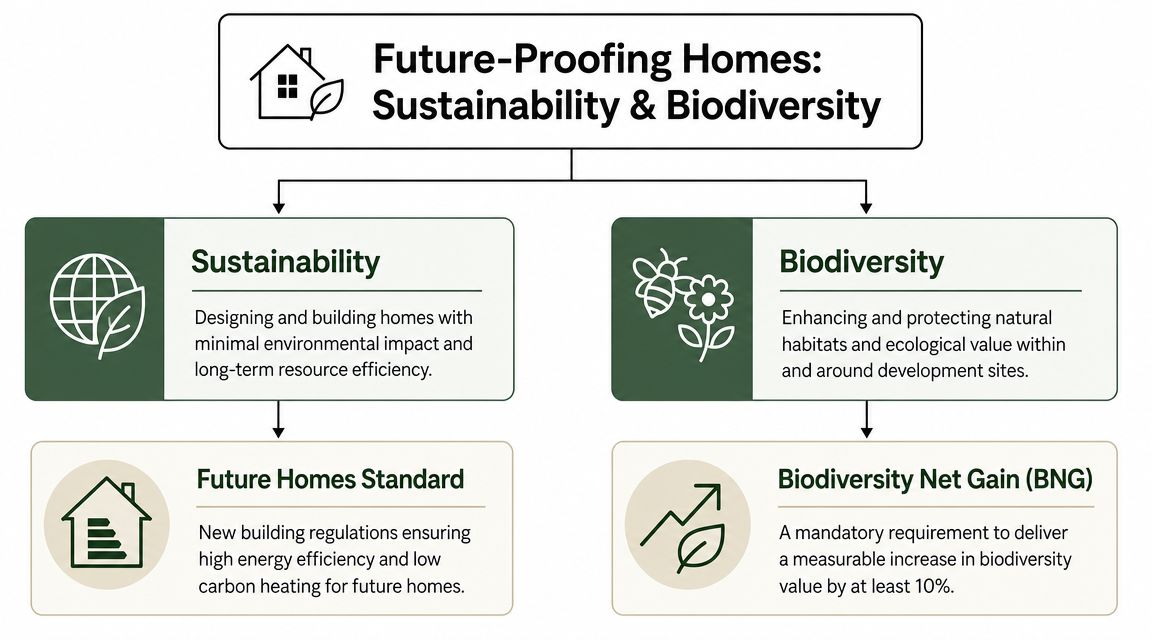
The government's Future Homes Standard guidance makes the direction of travel clear. New homes are expected to perform far better than older regulatory baselines, so early decisions on orientation, insulation levels, glazing, shading and ventilation need to be made in the architecture, not left to services engineers to solve later.
In practice, the best results usually come from disciplined, quiet decisions. Keep the form efficient. Control solar gain. Put glazing where it earns its keep. Allow proper space for heat pumps, hot water storage and MVHR from the outset, particularly on tight London plots where side access, acoustic screening and neighbour relationships all matter.
There are trade-offs. Full-height rear glazing may improve daylight and garden connection, but on a constrained urban site it can also create overheating risk, privacy issues and planning resistance if the composition feels out of character. Basements can be valuable, especially where planners resist above-ground bulk, but they bring higher embodied cost, more complex waterproofing and a direct effect on drainage and garden ecology.
A fabric-first approach remains the soundest starting point.
Biodiversity now affects the site plan
Biodiversity Net Gain is not a rural issue that can be ignored on a prime suburban plot. In England, many developments are now subject to mandatory BNG requirements, and the policy framework is set out on GOV.UK's Biodiversity Net Gain pages. Even where a particular self-build proposal falls outside the formal requirement, local authorities increasingly expect applicants to show that ecological value has been retained or improved.
That matters in South West London because many of the most desirable plots sit within established green settings. Mature trees, rear garden habitats, boundary planting and permeable ground often contribute to local character as much as the house itself. Remove too many built and natural features from the site too early, and the planning argument weakens as well as the ecology.
For clients, this changes the order of design decisions. Driveways, bin stores, lightwells, terraces, outbuildings, attenuation, tree protection and planting strategy need to be coordinated from the start. A drawing can appear clean and efficient while losing the very features that help win consent in a conservation area.
What future-proofing looks like in practice
Design priority | Early question to answer |
|---|---|
Energy and comfort | How will the house stay warm in winter and avoid overheating in summer without relying on corrective measures later? |
Low-carbon services | Where will heat pumps, ventilation equipment and associated acoustic treatment sit, inside and out? |
Garden and drainage | Can permeable surfaces, attenuation and usable outdoor space be designed as one scheme rather than competing demands? |
Ecology | Which trees, planting layers and habitats should be retained, protected or strengthened to support both planning and long-term site quality? |
A future-proof house holds its value because it performs well, adapts to tighter standards and still feels composed in its setting.
Common Pitfalls and Your Final Checklist
Most new house planning problems are predictable. They don't arise because clients are careless. They arise because decisions are taken in the wrong order, or because everyone is trying to preserve momentum before the fundamentals are settled.
What tends to go wrong
A few patterns come up repeatedly:
The brief is vague. That usually leads to late redesign once the family realises the plan doesn't match how they live.
The site is romanticised. Clients assume the plot will accommodate a larger or more complex house than the evidence supports.
Consultants arrive too late. Trees, drainage, levels and utilities then force redesign after planning work has already advanced.
Planning is treated as a one-off hurdle. In reality, consent is one milestone in a much longer route to delivery.
A practical checklist before you commit
Use this as a starting discipline:
Write a proper lifestyle brief Include routines, storage, privacy, entertaining, work patterns and how you want the garden to function.
Set a total project budget Include professional input, surveys, approvals, technical work and contingency.
Test the site early Don't freeze the design before the physical and planning constraints are understood.
Commit to pre-application strategy where the context is sensitive This is particularly important in conservation areas and around listed buildings.
Build the right team in the right sequence The site should determine which specialists need to be involved and when.
A bespoke house rewards patience. If the early decisions are disciplined, the rest of the process becomes far more intelligible and far less stressful.
If you're considering a bespoke new home in South West London or Surrey, Harper Latter Architects can advise on feasibility, planning strategy, heritage context, and the design development needed to turn an ambitious brief into a buildable project.