

Luxury Home Architects: Discover luxury home architects in 2026
Starting a bespoke home project is about more than just construction; it’s about shaping your future lifestyle. The single most important decision you'll make on this journey is choosing the right luxury home architect. They aren't just there to draw plans—they are your creative partner and the visionary who will turn your aspirations into a tangible, valuable home.
Why Your Architect Is Your Most Important Decision
When you’re creating a high-end residence in a place like South West London, the architect's role goes far beyond a set of drawings. A top-tier firm becomes your advocate, your creative guide, and the guardian of your project, right from the first sketch to the day you move in.
They have a unique ability to translate abstract ideas—the way you want to live, entertain, and relax—into a coherent architectural language. It’s a deep understanding of space, light, materials, and form, all coming together to ensure the final home isn’t just beautiful, but perfectly suited to you.
Architect vs Draughtsperson vs Designer A Comparison
It's easy to get these roles confused, but for a luxury home, the differences are critical. A RIBA-accredited architect brings a level of strategic oversight and design accountability that other professionals simply aren't trained for. This table breaks it down.
Role | Qualifications & Registration | Scope of Work | Best Suited For |
|---|---|---|---|
Architect | 7-8 years of training; legally protected title; must be registered with the ARB; RIBA accreditation is the gold standard. | Manages the entire project from concept to completion, including design, planning permission, technical detailing, and contract administration. | Complex, high-value projects like bespoke new builds, major renovations, and work on listed buildings where design vision and project management are key. |
Draughtsperson | Technical qualifications (e.g., HND/HNC) but not a degree in architecture. Not a protected title. | Focuses on producing technical drawings based on designs provided by others. They typically don't lead the design or planning process. | Simple extensions or conversions where the design is already clear and a full architectural service isn't needed. |
Designer | Varies widely. Can include architectural designers, interior designers, or others. The title "designer" is not protected by law. | Can be excellent at conceptual and aesthetic design but may lack the technical knowledge or legal authority for planning and building regulations. | Interior refurbishments, spatial layouts, or conceptual design work before an architect is appointed for technical execution. |
Ultimately, only a registered architect can provide the holistic, legally accountable service needed to navigate the complexities of a luxury residential build from start to finish.
Navigating South West London's Unique Landscape
The architectural landscape in boroughs like Wimbledon, Richmond, and Wandsworth brings its own set of challenges. With so many properties in conservation areas or holding listed status, you need a specialist approach.
An experienced local architect brings an intimate knowledge of:
Local Planning Policies: They understand the subtle preferences of each borough's planning department, which is crucial for securing permission without endless revisions.
Conservation and Heritage: They know how to blend modern living with a historic context, satisfying both your vision and strict regulatory demands.
Site Constraints: Whether it's a tight urban plot in Clapham or a property with tricky topography near Richmond Park, a skilled architect knows how to unlock a site’s hidden potential.
This local expertise is invaluable. For example, RIBA data shows that while housing makes up around 33% of all UK architectural work, this figure can jump to 80% for smaller, specialised practices focused on luxury homes in affluent areas like Surrey and South West London. It's a market where bespoke new builds are just as common as sophisticated renovations with landscape architecture for outdoor kitchens and terraces.
A great architect doesn’t just design a house; they design a home that elevates your quality of life. They are strategic problem-solvers, balancing vision with pragmatism to ensure the final result is both a design masterpiece and a sound financial investment.
A Structured Path to an Exceptional Home
Following a structured, RIBA-accredited process brings much-needed clarity and control to what can be a complex undertaking. This framework guides the project through defined stages—from the initial brief to construction and handover—and gives you total transparency on costs, timelines, and key decisions.
This methodical approach is the best way to manage the intricacies of a high-value project, offering peace of mind and a clear path forward. To help you get ready for those initial conversations, we've put together a resource on the practical steps to hiring the right professional.
How to Define Your Vision and Find the Right Architect

Before a single line is drawn, the most successful home projects begin with a moment of reflection. The real groundwork isn't about looking for an architect; it's about looking inward to define exactly what you want your home to achieve. This initial clarity is the North Star that guides every decision that follows.
This isn’t about you needing to sketch floor plans. It’s about translating your family’s lifestyle, your aspirations, and your practical, day-to-day needs into a coherent brief. Get this right, and your first conversations with potential luxury home architects will be focused, productive, and truly rooted in your ambitions.
Crafting Your Project Vision
To build a powerful brief, you need to think deeply about how you live now and, more importantly, how you want to live in the future. It’s a mix of grand aspirations and daily practicalities. We find a 'vision checklist' is a brilliant way to get your thoughts in order.
Start by digging into your lifestyle with a few probing questions:
Daily Routines: What does a typical day look like? Think about the morning rush to get out the door, where you work from home, how the kids do their homework, and where everyone unwinds in the evening.
Entertaining Style: Are you known for large, formal dinner parties, or do you prefer relaxed, intimate get-togethers with close friends? Is a seamless indoor-outdoor flow with a terrace and kitchen top of your list for summer?
Future Needs: Do you see your family growing? Or perhaps you're planning for the long term and need to consider features for ageing in place, like a lift or a primary bedroom suite on the ground floor.
Hobbies and Passions: What brings you joy? This is your chance to dream. We're talking about dedicated spaces like a sound-proofed home cinema, a climate-controlled wine cellar, a personal gym, or a quiet library for your book collection.
A truly successful luxury home is one that feels intuitively right. It effortlessly supports your lifestyle because it was designed around your specific routines, passions, and future aspirations from the very beginning.
This process of self-reflection is fundamental. It’s how abstract wants become a tangible set of requirements that an architect can really sink their teeth into. When you can articulate not just what you want, but why you want it, you give us the power to create a design that genuinely elevates your life. For more ideas on how this thinking shapes the final spaces, have a look at our guide on achieving high-end home interior design.
Researching and Shortlisting the Right Firm
Once you have a clearer vision, you can start the search for your architectural partner in South West London. The aim here is to find a practice whose portfolio not only excites you aesthetically but also proves they have the technical skillset your project demands.
A sensible first port of call is the Royal Institute of British Architects (RIBA) and the Architects Registration Board (ARB). Their directories list accredited professionals, which gives you a baseline guarantee of quality, insurance, and professional conduct.
As you look at different firms, zero in on a few key areas:
Portfolio Alignment: Go beyond the pretty pictures. Does their past work include projects of a similar scale, style, and complexity to yours? If you want a double-height basement extension under a listed building in Richmond, find an architect who has actually done it before, and done it well.
Design Philosophy: Spend some time on their website and read about their approach. Do they champion sustainability, have a passion for historical conservation, or lean towards a specific modern aesthetic? You’re looking for a firm whose core values match your own. It should feel like a good fit.
Local Experience: This one is crucial. An architect with deep roots in boroughs like Wimbledon, Wandsworth, or Merton will have an established network of contacts and an invaluable grasp of the local planning department’s quirks. That kind of insider knowledge can be the difference between a smooth planning journey and months of frustrating delays.
Your goal is to curate a shortlist of three to five firms. Remember, you aren't just hiring a contractor; you’re choosing a close collaborator for one of the most significant projects of your life. Finding the right fit is everything.
The Essential Questions to Ask Shortlisted Architects
Choosing your architect is arguably the biggest decision you’ll make for your entire project. That first meeting is your chance to look past the beautiful portfolios and really understand how a firm works. Think of it less like a one-way interview and more like a conversation to see if you click—is there trust, rapport, and a shared vision for your home?
These initial chats are about so much more than design flair. You’re searching for a trusted guide who can navigate you through a process that’s complex, deeply personal, and financially significant. Asking the right questions is how you uncover a firm's process, how they communicate, and, most importantly, how they solve problems.
Understanding the Design and Collaboration Process
The first thing to get a feel for is how your ideas will become a tangible design and what that working relationship will look like. Their answers here will tell you everything about their methods, their creativity, and whether they truly put their clients at the centre of the process.
A great place to start is simply asking: “Can you walk me through your design process, from our initial conversation to the day you hand over the keys?” This throws the door wide open. A confident architect will talk you through a clear, structured journey, often referencing the RIBA Plan of Work, and highlighting where you’ll need to make key decisions.
From there, you can dig a little deeper into how they think:
How do you start developing the first concepts? Do they begin with hand sketches, create physical models, or jump straight into 3D visuals? Knowing their tools helps you picture how your home will take shape.
What’s your approach to weaving our lifestyle and daily routines into the design? This gets to the heart of their ability to listen and translate your personal story into functional, beautiful spaces.
How much involvement will you need from us, and when? This is a practical question that helps align expectations from day one.
A good luxury home architect will have a clear, organised process that feels collaborative. You should leave feeling like you’ll be a core part of the creative team, guided by their expertise.
Gauging Real-World Experience and Problem-Solving
Your project in South West London comes with its own unique set of challenges, from local planning quirks to tight construction sites. You need an architect who has been there and done that, not just someone who gives vague assurances.
For anyone building in this part of London, the most critical question is: “What’s your experience securing planning permission in our specific borough?” An architect with genuine roots in Wandsworth, Richmond, or Merton won't just say they're familiar with it; they'll be able to talk about specific projects, local council priorities, and maybe even their working relationships with planning officers.
Follow that up with questions about their on-the-ground skills:
How do you deal with unexpected issues or budget changes during the build? This is a test of their pragmatism. You’re listening for answers that focus on clear communication, finding solutions, and making decisions together with you and the contractor.
Could you show us a project that’s similar to ours in scale and ambition? This is where they prove their portfolio is more than just pretty pictures—it's a record of delivering homes like the one you’re imagining.
Who will be our day-to-day contact, and how often will we get updates? Consistent, clear communication is the absolute foundation of a successful project. A firm with a well-defined communication plan is a firm that values your peace of mind.
A firm’s ability to talk openly about past challenges is a sign of confidence and honesty. The best architects don't pretend problems won't happen; they have robust systems in place to manage them when they do.
Ultimately, these conversations are all about building a relationship. The architect you choose will be your creative partner and staunchest advocate for months, or even years. Your goal is to find a team that not only has the design talent you admire but also the integrity and practical skill to bring it to life, flawlessly.
Understanding Architectural Fees and Project Costs
Let's talk about one of the most important aspects of any project: the budget. Getting to grips with the costs involved in a high-end architectural project is crucial, and it’s the first step towards a transparent and successful partnership.
When you bring a luxury home architect on board, you’re investing in far more than a set of drawings. You're securing a complete service that weaves together creativity, technical know-how, project management, and some serious problem-solving. Knowing how these services are priced is the key to budgeting with confidence.
Most architectural practices in the UK, including our own, tend to use one of a few main fee structures. The best approach often comes down to the specifics of your project—its complexity, its scope, and how you prefer to manage the finances.
A Comparison of Architectural Fee Structures
To help you understand how luxury architects charge for their services and what to expect, we’ve broken down the most common fee models. Each has its place, and the right one for your South West London project will depend on whether you’re planning a straightforward refurbishment or a complex new build on a tricky site.
Fee Structure | How It Works | Best For | Key Considerations |
|---|---|---|---|
Percentage of Construction Cost | Your architect’s fee is a set percentage (typically 8% to 15%) of the final certified build cost. | Full-service, complex projects where the scope may evolve, such as new builds or large-scale renovations. | The fee adjusts with the final build cost, which offers flexibility but less upfront certainty. Higher-spec projects often command a higher percentage. |
Fixed Fee | A lump sum is agreed upon at the start, covering a clearly defined scope of work. | Projects with a very predictable scope and timeline, where the work required is easy to quantify in advance. | Provides total cost certainty from day one, but changes to the scope will likely require the fee to be renegotiated. |
Time-Based Charges | You are billed at an agreed hourly or daily rate for the actual time the architect spends on your project. | Early-stage feasibility studies, initial consultations, or for ad-hoc services where the scope is difficult to define. | Offers maximum flexibility but can be harder to budget for over the long term. Best used for discrete, well-defined tasks. |
Ultimately, choosing a fee structure is about finding a balance between cost certainty and flexibility that feels right for you and your project.
The most important thing is transparency. Whichever structure is used, your architect should provide a clear, detailed breakdown of what is included in their fee and what would be considered an additional service. This clarity is the foundation of a strong working relationship.
What's Included and What's Extra
It’s vital to understand what an architect’s fee actually covers. Typically, this will be the core architectural services across the RIBA work stages—from shaping the initial concept and steering it through planning permission to producing technical drawings and overseeing the construction contract.
However, some specialist services usually sit outside this standard scope and are billed separately. It’s good to be aware of these from the outset.
These often include:
Detailed interior design, including bespoke joinery and furniture specification.
Specialist landscape architecture and garden design.
Fees for other consultants like structural engineers or party wall surveyors.
Council fees for planning applications and building control submissions.
To help you get a clearer picture, we’ve put together a comprehensive resource on this very topic. For a deeper dive, take a look at our guide to UK architect fees for high-end homes.
Having this knowledge means you can enter discussions with potential architects from an informed position, building a foundation of trust and clarity right from the start.
Navigating Conservation and Heritage Projects
South West London is home to some truly stunning period properties. If you live in Wimbledon, Richmond, or Barnes, you’ll know that entire streets are often protected by conservation area status. Owning one of these homes is a genuine privilege, but it also comes with a unique set of responsibilities when you decide to renovate or extend.
This is where a conservation-accredited luxury home architect becomes invaluable. These projects require a delicate touch, balancing the desire for modern luxury and function with a deep respect for the building’s history. It’s a specialist field, and a standard architectural approach just won’t cut it.
An architect with real heritage experience sees these properties as part of a shared story. They understand that every single design choice, from a new window profile to the pointing on the brickwork, will be closely examined by a local authority conservation officer.
Working With Conservation Officers
Your architect’s relationship with the council’s conservation team can literally make or break your project. These officers are the guardians of the area's architectural character, and getting their approval is everything. A skilled conservation architect knows how to build a collaborative dialogue from day one, rather than an adversarial one.
This involves a few key things:
Thorough Research: They will present a detailed historical analysis of your property, showing a genuine understanding of its significance.
Clear Justification: A robust 'Design and Access Statement' is crucial. It needs to clearly explain why changes are needed and how they will be sympathetic to the building.
Pre-Application Advice: Engaging with officers early on is a smart move. It allows the architect to test ideas and adapt the design before a formal submission, saving you time and avoiding costly rejections.
This proactive and respectful approach is fundamental to navigating the complex planning maze and securing necessary permissions, like Listed Building Consent.
The Art of Sympathetic Design
Sympathetic design is at the heart of heritage architecture. It’s not about creating a cheap copy of the past. It’s about introducing modern elements in a way that respects and even enhances the original building’s character, materials, and scale.
This allows for a beautiful conversation between old and new. For instance, a contemporary glass box extension can look incredible on a Victorian villa precisely because it doesn’t try to mimic the original brickwork. It is honestly and unapologetically modern, letting the historic fabric truly shine.
This philosophy is gaining serious momentum across the UK. The luxury housing market is seeing a major boom in this area, with a 25% rise in demand for sensitive refurbishments. We’re also seeing a trend towards integrating bespoke joinery and handmade details, with 65% of high-end clients now preferring natural materials like stone and timber. You can explore more about these luxury house trends and their impact on design.
Integrating Modern Luxury Into Historic Fabric
So, what does this actually look like in your home? It’s all about clever, sensitive integration that improves your lifestyle without erasing history. A conservation specialist can show you exactly how to:
Create Light-Filled Spaces: A striking glass extension can connect a dark period kitchen to the garden, flooding the room with natural light while creating a clear, beautiful distinction between the original house and the new addition.
Install Bespoke Joinery: Imagine a contemporary, minimalist wardrobe designed to fit perfectly within the old alcoves of a Georgian bedroom. It gives you modern storage without disrupting the room's classical proportions.
Conceal Modern Services: Advanced smart home technology, underfloor heating, and modern plumbing can be cleverly hidden within the building’s historic fabric. You get all the 21st-century comfort, completely out of sight.
Working on a heritage property is a hugely rewarding journey. By choosing the right architect, you ensure your home’s story is not just preserved but beautifully enhanced for generations to come, creating that perfect fusion of historic elegance and contemporary luxury.
Your Architect Questions, Answered
Embarking on a bespoke home project naturally brings up a lot of questions. We find that a little clarity upfront can make all the difference, so we’ve put together answers to some of the most common queries we hear from homeowners across South West London.
How Long Does the Architectural Design Process Take?
This is one of the first things clients ask, and the honest answer is: it depends. There's no one-size-fits-all timeline, as the design phase is a detailed process that shifts with the project's complexity, the nuances of planning, and how quickly decisions are made.
For a significant renovation or a new build in South West London, it's wise to be realistic. You should comfortably set aside 6 to 12 months just for the design, planning permission, and technical drawing stages. Remember, this is all before a single spade hits the ground.
What’s the Difference Between Planning Permission and Building Regulations?
Many people use these terms interchangeably, but they are two completely separate hurdles your architect will guide you over. Getting your head around the difference is key to understanding the scope of your architect’s role.
Planning Permission: This is all about the principle of the development. It looks at the building’s appearance, its use, and how it will affect the surrounding area and your neighbours. Your local council's planning department has the final say, based on their specific policies.
Building Regulations: These are the technical rulebook for construction. They set the minimum standards for everything from structural safety and fire protection to energy efficiency and accessibility. Approval here is a technical pass-or-fail exercise, not a subjective judgement.
Your architect takes the lead on preparing and submitting applications for both, making sure your project is compliant on every front.
Do I Really Need an Architect for a Small Extension?
While it might not be a legal requirement for very minor projects, bringing a luxury home architect on board adds a level of value that goes far beyond just ticking boxes. Their creative eye can completely reimagine a space, finding ways to maximise light and flow that you might never have thought of.
For any project in a conservation area or involving a listed building—a common scenario in boroughs like Richmond and Wimbledon—an architect’s specialist knowledge isn’t just helpful; it’s essential.
Their involvement also boosts your property's value and helps you navigate complex regulations with far less stress. This expertise is becoming even more critical as homeowners' priorities shift.
For instance, looking ahead to 2026, eco-conscious clients are increasingly demanding verifiably low-carbon homes. Healthy building specifications, like low-VOC paints and smart ventilation, are now becoming standard in over 60% of luxury briefs. RIBA insights are calling this the 'slow-luxe' trend, where sustainability and wellbeing are woven into the very fabric of the design. You can explore more about the latest trends in residential architecture for 2026 to see how this focus is shaping the homes of tomorrow.
Your Next Steps Towards a Bespoke Home
You've now got a much clearer picture of what it takes to find and work with the right luxury home architects in South West London. From pinning down your own vision and getting to grips with fees, to understanding the nuances of local heritage properties, you're in a great position to move forward with confidence.
Ultimately, creating an exceptional home isn't about one single decision. It's about building a partnership based on a shared vision, clear communication, and proven expertise.
Visualising the Path Forward
Embarking on a bespoke home project can feel daunting, but it follows a logical path. Your architect will guide you through a series of well-defined stages, managing the process on your behalf. This diagram gives you a high-level overview of how it works.
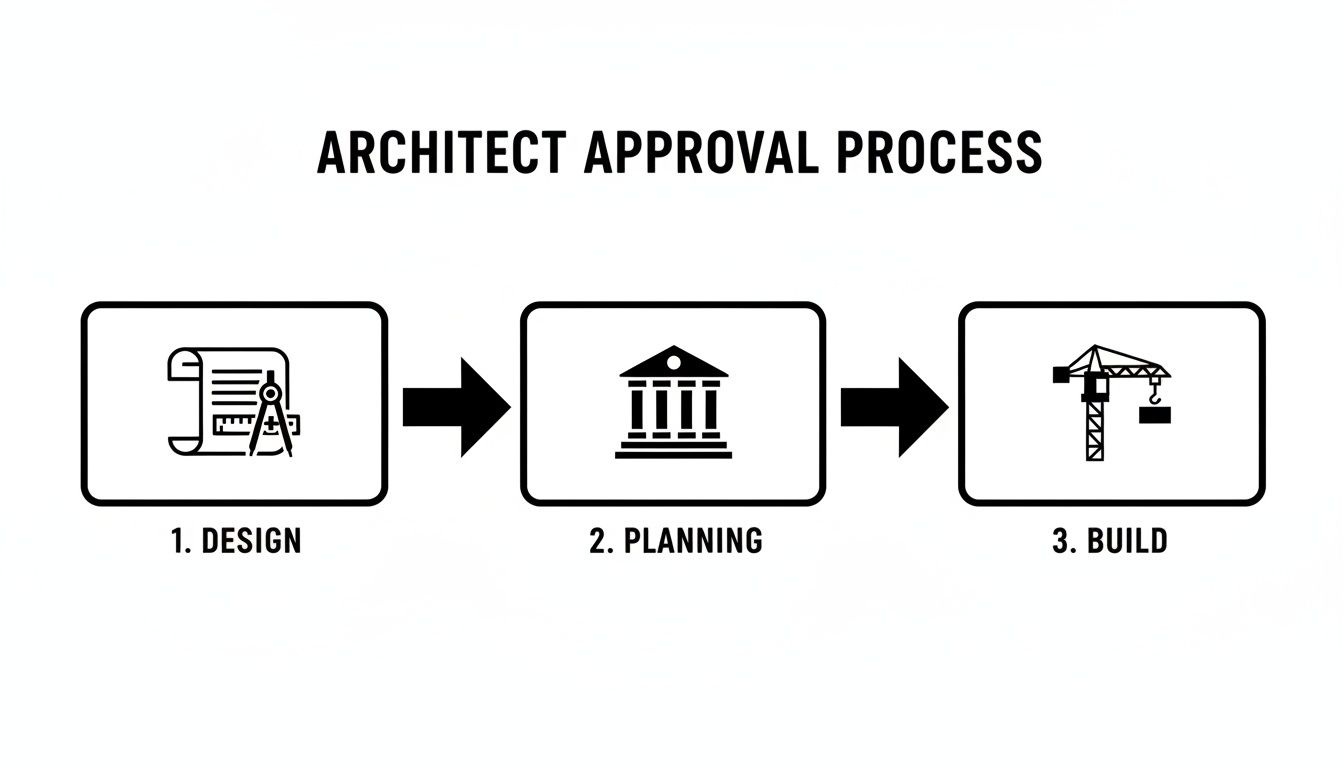
As you can see, a project moves from the creative design phase, through the formal planning process, and finally into the build itself. Each step requires a different set of skills, which is why having your architect lead the project is so crucial for a smooth journey.
It's Time to Take the Next Step
You’ve done the research and you know what's involved in creating a home that’s a true reflection of you. Now it’s time to turn those ideas into something real.
The journey from a simple idea to a beautifully finished, future-proof home always starts with a conversation. An initial chat is the perfect, no-obligation way to explore your project's potential with an experienced team who can show you what's possible.
The decision to build or renovate is a big one. The right architectural partner doesn’t just bring your vision to life; they make sure the entire process is managed with professionalism, creativity, and an absolute commitment to quality.
We're ready to help bring your vision to life, guiding you through every stage with clarity and care. Your dream home is closer than you think.
We invite you to book a complimentary initial consultation with Harper Latter Architects to discuss your project. Explore your vision with our experienced team and discover how we can help you create an exceptional home. Book your consultation today.