
How Much Does Home Extension Cost? UK Budget Guide

Updated: Oct 20, 2025
Let’s get straight to the big question everyone asks: "how much does a home extension actually cost?" It’s a bit like asking the price of a car – it depends entirely on the model, the size, and all the optional extras you choose.
Generally speaking, a typical single-storey extension in the UK can set you back anywhere from £40,000 to over £140,000. The final figure hinges on the size of your project, the complexity of the design, and, of course, your taste in finishes. Think of these numbers as a rough starting point for your financial planning.
Your Quick Guide To Home Extension Costs

Starting a home extension is an exciting journey, but grounding your dreams in financial reality is the first, most crucial step. There's no single, fixed price; instead, the cost is a spectrum influenced by your ambitions, your location, and the unique quirks of your property. This guide is designed to give you a clear, realistic snapshot before you get lost in the finer details.
The two biggest levers on your budget will always be the physical size of the extension (measured in square metres) and the quality of the finish. It’s simple, really: a small, functional utility room is going to cost a fraction of a large, open-plan kitchen-diner with bespoke cabinetry and high-end appliances. Being honest about your priorities from day one is essential.
Understanding the Price Brackets
To put some real numbers on this, let's break it down. Recent industry data shows a clear link between the size of an extension and the quality of its finish. For instance, a basic 20m² single-storey extension usually lands somewhere between £40,000 and £56,000, with a national average of around £48,000.
If you're thinking bigger, say a 50m² extension, the build cost could range from £100,000 up to £140,000. And if you opt for premium finishes? That’s when the costs really climb. A high-spec 30m² extension, for example, averages £92,500 but can easily push past £110,000. You can learn more about these extension cost insights and see how prices vary across the country.
It's vital to remember that these figures are just for the build itself. They almost never include professional fees for your architect and structural engineer, planning application costs, or the often-forgotten addition of 20% VAT on materials and labour. That last one alone can add a significant chunk to the final bill.
A common mistake is to focus only on the builder's quote. A robust, successful budget must also account for professional fees, surveys, planning applications, and a contingency fund of at least 10-15% for those inevitable surprises.
To give you a clearer picture of how size and finish influence the build cost, have a look at the table below. Use it as a preliminary guide to help align your vision with a sensible budget.
Estimated Home Extension Costs by Size and Finish (Excluding VAT)
This table provides a summary of estimated costs for single-storey extensions based on their size and the quality of materials and finishes chosen.
Extension Size (m²) | Basic Finish Cost Range (£) | Mid-Range Finish Cost Range (£) | Premium Finish Cost Range (£) |
|---|---|---|---|
20 | 40,000 - 56,000 | 56,000 - 75,000 | 75,000 - 90,000 |
30 | 60,000 - 84,000 | 84,000 - 110,000 | 110,000 - 135,000 |
40 | 80,000 - 112,000 | 112,000 - 148,000 | 148,000 - 180,000 |
50 | 100,000 - 140,000 | 140,000 - 185,000 | 185,000 - 225,000 |
Now that you have a ballpark figure in mind, the rest of this guide will dig deeper into all the other factors that will shape your final investment—from your postcode to the hidden costs many people overlook.
What Really Drives The Cost Of Your Extension?

While headline figures give you a decent starting point, the real key to managing your budget is understanding what actually drives the final price tag. Think of it like buying a car: there’s the price for the base model, but every extra you add—from the engine upgrade to the leather seats—pushes up the total cost. A home extension works in exactly the same way.
Every single decision, no matter how small it might seem at the time, has a knock-on effect on the budget. The type of bricks for the outer walls, the style of light fittings, the brand of taps… it all adds up. To get a real grip on your potential spending, we can break down the main cost drivers into a few key areas.
Size And Complexity Of The Build
The most obvious cost factor is size. It’s simple, really: a larger extension needs more materials, more labour, and more time on site, which all increases the price. But complexity is just as important. A straightforward, single-storey rectangular box will always be more budget-friendly than a two-storey wrap-around extension with a complicated roof design.
The cost per square metre (£/m²) is the industry’s go-to metric for estimating and comparing projects. For a typical single-storey extension, you can expect to see figures in the £1,800–£2,400/m² range nationally. However, if you're aiming for high-end finishes or a more complex design, that can easily climb to £2,500–£3,500/m², especially here in London and the South East.
Double-storey extensions are more efficient when it comes to the cost of the foundations and roof, but they still cost proportionally more overall. You can typically expect to pay 50–60% more than a single-storey build due to the extra structural work and more involved construction. And don't forget, these figures almost always exclude VAT. You can discover more insights about 2025 extension costs and see how different project types stack up.
Material Choices And Structural Elements
The materials you choose have a direct and significant impact on the bottom line. And we’re talking about much more than just the bricks and mortar.
Glazing: Standard uPVC windows are the most economical option, whereas aluminium-framed bi-fold doors or bespoke timber sash windows can cost several times more.
Roofing: A simple flat roof with a felt or EPDM covering is far cheaper than a pitched roof finished with natural slate tiles and dotted with Velux windows.
Cladding: Modern finishes like timber or zinc cladding look fantastic but come at a premium compared to traditional brickwork or a simple render.
Foundations: This is a big one that can catch people out. The ground conditions at your property might throw up a surprise. Poor soil could mean you need deeper, more specialised foundations, adding thousands to the groundwork phase before you’ve even got out of the ground.
Every material has a price point. While it’s tempting to opt for the most luxurious finishes, balancing high-impact splurges (like a stunning worktop) with more standard choices elsewhere is a smart way to manage costs without compromising on style.
Quality Of Interior Finishes
This is where a budget can really run away from you if you’re not careful. The "finish" is the stage where an empty shell becomes a liveable, beautiful space, and the choices are practically endless. A basic-spec extension might feature laminate flooring and standard off-the-shelf kitchen units.
A premium finish, on the other hand, involves high-end specifications that can dramatically increase the cost. We’re talking about things like:
Bespoke Joinery: Custom-built wardrobes, media units, and shelving that fit the space perfectly.
High-End Kitchens: Designer appliances, stone worktops, and custom-made cabinetry.
Luxury Bathrooms: Designer sanitaryware, natural stone tiles, and walk-in wet rooms.
Advanced Systems: Underfloor heating throughout, smart home automation, and sophisticated architectural lighting schemes.
Each of these elements contributes to the final square metre rate, which helps explain why two extensions of the exact same size can end up with vastly different price tags. Understanding this from the outset allows you to make informed decisions and put your money where it matters most to you.
A Detailed Breakdown Of Where Your Money Goes
To really get a grip on what a home extension costs, you have to look past the headline figure. Just thinking in terms of cost-per-square-metre can be seriously misleading; the real story is in how your budget gets carved up between all the different skills and materials needed to do the job properly.
When you break it down, you quickly realise a build is so much more than just bricks and mortar. It’s a complex operation that pulls together skilled trades, essential supplies, detailed design work, and crucial oversight. Each of these parts needs its slice of the total investment.
The Three Pillars Of An Extension Budget
For a typical mid-range extension, your budget will almost always be split across three core areas: materials, labour, and professional fees. The exact percentages will shift depending on how ambitious your design is or the quality of finishes you choose, but this structure gives you a clear idea of where the money actually goes.
Materials, for instance, usually take the biggest bite out of the budget. We’re talking about everything from the concrete in the foundations and blocks for the walls, right through to the windows, roofing, insulation, and plasterboard. Hot on its heels is labour – the cost for the skilled teams on site who turn the drawings into a physical reality. This includes your builders, electricians, plumbers, and plasterers.
This infographic gives you a simple visual of how a typical project budget is shared out.
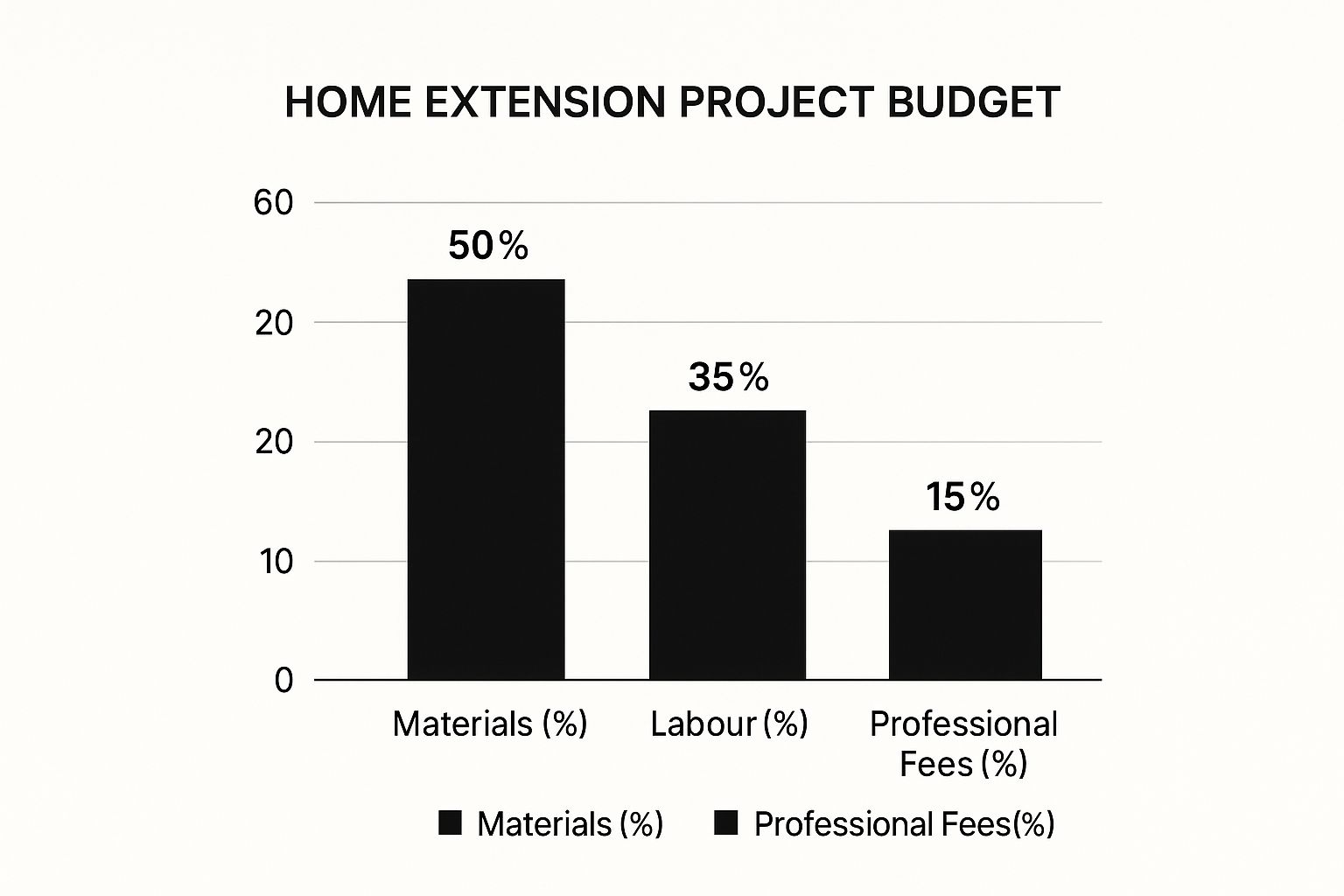
As you can see, the physical construction (materials and labour) eats up the lion’s share of the money. Professional services make up a smaller, but absolutely critical, piece of the pie.
To see how these percentages play out in the real world, let's look at the cost allocation for a typical home extension.
Expense Category | Percentage of Total Budget |
|---|---|
Materials | 40-50% |
Labour | 30-40% |
Professional Fees | 10-15% |
Contingency Fund | 5-10% |
This table provides a great starting point for understanding your own budget, showing that the physical build accounts for the majority of the cost, but the professional input is a vital, non-negotiable component.
A Real-World Case Study
To put some real numbers to this, let’s look at a 30m² single-storey kitchen-diner extension built in Manchester. It’s a perfect real-world example. The final project cost came in at £72,800 with a solid, mid-range finish.
Here’s how that budget was spent: materials accounted for 46% (£33,500), and the labour to put it all together was 34% (£24,800). The vital professional fees for the architect, structural engineer, and building control inspections took up 12% (£8,700) of the pot. The final 8% (£5,800) was smartly kept back as a contingency fund, which covered things like waste removal and unexpected drainage work.
The Value Of Professional Fees
That 10-15% of the budget set aside for professional fees? It’s arguably the most important money you’ll spend. This is your investment in expert guidance to navigate the entire process smoothly, from the first sketch to the final sign-off.
These fees typically cover:
Architectural Design: Creating the detailed plans, elevations, and 3D models that turn your ideas into something that can actually be built.
Structural Engineering: Doing the maths to specify the right steel beams, foundations, and other key structural parts to make sure the building is safe and sound.
Planning Applications: Handling all the paperwork and submissions to the local council to get the green light.
Building Regulations: Producing the technical drawings and specifications needed to prove your extension meets national construction standards.
Trying to go it alone without this expertise is a recipe for delays, budget blowouts, and compliance headaches. To get a better sense of what’s involved, have a look at our guide on decoding extension architect costs and the real value they bring to a project.
How Your Postcode Impacts The Final Price

It’s the unspoken truth of UK construction: where you live has a dramatic effect on your final bill. The answer to "how much does a home extension cost?" can change significantly just by crossing a county line. This isn't just a minor fluctuation; the price gap between building in London and the South East versus the North of England or Wales can be staggering.
This ‘location premium’ isn’t arbitrary. It’s driven by real-world economic factors that directly influence every quote you’ll receive. Understanding these forces is key to setting a realistic budget, especially if you're based in a high-value area like South West London.
The London Premium Explained
The single biggest driver behind higher costs in London and the surrounding home counties is the price of labour. It’s that simple. Skilled tradespeople—from builders and electricians to plasterers and plumbers—command higher daily and hourly rates here than anywhere else in the UK. This is a direct reflection of the much higher cost of living in the capital.
But it’s not just labour. Several other factors stack up, adding thousands to your project before a single brick is even laid.
Material Sourcing and Delivery: Getting materials into congested urban areas often comes with surcharges for parking, timed delivery slots, and navigating low-emission zones.
Site Accessibility: London properties often have tighter access. This can make getting machinery and materials onto the site more complex and time-consuming, which bumps up labour costs.
Scaffolding and Waste Removal: These essential services are consistently more expensive in the South East, simply because of the higher operational costs for the companies providing them.
The regional cost variation is huge. A project quoted at £80,000 in the North of England could easily command a price of £100,000 to £115,000 for the exact same work in London or Surrey. That’s a premium of 25-40%.
Planning And Local Authority Hurdles
Another key factor is the sheer complexity of local planning. Councils in densely populated and historic boroughs like Wimbledon, Richmond, or Chiswick often have far stricter planning policies and more rigorous approval processes.
Navigating these rules demands more detailed architectural drawings, specialist reports (like tree or heritage statements), and a much deeper understanding of local conservation rules. This added complexity naturally increases the professional fees required just to get your project off the ground.
For a detailed look at what’s involved, it’s worth reading our comprehensive UK house extension planning permission guide. This added layer of diligence, while essential for a compliant build, contributes directly to the higher upfront costs of extending your home in these desirable postcodes.
Budgeting For Your Specific Postcode
So, what does this all mean for you? If you're planning an extension in a high-cost area, you have to approach your budget with this local premium baked in from the very start. Using national average costs as a baseline will only lead to a significant budget shortfall down the line.
To get an accurate picture, always seek quotes from at least three reputable, local builders who understand the specific challenges and costs of working in your neighbourhood. Their estimates will give you a far more realistic reflection of the true market rate. By doing your research and budgeting for your specific postcode, you can move forward with financial confidence.
Navigating Hidden Costs And Budgeting For Success
A successful home extension isn't just measured by the quality of the final build; it's defined by how well the budget was managed from the very start. The initial quote from your builder is just one piece of the puzzle—the tip of the iceberg, really. The real test of a robust budget is how it handles the expenses you didn't see coming.
These so-called 'hidden' costs aren't actually hidden. They're the professional services, surveys, and administrative fees that are a necessary part of any compliant, well-executed build. Getting your head around these from day one is the secret to staying in control of your finances and avoiding stressful surprises down the line.
Your Essential Pre-Build Cost Checklist
Before a single shovel hits the ground, a series of crucial reports, applications, and agreements need to be sorted and paid for. These aren't optional extras; they're non-negotiable costs that ensure your extension is legal, structurally sound, and completely safe. Think of them as the foundational investment in your project's long-term success.
Planning Application Fees: If your extension doesn't fall under Permitted Development, you'll need to submit a full planning application. In England, this currently costs £206.
Structural Engineer Reports: Your architect designs the vision, but a structural engineer makes sure it will stand up safely. They provide the vital calculations for foundations, steel beams (RSJs), and roof structures. Fees typically land between £500 and £1,500.
Building Regulations Submission: This is entirely separate from planning permission. It's a check to ensure your new space meets national standards for things like thermal efficiency, fire safety, and ventilation. Expect to pay somewhere in the region of £750 to £2,000, depending on how complex the project is.
Site Surveys: To create accurate architectural plans, you'll almost certainly need a detailed topographical survey of your property. This can cost anywhere from £400 to £1,200.
Party Wall Agreements: Building on or close to a boundary with a neighbour? You'll need a Party Wall Agreement. This could be a simple, low-cost notice, but if surveyors get involved, the costs can quickly climb to £1,000-£2,000 per neighbour.
It’s a common mistake to confuse the builder’s quote with the total project cost. A truly comprehensive budget accounts for every single professional fee, survey, and statutory application needed before construction can even begin.
The Non-Negotiable Contingency Fund
Beyond all the planned expenses, every single renovation project holds the potential for surprises. This is where a contingency fund becomes your most valuable financial tool. It isn't 'spare cash'—it's an essential safety net that should be baked into your budget from the outset.
Seasoned builders and financial experts will always recommend setting aside 10-15% of your total build cost for this fund. So, for a £70,000 extension, that means having an accessible buffer of between £7,000 and £10,500.
This fund is there to cover the kind of challenges that no initial survey can predict. Common examples include:
Poor Ground Conditions: Discovering unstable soil that suddenly requires deeper, more expensive foundations.
Supply Chain Issues: Sudden price hikes or shortages of key materials like timber, steel, or even plasterboard.
Hidden Structural Problems: Uncovering issues with the existing house once work starts, like old pipework that needs rerouting or rotten joists that need replacing.
Having this fund ready transforms a potential crisis into a manageable problem. It gives you peace of mind and ensures that an unforeseen hitch doesn't force you to compromise on your finishes or, even worse, bring the project to a grinding halt.
To get a clearer idea of your initial build costs, our [UK home extension cost calculator](https://www.harperlatterarchitects.co.uk/post/uk-home-extension-cost-calculator-uk-estimate-your-project) is a great place to start. It will help you estimate a baseline budget, giving you a solid number from which you can calculate your all-important contingency fund.
Bringing Your Vision to Life Without Overspending
Now that we’ve unpacked the costs—from the build itself to those easy-to-forget professional fees—it’s time to turn that knowledge into a solid plan. A successful home extension is built twice: once on paper, with careful planning, and a second time with bricks and mortar. This last part is all about creating a clear roadmap to get your project over the line, both beautifully and financially intact.
Embarking on this journey with confidence means taking the reins from day one. A home extension is a huge investment, of course, but meticulous planning and smart decisions are what separate a brilliant outcome from a stressful one. You’re the project leader, and this process makes sure your vision gets built without any nasty financial surprises.
Creating Your Initial Brief
First things first: you need to define exactly what you want. This is your project brief. Think of it as the foundational document that crystallises your vision and guides every single decision from here on out. It doesn’t need to be full of technical jargon, but it does need to be specific.
Start by asking yourself the big questions:
Purpose: What is this new space really for? Is it a bustling kitchen-diner for family weekends, a quiet sanctuary to work from home, or a much-needed extra bedroom?
Feel: How do you want to feel in the space? Bright, airy, and flooded with natural light, or cosy, intimate, and warm?
Must-Haves: What are your absolute non-negotiables? This could be anything from sleek bi-fold doors and a big kitchen island to clever, hidden storage solutions.
This brief will be worth its weight in gold when you start talking to architects. It gives them a crystal-clear picture of your goals and ambitions right from the start.
Setting a Realistic Budget
With your brief in hand, you can now put a real number on your plans. Use the cost breakdowns from earlier in this guide to build out a proper financial forecast. Don’t forget to include everything: the estimated build cost, a 10-15% slice for professional fees (your architect and engineer), and—this is critical—a contingency fund of at least 15% for the unexpected.
Being brutally honest with your finances at this stage will save you a world of pain later. It’s about aligning your dream extension with what’s genuinely achievable, so you can see the project through without stretching yourself to breaking point.
Your budget is your project's most important tool. A well-planned, realistic budget that includes a healthy contingency fund is the single best defence against stress and financial pressure during the build.
Selecting The Right Team
Your choice of architect and builder will make or break your project. It’s that simple. Look for professionals with a proven track record of delivering projects just like yours, especially in your local area. An architect based in South West London, for example, will have a deep understanding of the local planning quirks and a network of trusted builders they’ve worked with before.
When the quotes from builders start coming in, insist on a detailed, itemised breakdown. This transparency is absolutely vital. It lets you see exactly where every penny is going, compare quotes on a true like-for-like basis, and spot areas where you might be able to find savings. A vague, one-page quote is a massive red flag; a detailed schedule of works shows professionalism and keeps you in control.
Frequently Asked Questions About Extension Costs
Even with a detailed plan, questions always pop up when budgeting for a home extension. This final section tackles some of the most common queries we hear from homeowners, giving you clear, practical answers to help finalise your plans and understand the true value of your investment.
How Much Value Does An Extension Add To A House?
A well-designed extension can be a fantastic investment, often giving your property’s value a significant boost. While there’s no single magic number, a thoughtfully executed project like an open-plan kitchen-diner can add between 15-20% to your home's market price.
But here’s a crucial point to remember: every area has a property price ceiling. It's vital to research what homes like yours are selling for locally. This helps you ensure your total investment (your house's current value plus the extension cost) doesn't overshoot what buyers are actually willing to pay in your neighbourhood. Overspending can mean you don't recoup the full cost when you eventually sell.
Do I Need Planning Permission For My Extension?
Not always, but you absolutely have to be certain. Many smaller, more straightforward extensions can be built under what are known as Permitted Development (PD) rights. Think of these as a type of pre-approved permission from the government that lets you carry out certain works without a full planning application.
However, these rights come with very strict rules on size, height, and how close you can build to your boundaries. For anything larger, more complex, or if your home is in a conservation area or is a listed building, a full planning application will almost certainly be needed.
The golden rule is to never assume. Your local council's planning department is the definitive source of truth. Always check with them or consult your architect before getting too far into the design process.
How Can I Save Money On My Home Extension?
Knowing how much a home extension costs is one thing; finding ways to trim that figure is another challenge entirely. While cutting corners on structural work or professional fees is always a false economy, there are several practical ways to make your budget stretch further without compromising on quality.
Here are a few effective cost-saving strategies to consider:
Choose Standard Sizes: Opting for off-the-shelf windows and doors is significantly cheaper than ordering bespoke, custom-made units. This one decision can genuinely save you thousands.
Keep The Design Simple: A straightforward rectangular layout with a simple roof is far more cost-effective to build than a complex shape with lots of corners and intricate rooflines. Simplicity saves on both labour and materials.
Source Materials Yourself: If you have the time and confidence, you can sometimes save a good amount by sourcing things like kitchen units, tiles, or flooring directly from suppliers, cutting out the builder's markup.
Project Manage The Build: Taking on the project manager role can save you the 10-15% fee a main contractor would typically charge. Be warned, though: this is a demanding, time-consuming job that requires brilliant organisational skills. It’s not for the faint-hearted.
Phase The Finishes: If funds are tight, focus on getting the structural work done and the space watertight. You can always come back to the final decorating, flooring, and landscaping at a later date as your budget allows.
Bringing your vision for a beautiful, functional home to life requires expert guidance. At Harper Latter Architects, we specialise in creating bespoke extensions and renovations across South West London that perfectly balance your ambitions with your budget. Explore our architectural services to see how we can help you start your journey.
Comments