
How Much Do Home Extensions Cost: how much do home extensions cost in the UK?
Figuring out how much a home extension costs can feel like a real headache, but the core numbers are actually quite straightforward. In the UK, a typical single-storey extension will set you back somewhere between £2,200 and £3,300 per square metre. Of course, if you're in London, you can expect to be at the higher end of that scale.
Even a fairly modest extension is a serious investment, so getting your head around the finances from day one is the most critical step you can take.
Your Practical Guide To Home Extension Costs
Getting to grips with the financial side of a home extension is the first major milestone in transforming your property. When you understand the numbers from the outset, you can make sure your vision actually aligns with your budget, which helps avoid any nasty surprises later on. That’s exactly what this guide is here to do—give you clarity.
The cost per square metre is a solid starting point, but it's really just one piece of a much bigger puzzle. The final figure will be shaped by everything from the type of extension you choose to the professionals you bring on board.
In this comprehensive guide, we'll break down everything you need to know, including:
Detailed cost estimates for different types of extensions
The essential professional fees you absolutely must budget for
Key factors that can push your final spend up or down
Smart ways to keep your budget under control
Understanding The Baseline Figures
Before we get into the nitty-gritty, it's useful to have a clear baseline in mind. The latest figures for 2025 show that building a single-storey extension in the UK costs between £2,200 and £3,300 per square metre, though this will shift depending on where you are and the level of finish you’re after.
For homeowners here in South West London, a typical 30-square-metre extension—perfect for that dream open-plan kitchen—could land anywhere from £66,000 to £99,000, and that’s before you add VAT and professional fees.
This chart gives you a quick visual on the typical cost ranges you can expect for a home extension in the UK, from a basic build to a high-end, bespoke finish.
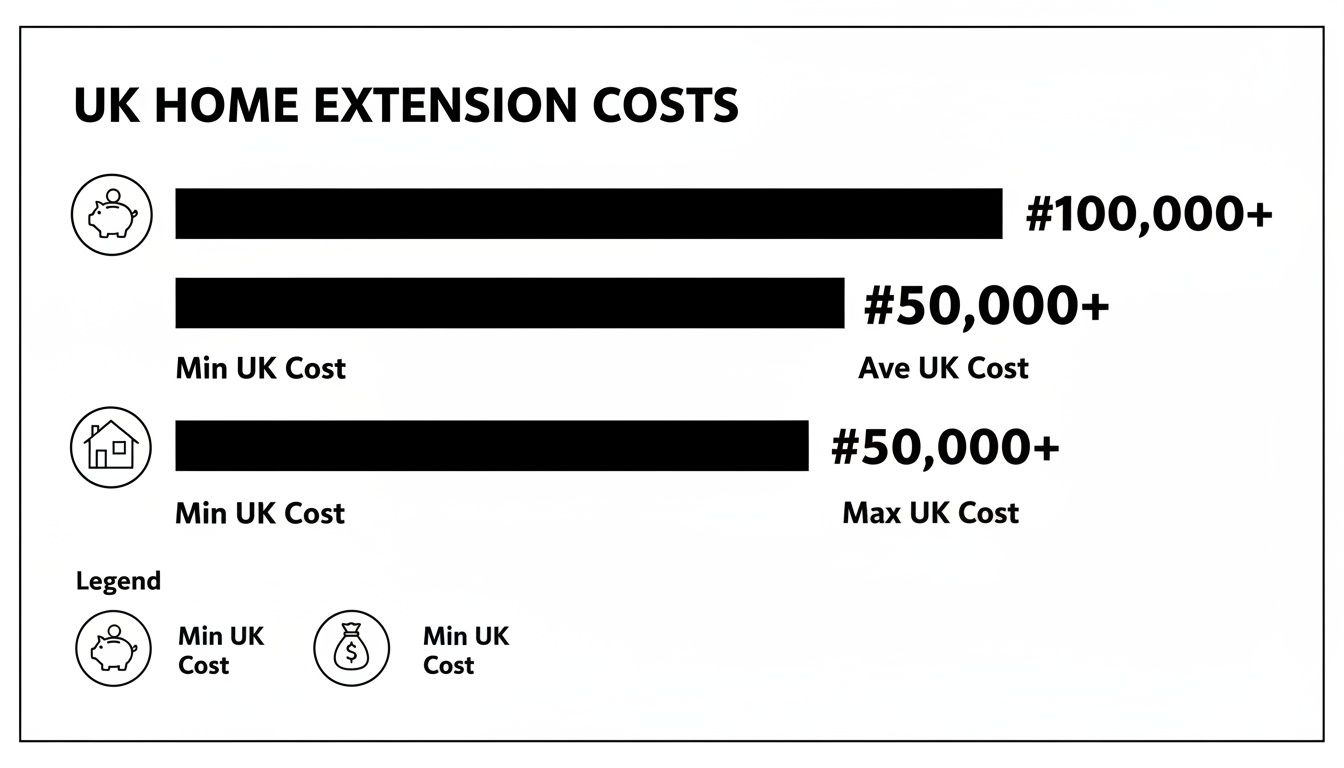
As you can see, while there's a clear average, the final price tag can vary massively depending on what your specific project involves. To help you get a preliminary idea of your project's potential costs, you can also explore our guide on using a UK home extension cost calculator.
Here’s a quick summary to keep in mind.
Estimated Extension Build Costs At A Glance (Per m²)
This table breaks down the average build costs per square metre for different levels of specification, comparing the UK average with typical London prices. It’s a great way to quickly gauge potential expenses for your project.
Specification Level | Average UK Cost (per m²) | Average London Cost (per m²) |
|---|---|---|
Basic Quality | £2,200 - £2,500 | £2,600 - £2,900 |
Good Quality | £2,500 - £2,900 | £2,900 - £3,400 |
Excellent Quality | £2,900 - £3,300+ | £3,400 - £3,800+ |
Remember, these are ballpark figures for the build itself. Once you start factoring in glazing, kitchens, bathrooms, and professional fees, the numbers will climb. Understanding these initial figures helps you start shaping a project that truly fits both your ambitions and your financial reality.
Understanding Costs For Different Extension Types
Not all extensions are created equal, and their price tags reflect that. To get a real grip on how much your home extension will cost, you first need to figure out which type best suits your property and ambitions. Each serves a different purpose, from modestly increasing your footprint to completely reinventing your ground floor.
Exploring these common options reveals how size, complexity, and structural work all play a part in shaping the final budget. It's not as simple as bigger equals more expensive; clever architectural design can often maximise value while trimming unnecessary costs. Let's break down the most popular types.
Single-Storey Rear Extensions
This is often the most straightforward and popular type of extension. It involves pushing the back of your home out into the garden to create a larger kitchen, a new dining area, or a spacious family room. Because they are typically less complex structurally, they often represent the most cost-effective way to add square footage.
However, "simple" doesn't mean basic. The finish, glazing choices (like those beautiful large sliding or bifold doors), and the internal fit-out will all have a huge say in the final figure.
Typical Cost Range: For a good quality finish in London, you should expect to budget between £75,000 and £120,000+ for a standard-sized rear extension.
Side-Return Extensions
Many Victorian and Edwardian terraced houses have that narrow, often wasted alleyway running alongside the back of the property. A side-return extension simply fills in this space, squaring off the rear of the house.
While the added floor area might seem modest on paper, the impact is enormous. It can transform a small, dark kitchen into a wide, light-filled open-plan space without eating into your garden. The catch is that the structural work is more involved, as it means altering the original rear wall of the house.
Key Benefit: Dramatically improves the layout and floods the existing ground floor with natural light.
Cost Factor: Involves significant structural changes and often complex roofing work to connect the new and old structures seamlessly.
Wrap-Around Extensions
Just as the name suggests, a wrap-around extension combines a side-return with a rear extension, creating a much larger L-shaped addition. This is the ultimate ground-floor transformation, offering enough space for a multi-functional kitchen, dining, and living area that opens directly onto the garden.
This is a major project. It involves extensive structural work on two external walls of your home, and both the foundations and the roofing are far more complex. The larger scale naturally increases costs across the board for materials, labour, and finishes. If you're planning a significant kitchen project within this new space, our guide to designing a kitchen extension offers some really valuable insights.
Typical Cost Range: Given their scale and complexity, wrap-around extensions typically start from £120,000 and can easily push past £200,000, depending on the size and level of specification.
Double-Storey Extensions
If you need to add both ground-floor living space and extra bedrooms or bathrooms upstairs, a double-storey extension is the most logical route. It allows you to maximise the potential of the new footprint you're creating.
Interestingly, while the total cost is higher than a single-storey project, the cost per square metre is often lower. Why? Because you're building on foundations that are already being laid and sharing one roof across two levels, which creates a real economy of scale.
Cost Efficiency: You gain twice the internal space for significantly less than double the cost of a single-storey version.
Considerations: These projects are more disruptive and will almost certainly require full planning permission due to their scale and potential impact on neighbouring properties.
Choosing the right type of extension is always a balance between your home’s potential, your family’s needs, and your financial reality. Each option presents a unique opportunity, and understanding their relative costs is the first step towards making a confident, informed decision for your home.
Budgeting For Essential Professional Fees
When you start adding up the numbers for a home extension, it’s easy to focus on the build itself—the bricks, mortar, and glazing. But that’s only part of the equation. A successful, legally sound, and beautifully finished project relies on a team of skilled professionals. It’s best to see their fees not as an extra expense, but as a critical investment in the quality, safety, and long-term value of your home.
Think of these experts as the navigators for your project. They are the ones who translate your vision into workable plans, ensure the structure is safe, and handle the complex web of regulations that govern any build. Trying to go it alone can lead to costly delays, structural nightmares, or even legal challenges down the line.
The Key Professionals You Will Need
To budget accurately, you need to know who you’ll be working with and what they bring to the table. For almost every extension, you'll need three key experts: an architect, a structural engineer, and a party wall surveyor.
Architects: Your architect is the creative and strategic lead. They do far more than just draw up plans; they design a space that genuinely works for your lifestyle, maximises light and flow, and navigates the maze of planning permission. This is especially crucial in conservation areas or for listed buildings. Their expertise can actually save you money by designing for efficiency and avoiding expensive planning rejections. For a deeper dive, our guide on decoding extension architect costs offers more detail.
Structural Engineers: Once the design is settled, a structural engineer performs the vital calculations to make sure it’s all safe and stable. They’ll specify the size of steel beams (RSJs), the depth of the foundations, and any other structural elements needed to hold everything up. Their input is non-negotiable and forms a core part of the technical drawings needed for Building Regulations approval.
Party Wall Surveyors: If your extension is being built on or right up to the boundary with a neighbour, or if you’re excavating near their property, you will legally need a Party Wall Agreement. A surveyor acts as an impartial expert, ensuring your neighbour's property is protected and the work is carried out correctly, which helps prevent stressful and costly disputes.
Typical Professional Fee Structures
So, what does this all mean for your budget? As a rule of thumb, professional fees typically account for 10-12% of the total project cost. For a bespoke extension in South West London, this is a significant and necessary part of your financial planning. On a typical £80,000 extension, you could expect professional fees to total around £8,700, covering everything from the initial design to structural calculations and planning submissions.
Here’s a general idea of what to expect for a project in the £80k-£100k range:
Professional | Typical Fee Structure | Estimated Cost |
|---|---|---|
Architect | 8-15% of the total build cost | £6,400 - £15,000 |
Structural Engineer | Fixed fee or hourly rate | £1,500 - £2,500 |
Party Wall Surveyor | Fixed fee per neighbour | £1,500 - £3,000 (per neighbour) |
It's crucial to remember this: investing in high-calibre professional advice at the start is one of the most effective ways to control costs over the entire life of the project. An experienced team can foresee problems, design out inefficiencies, and ensure a smooth process from concept to completion.
What Really Drives Your Final Project Cost?
Ever wondered why two extensions that look almost identical can end up with completely different price tags? The truth is, the final cost goes far beyond a simple calculation per square metre. Several crucial factors can push a budget up or down, and understanding them is the key to staying in control.
From your postcode to your choice of windows, every detail plays a part. Getting to grips with these cost influencers early on helps you make smart, informed decisions, ensuring you can achieve your vision without any nasty financial surprises along the way.
The London Premium: Location, Location, Location
It’s an unavoidable fact of life in the property world: where you build really matters. Construction costs aren't the same across the UK, and London always commands a premium. This is down to higher labour rates, the logistical headaches of working in a crowded city, and sheer demand. For anyone planning a project in South West London, this is the first thing to factor into your budget.
Recent figures show that London extension costs are roughly 9% higher than in other parts of the UK. While the national average project cost hovers around £86,443, a standard 30-square-metre extension in London will likely set you back somewhere between £83,258 and £103,834. That works out to a per-square-metre price of between £2,775 and £3,461 in the capital—a significant step up from the national average. You can dig deeper into these regional differences in this complete 2025 UK extension cost guide.
Quality of Finishes: The Specification Level
The level of finish you opt for is one of the biggest variables in your extension's final cost. This covers absolutely everything, from the external brickwork and roof tiles to the internal flooring, light fittings, and even the door handles.
Think of it like choosing the spec for a new car. A basic model gets you from A to B perfectly well. But if you start adding premium leather seats, a top-of-the-range sound system, and a panoramic sunroof, the price will naturally climb. It’s exactly the same with a home extension.
Standard Specification: This involves good-quality, reliable materials like standard uPVC windows, laminate flooring, and off-the-shelf doors. It’s functional, smart, and budget-friendly.
High-End Specification: Here, you’re looking at premium materials such as engineered hardwood flooring, sleek aluminium-framed glazing, underfloor heating, and bespoke joinery.
Luxury Specification: At the very top end, you might be considering imported stone worktops, custom-made cabinetry from specialist workshops, and sophisticated designer lighting schemes.
Your choice of specification is where your personal taste directly meets your budget. An architect is invaluable here, helping you achieve a high-end look through clever material choices and smart design—a process we call 'value engineering'.
Ground Conditions and Site Access
What’s happening underneath your garden can hold some expensive surprises. Unforeseen ground conditions—like heavy clay soil needing deeper foundations, a high water table, or a network of tree roots—can easily add thousands to your groundwork costs.
Just as important is how easily builders can get to the site. If you live in a mid-terrace house with no rear access, every single bag of cement, every plasterboard sheet, and every piece of equipment has to be carried through your home. This slow, labour-intensive process will inevitably be reflected in your builder's quote.
To help you get a clearer picture of what might affect your own project, we've put together a simple checklist.
Project Cost Influencer Checklist
Use this table to spot the factors that could have a real impact on your budget. Being aware of these from the outset allows for much more accurate financial planning.
Factor | Potential Cost Impact | Brief Explanation |
|---|---|---|
Location | High | Labour, material, and logistical costs vary significantly by region, with London being the most expensive. |
Ground Conditions | Medium to High | Poor soil (e.g., clay, peat), a high water table, or extensive tree roots will require more complex and costly foundations. |
Site Access | Medium | Restricted access (e.g., terraced houses) increases labour time and logistical complexity, driving up costs. |
Specification Level | High | The choice between standard, high-end, or luxury finishes is one of the biggest budget drivers. |
Glazing | Medium to High | Large-format sliding doors, bifold doors, and structural glass roofs are expensive items, especially high-performance units. |
Bespoke Features | High | Custom joinery, curved walls, or unique architectural details are significantly more costly than off-the-shelf solutions. |
Structural Complexity | High | Removing multiple structural walls or creating large, open-plan spaces requires more steelwork and engineering input. |
Heritage Constraints | Medium to High | Work on listed buildings or in conservation areas requires specialist materials and craftsmanship, increasing costs. |
Sustainable Tech | Medium | Integrating features like solar panels, heat pumps, or rainwater harvesting systems adds to the upfront cost but saves money long-term. |
Drainage & Utilities | Medium | Needing to move manholes, drains, or utility supplies (gas, water, electric) can be surprisingly expensive and disruptive. |
Thinking through these points with your architect will help build a budget that’s robust and realistic, minimising the chance of unexpected costs later on.
The Impact of Glazing and Bespoke Features
Huge expanses of glass, like bifold doors, sliding systems, and glass roofs, are incredibly popular for good reason—they flood spaces with natural light. However, high-performance glazing is a major budget item. The bigger the opening and the better the thermal efficiency (U-value), the more it will cost.
In the same vein, anything bespoke will always be more expensive than a standard, off-the-shelf product. This applies to features like:
Custom-built joinery, such as fitted window seats, bookcases, or media units.
Unique architectural details, like curved walls or a complex roof structure.
High-end kitchen and bathroom fit-outs involving premium appliances and custom cabinetry.
Successfully navigating these factors is all about striking the right balance. By understanding what drives costs, you can have clear, productive conversations with your architect and builder, ensuring your finished extension is everything you hoped for, without the financial headache.
Smart Strategies For Managing Your Extension Budget
Knowing the numbers is one thing, but keeping your project on track financially is another challenge altogether. The key to managing your extension budget isn’t about cutting corners or sacrificing your vision. It’s about making smart, informed decisions from the very beginning, ensuring every pound is invested wisely to get the best possible home for your money.
It all comes down to robust planning and expert guidance. By thinking strategically about your brief, your choice of builder, and your material palette, you can navigate the construction process with confidence and sidestep those dreaded costly overruns.
Establish A Detailed Brief From Day One
The single most effective tool for budget control is a detailed, unambiguous brief developed with your architect. Think of this document as your project’s constitution; it outlines exactly what you want to achieve, from the overall layout right down to the position of the light switches. A vague brief is an open invitation for scope creep and unexpected costs to wander in.
Investing time upfront to separate your "must-haves" from your "nice-to-haves" creates a clear roadmap. This clarity allows contractors to provide precise, like-for-like quotes, reducing guesswork and the risk of prices escalating once work begins.
Secure Multiple Quotes and Vet Your Builder
Never, ever accept the first quote you receive. We always recommend getting at least three detailed tenders from reputable, properly vetted contractors. This isn't just about getting a fair price; it also gives you incredible insight into how different builders approach the exact same project.
But remember, the cheapest quote is rarely the best. You need to look for transparency, professionalism, and glowing references. A builder who provides a thorough cost breakdown shows they understand the project inside out and are far less likely to surprise you with hidden extras later on.
The Non-Negotiable Contingency Fund
No matter how meticulous your planning is, home extensions have a knack for unearthing surprises. It could be an unforeseen structural issue hiding in a wall, tricky ground conditions, or supply chain delays. This is precisely why a contingency fund is absolutely essential.
We strongly advise all our clients to set aside 10-15% of the total construction cost as a contingency. This isn't a slush fund for shiny upgrades; it’s a crucial safety net to cover genuine unforeseen expenses. It ensures the project can continue smoothly without financial strain or painful compromises on quality.
Embrace Value Engineering
This is where a good architect really earns their stripes. Value engineering is a systematic process of refining the design and material choices to achieve the best possible value without watering down the core vision. It’s not about choosing cheaper alternatives; it's about making smarter ones.
For instance, this might involve:
Reconfiguring a layout to reduce the need for expensive structural steelwork.
Selecting alternative materials that deliver a similar high-end look for a fraction of the cost.
Simplifying complex construction details to cut down on labour time on site.
By working together, we can protect your budget while ensuring the final design is still exceptional. Another great strategy is to phase the project – perhaps completing the main structure first and tackling the interior fit-out later. It can be a really pragmatic way to manage cash flow for larger transformations.
Begin Your Home Extension Journey With Confidence
Understanding how much a home extension really costs is the first, most critical step in turning your ideas into a beautifully crafted reality. It’s about more than just numbers on a page; it’s about making smart decisions that protect your investment and, ultimately, improve your day-to-day life.
From getting to grips with the build cost per square metre to budgeting for professional fees and factoring in those high-end finishes, you now have the insight you need to plan your project with clarity. A well-planned extension isn't just an expense—it's a powerful investment in your property's future and, more importantly, in your family's quality of life. The real key is balancing creative ambition with a realistic, well-thought-out financial strategy.
Take The Next Step With Expert Guidance
Thinking through every single detail—from the practicalities of the structure right down to the bespoke joinery—is what separates an adequate extension from an exceptional one. This kind of foresight is what prevents costly surprises down the line and ensures a smooth journey from the first sketch to the final build.
A successful home extension is the result of a creative vision underpinned by meticulous financial planning. It’s a collaboration between your aspirations and architectural expertise, ensuring every pound spent adds tangible value and lasting enjoyment to your home.
If you are planning a high-end extension in South West London or Surrey and value bespoke design paired with flawless project delivery, the next logical step is a conversation with an expert. A professional consultation can transform your initial thoughts into a clear, actionable plan, setting the stage for a beautifully realised space that perfectly suits your lifestyle.
Ready to explore the potential of your home? Contact Harper Latter Architects today to arrange your initial consultation and begin your journey with confidence.
Answering Your Key Questions About Home Extension Costs
Even the most detailed plan can leave you with a few lingering questions about the budget. It’s completely normal. Below, we’ve answered some of the most common queries we hear from homeowners to help you plan your extension with a bit more clarity and confidence.
How Much Does An Architect Cost For An Extension?
For a full architectural service, you can generally expect fees to be around 8-15% of the total construction cost. It’s tempting to see this as just another expense, but it’s more accurate to think of it as an investment in the final outcome of your project.
This fee isn’t just for a set of drawings. It covers the entire creative and technical journey: designing a space that truly maximises light and flow, navigating the often-tricky planning permission process, and producing the highly detailed drawings builders need to get things right. Crucially, it also includes project oversight during the build, which helps catch costly errors before they happen and ensures the quality of the finish is up to scratch.
In our experience, an architect’s input is one of the single most effective ways to add value to your home. They often spot opportunities for savings and clever design solutions that can far outweigh their fee.
Does A Kitchen Or Bathroom Add More To The Cost?
Without a doubt. Any part of an extension that needs specialist plumbing, intricate electrical work, and high-end fittings—like kitchens and bathrooms—will push up the cost per square metre. In the trade, these are often called 'wet' areas for obvious reasons.
Compared to a straightforward living room or bedroom, you should budget for the build cost in these rooms to be 20-50% higher. The final number really comes down to your personal taste and specification, from the brand of appliances and sanitaryware you choose to whether you opt for bespoke cabinetry and artisan tiles.
Do I Really Need A Contingency Fund?
Yes. We consider this non-negotiable for any successful project and advise every single client to put aside a contingency fund of 10-15% of the total build cost.
It's really important to be clear on what this fund is for. It isn’t a slush fund for adding nice-to-have extras or upgrading your kitchen worktops halfway through. Think of it as a vital safety net for the genuine unknowns that can, and often do, pop up during construction.
These unforeseen issues could be anything from:
Unexpected problems underground, like poor soil quality that means your foundations need to be redesigned.
Structural surprises lurking in the original house that only come to light once walls are opened up.
Sudden spikes in material prices or supply chain issues that can knock the schedule off course.
Having this fund ready means your project can absorb these bumps in the road without forcing you to cut corners on the design or compromise on quality. It gives you peace of mind and the financial resilience to deal with challenges properly, rather than letting them derail the whole build. Honestly, proceeding without one leaves your project far too vulnerable.
Planning a bespoke extension requires expert guidance to navigate the costs and deliver an exceptional result. At Harper Latter Architects, we specialise in creating high-end, beautifully crafted homes across South West London and Surrey. Get in touch with our team to discuss your project.