
Carlo Scarpa Architecture: Master of Detail & Design
A stair nosing can tell you whether an architect understands time. In a well-made house, the edge isn't just trimmed neatly. It anticipates wear, catches light and makes the transition from one material to another feel intentional.
Introducing Carlo Scarpa A Master of Detail
Run your hand along a bronze pull, then across a timber frame that stops just short of a stone reveal. That slight pause, that shadow line, that deliberate separation, is where Carlo Scarpa architecture begins. He treated details not as decoration applied at the end, but as the place where architecture becomes legible.
Why Scarpa still matters
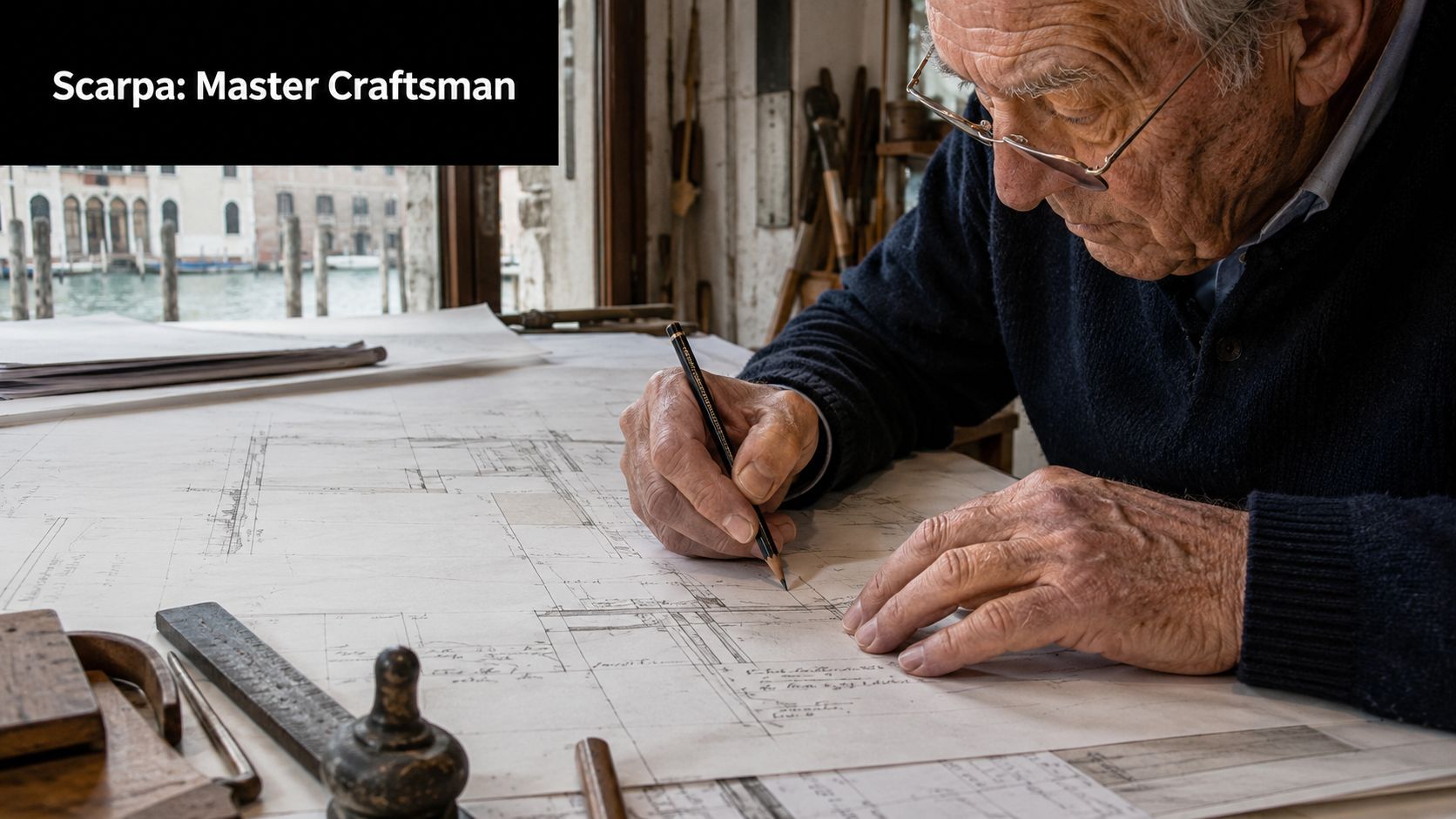
Carlo Scarpa (1906 to 1978) was an Italian architect whose career ran from his first independent commission in 1926 until his death in 1978, during which he completed over 50 projects in Italy and abroad, later receiving posthumous recognition from British institutions including the RIBA Gold Medal, as noted in this Scarpa biography on Italy Segreta.
That output is modest by commercial standards. It is not modest in influence. Scarpa's authority comes from selectivity, discipline and an unusually exact understanding of how buildings age.
He is often described as a Venetian architect, and that matters. Venice teaches you quickly that buildings are never finished objects. They settle, weather, stain, absorb moisture and carry traces of previous interventions. Scarpa didn't fight that reality. He designed with it.
Not a style to copy
Homeowners often approach Scarpa through photographs. They notice the concrete, the brass, the precisely cut stone, the layered thresholds. The risk is obvious. If you borrow only the visual language, you end up with imitation.
The more useful lesson is methodological:
Read the existing building first: Scarpa started with what was already there, including irregularities, scars and constraints.
Design the meeting points carefully: He put enormous effort into edges, junctions and transitions.
Let new work look new: He didn't disguise modern insertions as old fabric.
Practical rule: If a detail only works when everything is pristine, it isn't a Scarpa detail. His best work remains convincing once touched, repaired and lived with.
A craftsman as much as an architect
Scarpa's reputation rests partly on drawing, but more on making. He thought like a craftsman. That is why architects, joiners, metalworkers and conservators still study him with unusual seriousness.
For a South West London audience, that's the key point of entry. His work offers a way to think about listed terraces, Edwardian villas, mews houses and carefully detailed new homes without collapsing into either pastiche or sterile minimalism. Scarpa architecture isn't about looking Italian. It's about making every intervention earn its place.
The Soul of the Detail Scarpa's Design Principles
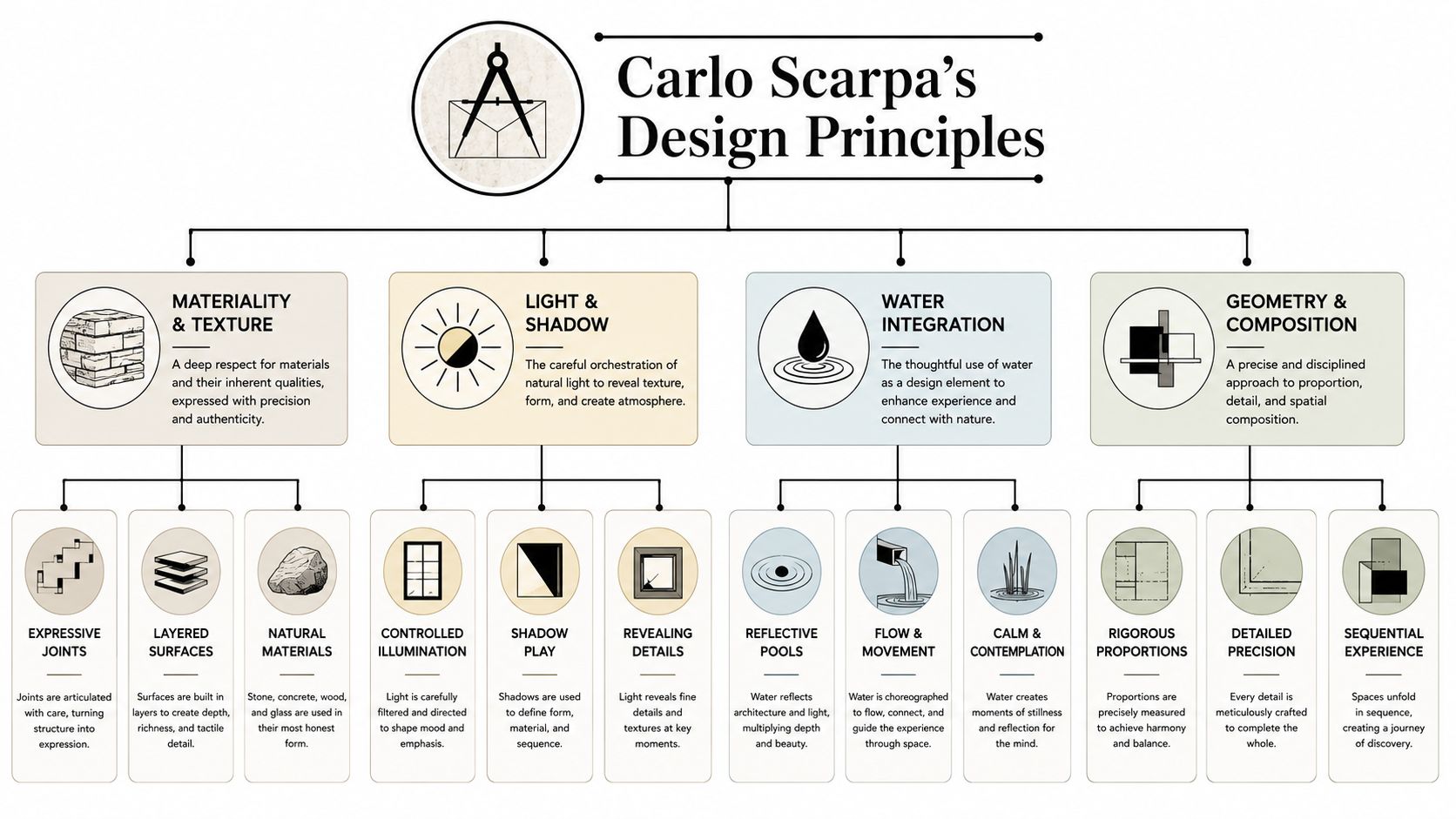
Scarpa's principles aren't difficult to understand once you stop treating them as theory. They are practical. He looked hard at what materials do, how light behaves and where two things meet. Then he made those moments visible.
The joint is never incidental
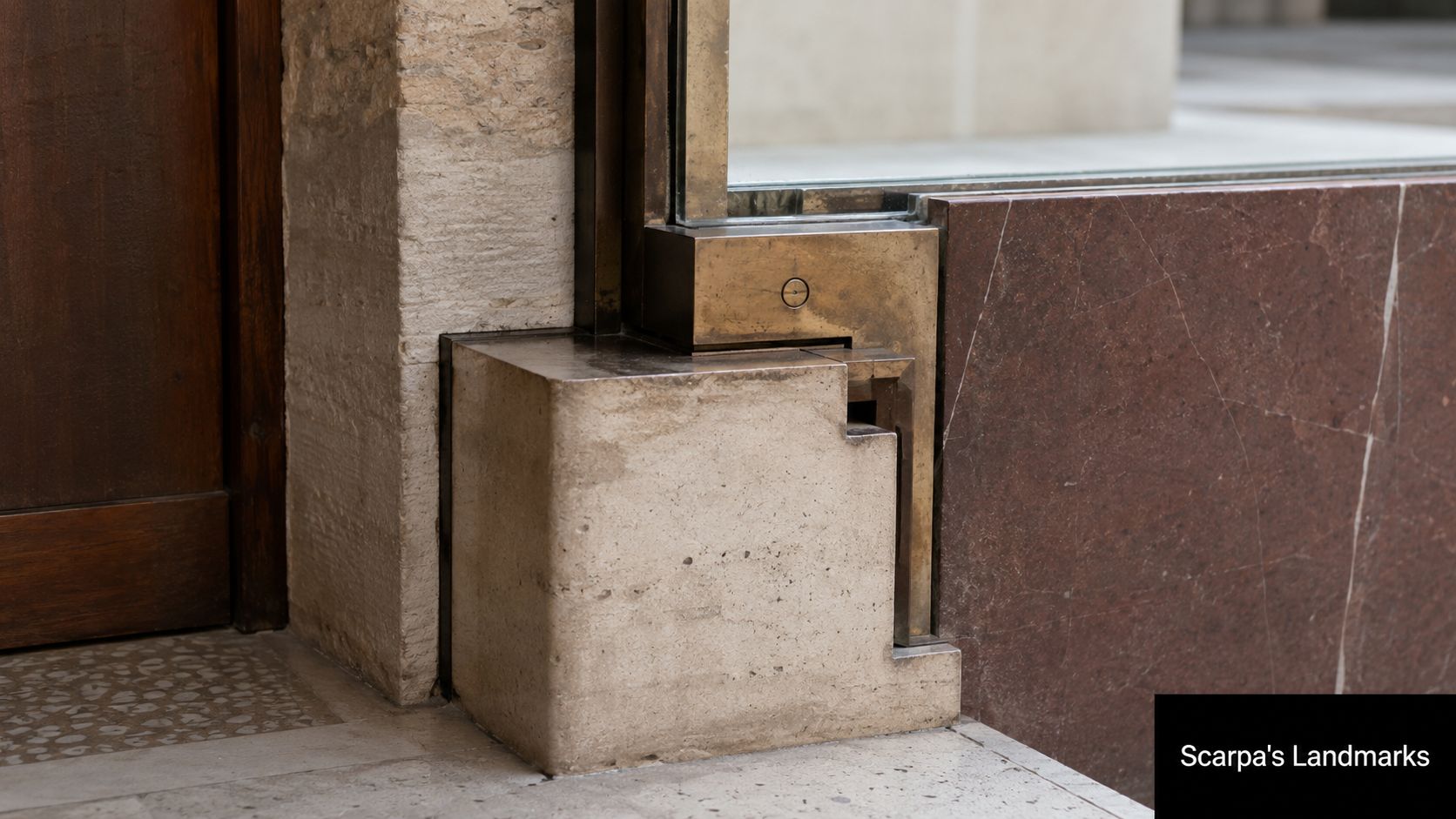
Scarpa preferred small interventions and restoration-led design over wholesale reconstruction, using joints and material transitions to reveal a building's history and reject pastiche in favour of showing the “different layers of construction”, as described in this design history reference.
That idea sounds abstract until you apply it to a house. Think of the joint between a new oak stair and an existing masonry wall. Most projects try to hide the discrepancy. They caulk it, plaster over it or force a false flushness. Scarpa would do the opposite. He would articulate the meeting so the old wall remains old, the stair remains new, and the gap becomes controlled rather than embarrassing.
In conservation work, that approach is more than elegant. It is honest.
Materials should behave like themselves
Stone should feel weighty. Timber should show grain and movement. Metal should weather with dignity. Scarpa's work is compelling because he didn't ask one material to impersonate another.
For residential design, that usually leads to a stricter palette. Fewer finishes. Better chosen ones. More attention to how each surface ends.
A useful way to think about it is this:
Principle | What works | What usually fails |
|---|---|---|
Material contrast | Stone against timber with a clear reveal | Trying to blend unlike materials into one seamless plane |
Expressed junctions | Shadow gaps, metal trims, stepped thresholds | Sealant-led detailing used as a design solution |
Visible ageing | Patinating brass, oiled timber, natural stone | Fragile coatings that chip and date quickly |
Light is part of the construction
Scarpa used light with the same care he gave to joinery. He didn't just brighten rooms. He shaped routes, pauses and moments of attention.
That matters in London houses, where side returns, basements and rear extensions often depend on borrowed light. A Scarpa-informed approach does not mean adding glazing everywhere. It means deciding where light should strike a wall, skim a stair, mark a threshold or draw you towards a garden.
Sometimes the best detail is a recess deep enough to cast a consistent shadow.
Water, reflection and movement
Water appears often in discussions of Scarpa because it gave him another medium through which to register change. Reflection, sound and surface movement all became spatial tools. In a London domestic setting, that idea translates less directly.
You don't need a canal or formal water court to use the principle. You do need to understand that architecture improves when it acknowledges movement, weather and maintenance rather than pretending they don't exist.
That is one reason Scarpa remains useful now. His principles form a repeatable system:
Preserve what carries meaning
Insert new work precisely
Use detail to explain the relationship
Accept that buildings change through use
Landmarks in Detail Three Seminal Case Studies
Scarpa's buildings repay slow looking. The lesson isn't only in the plan or the section. It is in how your body moves through them, how a hand meets a rail, how a bridge lands, how a floor turns to meet a wall.
Brion Cemetery and the architecture of pause
At Brion Cemetery, Scarpa handles concrete, water and the natural setting with extraordinary restraint. The project is often called poetic, which is true but not especially helpful. What matters in practice is how carefully it is assembled.
Paths do not merely connect one space to another. They slow you. Water isn't ornament. It creates distance, reflection and a measured sense of approach. Concrete is never treated as a blunt mass alone. It is cut, profiled and set against finer components so that heaviness gains precision.
For residential architects, the transferable lesson is about sequencing. Large houses often fail because every room tries to perform at full volume. Scarpa understood the value of compression, release and stillness. A stair landing, a courtyard edge, a bench beneath a window. These are not leftover spaces. They are where calm is made.
Castelvecchio and the discipline of contrast
If you want a masterclass in working with old fabric, study Castelvecchio. Scarpa inserted modern elements into a medieval structure without apology and without vandalism. He allowed the historic building to remain visibly historic while making the new work unmistakably of its own time.
That remains one of the soundest principles in conservation and heritage architecture. Trying to make every intervention disappear usually produces one of two bad outcomes. Either the addition turns timid and false, or the original fabric is overworked so the join looks neat on day one and unconvincing thereafter.
At Castelvecchio, movement through the building sharpens your awareness of those decisions. A stair doesn't merely serve circulation. It announces a shift in chronology. A balustrade, plinth or bridge becomes an instrument for distinguishing old from new.
The strongest heritage interventions don't mimic. They clarify.
Many London refurbishments go wrong in this specific aspect. Designers become so anxious about visual continuity that they flatten the whole building into one generic finish language. Scarpa's answer is firmer. Respect the old by reading it accurately, then add to it with equal seriousness.
Querini Stampalia and design under pressure
The Querini Stampalia Foundation may be the most immediately relevant Scarpa project for British residential work because it turns constraint into design. Water ingress, threshold management and the relationship between interior levels and external conditions are not hidden technical problems. They become part of the architectural order.
That is especially instructive below ground or at garden level in London, where drainage, moisture and level changes dictate far more than most aesthetic mood boards admit. Scarpa's solution was not to deny those pressures. It was to choreograph them.
A short film helps show how that sensibility works in built form:
Three practical lessons emerge from Querini Stampalia:
Design thresholds as systems: Don't treat the doorway, sill and floor finish as separate packages.
Give water a route: Buildings perform better when drainage is spatially understood, not buried as an afterthought.
Use level changes deliberately: A slight step, channel or change in material can solve technical problems while enriching experience.
These projects differ in programme and atmosphere, yet they share one discipline. Scarpa turns tolerance, weathering and transition into architecture. That is why his buildings still feel useful rather than merely admired.
Scarpa's Enduring Influence on Contemporary Design
Scarpa's influence survives because the problems he tackled haven't gone away. Existing buildings still require adaptation. Junctions still fail when they are lazily resolved. Expensive houses still disappoint when the surfaces are handsome but the interfaces are weak.
Why contemporary architects keep returning to him
Scarpa's technical approach is marked by material layering and craft-led interfaces, including hand-finished metalwork, complex joints and custom door pulls that turn small tolerances into visible design features. As noted in Architectuul's overview of his work, that makes his architecture a useful benchmark for well-engineered junction detailing in projects such as London basement extensions.
That point matters more than any stylistic influence. In today's high-end residential work, the pressure points are often highly specific:
Basement connections: Existing structure meets new retaining work, waterproofing, stairs and finishes.
Refurbishment interfaces: Original cornices, skirtings, floors and window linings meet upgraded thermal and acoustic assemblies.
Bespoke interiors: Joinery only feels luxurious when doors, handrails, ironmongery and shadow gaps are controlled consistently.
Scarpa offers a way to think through those moments.
What carries forward and what doesn't
Not everything in Scarpa can be transplanted directly. Some details depend on craftspeople, procurement routes and tolerances that aren't always available on contemporary residential programmes. But the underlying discipline carries forward well.
A sensible contemporary reading of Carlo Scarpa architecture usually includes:
Clear distinction between original and inserted fabric
Durable, tactile materials that improve with use
Junctions designed early, not improvised on site
A refusal to hide every movement joint or tolerance
What doesn't work is the superficial version. Bronze added for prestige. Stone applied thinly as cladding effect. Over-complicated joinery with no maintenance logic. Scarpa's details succeed because they are structurally and materially coherent, not because they look rarefied in photographs.
Influence beyond museums
His legacy now sits comfortably within both conservation practice and bespoke residential design. Architects continue to borrow his seriousness about thresholds, hand contact and layered construction because those ideas answer practical questions. How should a new stair meet a party wall? How do you add contemporary glazing to an older house without making the whole elevation feel evasive? How do you let materials age without the project looking unfinished?
Scarpa's relevance lies there. Not in nostalgia, but in precision.
Applying Scarpa's Lessons in South West London
A Scarpa-inspired house in South West London should not look like a Venetian museum. It should feel composed, sturdy and exacting in the places where London houses are most often compromised.
The local conditions are clear enough. Much of the housing stock is historic, and heritage review is often central to what can be altered. The practical challenge, especially with listed and pre-1945 buildings, is how to use layering, light and crafted detail without harming original fabric or frustrating planning expectations. That issue matters in a context where Historic England notes more than 500,000 listed buildings in England, as discussed in this video commentary on Scarpa and UK heritage constraints.
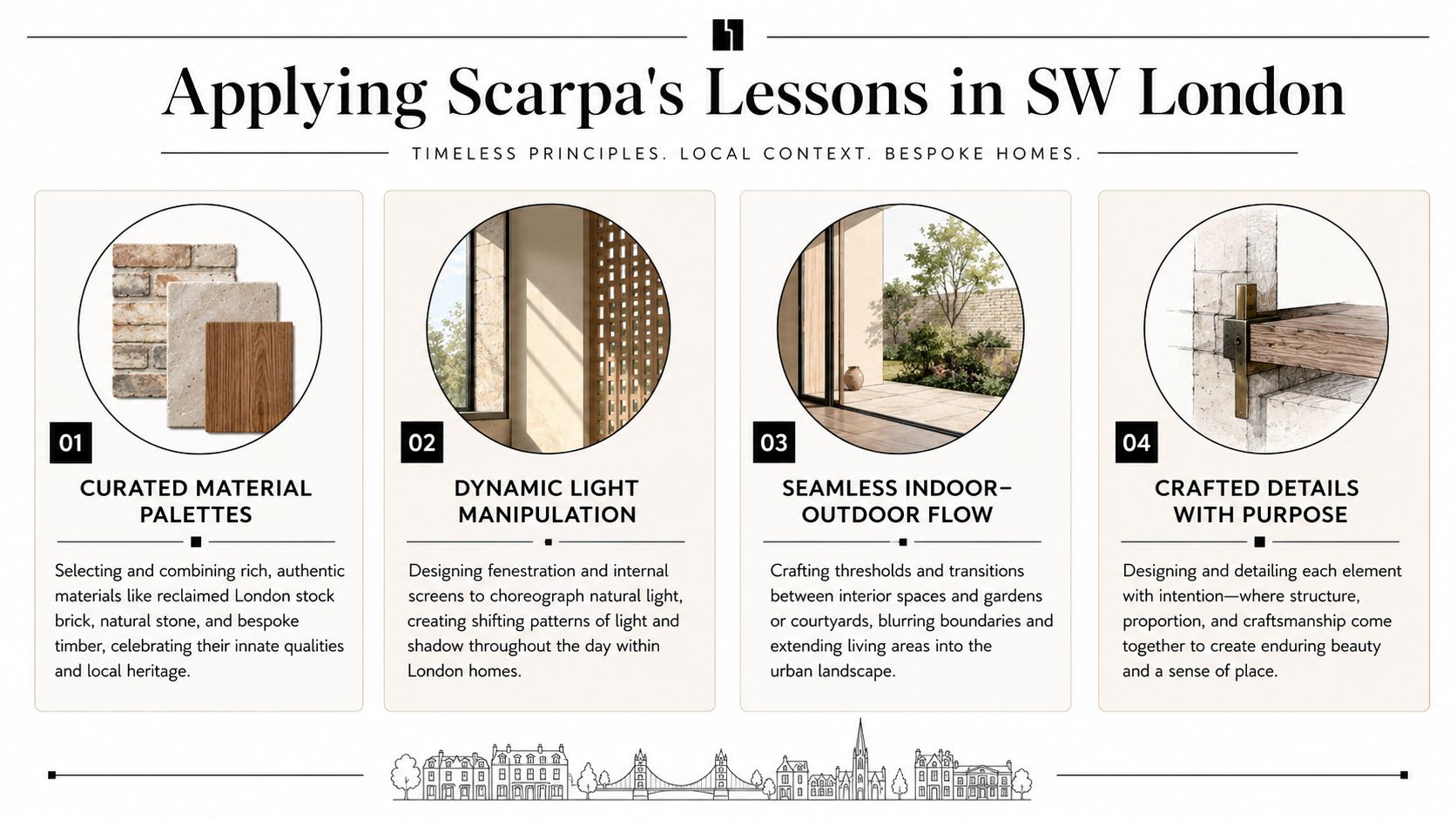
In a listed house, restraint beats imitation
The first mistake is to translate Scarpa into decorative motifs. That nearly always weakens a heritage project. The better route is to use his principles to decide what should remain untouched, what may be adapted, and how the new work should announce itself.
In practice, that often means:
Preserving legible fabric: Original stair cores, chimney breasts, panelling layouts and masonry irregularities usually carry more value than homeowners first assume.
Inserting contemporary work with a fine grain: New doors, lining panels, shelving or screens can sit within old rooms without pretending to be period reproductions.
Designing reveals and thresholds carefully: Window boards, skirtings, architraves and floor junctions do most of the visual work in heritage interiors.
A good test is simple. If the new intervention can only succeed by erasing evidence of the existing building, it is probably too blunt.
Basements and rear extensions need disciplined detailing
Scarpa's work is surprisingly relevant to subterranean and heavily serviced projects. Basements in particular require a level of technical honesty that many luxury interiors avoid. Waterproofing build-ups, structural transfers, ventilation requirements and level transitions all need somewhere to go.
Scarpa's lesson is not to display technology theatrically. It is to give every layer a readable order.
That can shape a London basement in several ways:
Problem | Scarpa-informed response |
|---|---|
Low natural light | Use deep reveals, stepped openings and carefully placed internal glazing to direct light rather than flatten it |
Complex material junctions | Separate materials with trims, recesses or expressed shadow lines instead of forcing flush joins |
Movement and maintenance | Choose components that can be accessed, repaired and re-finished without disfiguring the room |
Homeowners looking at interior architecture in London often focus first on finishes. The more durable value lies in the interfaces behind them.
A luxurious room is rarely defined by the marble alone. It is defined by how the marble stops, turns and meets the next thing.
Bespoke joinery is where the philosophy becomes tangible
This is the part clients feel most directly. Scarpa paid serious attention to the pieces people touch. Handrails, door pulls, shelf edges, cabinet frames and stair details all carry disproportionate emotional weight because they are encountered daily.
For South West London homes, that can translate into:
Staircases with composure: Not sculptural for its own sake, but carefully proportioned with clear landings, precise handrails and believable junctions to walls and floors.
Libraries and studies with depth: Layered shelving, recesses and integrated lighting that give mass and shadow rather than flat cabinetry.
Garden thresholds that feel deliberate: Stone cills, timber tracks and framed views that make the transition to terrace or lawn feel grounded.
What works is customisation with purpose. What fails is bespoke work that exists only to look expensive. Scarpa reminds us that the smallest piece of joinery should participate in the architectural whole.
Planning, craft and buildability
There is always a trade-off. Rich detailing takes time, coordination and disciplined site management. Some details that look effortless on paper become needlessly risky if they rely on unrealistic tolerances or obscure specialist procurement.
The practical approach is selective intensity. Don't detail everything to the same pitch. Choose the moments that matter most:
Primary thresholds
Main stair and landing sequence
Key hand-contact elements
Garden-facing openings
Rooms where old and new fabric meet most directly
That is how Scarpa's thinking becomes viable in real projects. Not by turning every corner into an exhibition piece, but by concentrating effort where the building's story is most visible.
Architecture as a Story of Lasting Craft
Scarpa's enduring lesson is straightforward. A building gains character when its materials, joints and alterations are handled with enough care to make time visible rather than embarrassing.
Popular coverage often leaves a practical question unresolved. Can this level of craft sit comfortably with current British expectations around performance, retrofit and cost discipline? It can, but only if Scarpa is understood as a method rather than an image. The challenge, in a climate shaped by retrofit priorities and the RIBA 2030 Climate Challenge, is to reinterpret his work as a sustainable design system for London homes, not as a museum-like aesthetic, as noted in this discussion of Scarpa's relevance to contemporary practice.
What that means in practice
The strongest contemporary reading of Carlo Scarpa architecture does three things at once:
It preserves valuable fabric rather than replacing it casually
It introduces new work clearly and with technical discipline
It invests in durable details that age well and can be maintained
That combination is exactly what many high-end residential projects need. It avoids disposable luxury. It avoids false historicism. It produces houses with depth.
Good conservation is not nostalgic, and good contemporary detailing is not cold. Scarpa showed that both can belong to the same building.
His relevance in South West London lies there. In the Victorian terrace that needs a calm new stair. In the listed villa that needs modern comfort without historical theatre. In the new build that wants gravity, not fashion. Even meticulously crafted elements such as bespoke joinery design become stronger when approached through that lens.
A house becomes memorable when it tells the truth about what was there before, what has been added and how those pieces now live together. Scarpa understood that better than almost anyone.
If you're planning a heritage refurbishment, a basement extension or a finely crafted new home in South West London, Harper Latter Architects can help translate those principles into a buildable, elegant scheme. Their work combines conservation judgement, bespoke detailing and contemporary residential design to create houses that are both enduring and personal.