
UK Building Control Requirements: Your 2026 Guide
You've probably reached the point where the exciting part of the project is becoming real. The layouts are taking shape, the joinery ideas are getting more specific, and the conversation has moved from inspiration images to actual drawings. Then someone mentions building control requirements, and the mood changes slightly.
That reaction is normal. Most clients don't find building control confusing because it is obscure. They find it confusing because it sits alongside several other approval routes that sound similar but do very different jobs. On a high-end house project in Wimbledon, Richmond or elsewhere in South West London, that usually means building control sits in the same conversation as planning permission, listed building consent and party wall matters. They overlap in practice, but they are not the same thing.
Building control is not there to frustrate good design. It is the technical system that helps make sure the house is safe, sound, efficient and capable of being signed off properly at the end. If you are investing heavily in a bespoke home, that should be reassuring. It protects the finished building, your programme, and your ability to sell or insure the property later.
Embarking on Your Project The Role of Building Control
A familiar scenario goes like this. A homeowner secures a promising sketch design for a rear extension, loft conversion or substantial internal remodelling. Planning feels manageable, especially if some of the work may fall under permitted development. Then the practical questions begin. How will the new steelwork be justified? What does the staircase need to do in a fire? How much insulation can be added without causing condensation problems? What evidence will the inspector want before completion?
That is where building control stops being an abstract term and becomes a central part of the project.
Why clients often underestimate it
Many residential clients assume the difficult part is getting permission to build. In reality, the technical route can become the more demanding one. The Planning Portal's guidance on whether you need approval makes the point plainly: many “minor” residential projects are not minor in compliance terms, because building control governs materials, structure, insulation, access and the final completion certificate.
That matters a great deal on refined residential work. A simple-looking kitchen extension may involve drainage alterations, structural openings, thermal upgrades, ventilation changes and electrical work, all of which need to be coordinated properly. A basement or major refurbishment multiplies those moving parts.
Practical rule: if work changes how the house stands up, resists fire, keeps out moisture, conserves energy, ventilates rooms or handles services, building control is likely to matter.
It's one piece of a larger approval puzzle
One of the biggest mistakes I see is treating each approval path in isolation. Clients are often told to “deal with planning first” and think the rest can follow later. That approach works badly on complex homes.
Planning asks whether the proposal is acceptable in principle. Building control asks whether it is technically compliant. Listed building consent protects heritage significance. Party wall procedure manages neighbour-facing rights and process. Good project leadership joins those threads early, rather than resolving them one by one after design decisions are already fixed.
If you're still at the stage of appointing the right team, this guide on finding an architect for a residential project is worth reading before you commit.
The Legal Foundation Building Regulations Explained
Building Regulations are the statutory technical rules that govern how construction work must be designed and carried out. They are concerned with performance. In practice, that means safety, health, welfare, accessibility, energy efficiency and the proper functioning of the building.
Planning permission and Building Regulations are often discussed together, but they answer different questions.
Planning decides what you may build
Planning is about land use, scale, appearance, impact on neighbours and local policy. It gives you the right to build, assuming consent is granted.
Building Regulations deal with building it right. They look at whether the structure is adequate, whether escape in a fire is acceptable, whether moisture is controlled, whether insulation and services meet current standards, and whether the work can be signed off lawfully.
A project may need both. It may need one but not the other. It may also need listed building consent or separate legal procedures as well.
The system has a long public-safety history
This isn't arbitrary bureaucracy that appeared recently. The UK system has deep roots. The history of building regulations and control in England and Wales traces modern building control back to the period after the Great Fire of London, when the first Building Act was passed. It identifies the 1875 Public Health Act as the significant step that systemised local powers over fire protection, structural stability, drainage and ventilation.
That history matters because it explains the logic of the current system. The rules evolved to prevent failure, improve living conditions and reduce risk. Today's detail may be more technical, but the basic purpose hasn't changed.
Building control is best understood as a public-safety framework applied through design, documentation and inspection.
Why this matters on domestic projects
For homeowners, the legal foundation becomes practical very quickly. Once you alter a loadbearing wall, excavate for a basement, replace thermal elements, move drainage, add habitable accommodation or rework stairs, you are no longer just making aesthetic choices. You are changing how the building performs.
That is why a well-run project resolves compliance issues in parallel with design development. Waiting until the end rarely saves time. More often, it forces late redesign.
A useful way to think about it is this:
Planning permission asks whether the proposal is acceptable in its setting.
Building Regulations ask whether the proposal is technically safe and compliant.
Listed building consent asks whether historic significance is being preserved.
Party wall procedure asks whether adjoining owners are protected through the correct process.
Clients don't need to become specialists in each system. They do need to understand that all four can influence the same drawing.
What a Building Control Body Actually Checks
A building control body does far more than turn up at the end and glance around the finished house. The process starts with the design information itself. Plans, sections, specifications, structural calculations and technical details are examined against the Approved Documents, which are the benchmark route used to show compliance with the Building Regulations. The Designing Buildings overview of Building Regulations notes that this is how building control bodies assess whether plans and site work satisfy the functional requirements.
The checks in plain English
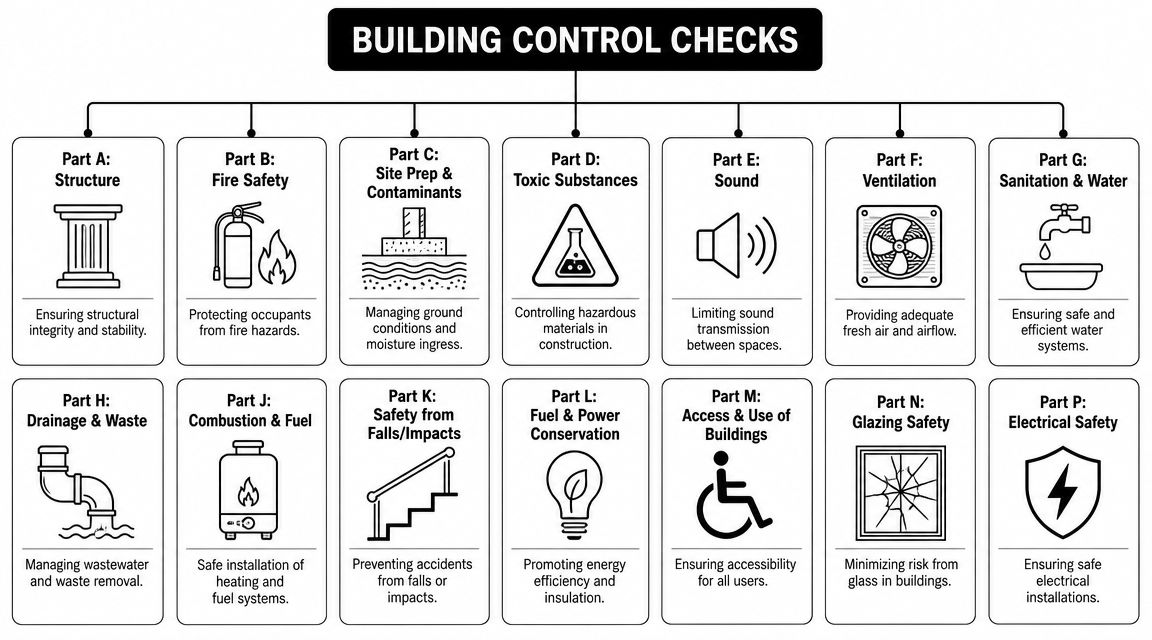
On residential work, the most common areas of scrutiny include:
Structure. Foundations, beams, lintels, roof alterations, retaining walls and any work that affects how loads are transferred.
Fire safety. Escape routes, doors, separation, alarms and how new layouts affect means of escape.
Moisture and site conditions. Damp-proofing, waterproofing, below-ground construction and resistance to water ingress.
Ventilation. Extract rates, background ventilation and how airtight construction is balanced with healthy air movement.
Drainage and waste. New foul and surface water runs, inspection chambers and below-ground coordination.
Energy performance. Fabric upgrades, insulation continuity, thermal bridging and how the extension or refurbishment meets Part L.
Electrical safety. Not just the wiring itself, but the proper certification route for the installation.
For luxury refurbishments, one project often triggers several Parts at once. The same Designing Buildings guidance on compliance through Approved Documents is useful reading in practice because it reflects how technical evidence needs to be assembled early, not after the contractor has already built the work.
Why the inspection process starts before site
The projects that go smoothly are the ones where compliance is designed in from the beginning. If the structural engineer, architect and specialist suppliers are aligned early, site inspections tend to confirm what was already properly considered on paper.
The projects that struggle are the ones where key decisions are deferred. Common examples include staircase geometry left unresolved, insulation build-ups that no longer fit the window details, or basement waterproofing specified too vaguely for anyone to sign off with confidence.
Here is a useful visual summary of the subject before looking at the process in more depth.
On site reality: inspectors don't approve intentions. They assess evidence, workmanship and whether the built work matches the submitted information.
Typical moments where checks happen
Although every project differs, building control inspections commonly occur around these points:
Excavations and foundations before concrete is poured.
Below-ground drainage before trenches are backfilled.
Structural works when steel, floor or roof alterations are accessible.
First fix and concealed elements before finishes hide the critical work.
Completion once the building can be assessed as a whole.
That's why “we'll sort it later” is such an expensive phrase on residential projects.
Choosing Your Path Full Plans vs Building Notice
Homeowners are often offered two routes for domestic building control applications. On paper, they can sound like a choice between thorough and simple. In practice, the better choice depends on complexity and risk.
For straightforward work, a Building Notice can appear attractive because it reduces upfront paperwork. For anything ambitious, a Full Plans application usually gives much better control over outcome.
The practical difference
A Full Plans application involves submitting detailed drawings and supporting information before work starts. The building control body reviews the design and issues comments or approval.
A Building Notice is lighter at the beginning. You notify the authority that work will start, and compliance is checked progressively on site. That can suit very small, uncomplicated domestic work, but it leaves more unresolved until the build is under way.
Comparison of Building Control Submission Routes
Aspect | Full Plans Application | Building Notice | Harper Latter's Recommendation |
|---|---|---|---|
Level of detail at the start | Detailed drawings, specifications and technical information submitted before work begins | Limited upfront detail | Use Full Plans where the design includes structural change, reconfiguration or specialist elements |
Certainty before site starts | Higher certainty because key compliance issues are reviewed in advance | Lower certainty because issues may emerge during construction | Full Plans is usually the safer route for extensions, basements and major refurbishments |
Speed to initial submission | Slower to prepare because the design must be coordinated | Faster to lodge | Early speed often creates later delay if unresolved issues appear on site |
Risk of redesign | Lower, because technical conflicts are more likely to be identified earlier | Higher, especially where several trades or consultants are involved | Full Plans is generally better value on complex homes because it reduces abortive work |
Suitability for high-end homes | Strong, especially where bespoke joinery, heritage fabric, specialist glazing or advanced services are involved | Weaker, because luxury projects rarely stay simple once opened up | Choose Full Plans for quality control as much as for compliance |
Inspector feedback | More structured plan review before works proceed | More reactive site-based feedback | Clients usually benefit from early written clarity |
What works and what does not
A Building Notice can work for limited, predictable work where the construction is conventional and the risk of hidden complications is low. It works badly where the house is old, listed, heavily altered already, or likely to reveal surprises once strip-out begins.
For most high-value residential projects, I advise clients to treat the technical package as part of protecting the investment. A basement extension, deep retrofit, major internal reordering or heritage alteration has too many linked decisions to leave unresolved.
That is especially true when planning, listed building issues and neighbour matters are running alongside. If one approval route is vague, the uncertainty tends to spill into the others.
Navigating Complex Projects Basements Listed Buildings and Eco-Homes
The further a project moves away from standard housebuilding, the less useful generic advice becomes. Basements, listed properties and highly sustainable homes each bring their own building control requirements. On many London projects, they overlap.
Basements demand coordination, not just calculation
A basement extension may look like a structural exercise, but the technical picture is wider than that. Yes, the temporary works and permanent structure are critical. So are waterproofing strategy, drainage resilience, escape routes, ventilation and the consequences of introducing habitable accommodation below ground.
What tends to go wrong is fragmentation. The engineer may solve the structure. A waterproofing specialist may specify membranes and channels. The contractor may propose site changes later. Unless those decisions are tied together in one coordinated set of information, approval and inspection become harder than they need to be.
If your scheme involves excavation under or beside an existing house, this article on building a basement beneath an existing property is a helpful starting point.
Basement projects fail compliance most often at the junctions. Wall to slab, threshold to lightwell, stair enclosure to escape route, and structure to waterproofing.
Listed buildings require technical compromise done well
Heritage projects can be the most rewarding, and also the most delicate. Modern regulations still apply, but they cannot be applied directly without regard to historic fabric. A listed townhouse in Wimbledon Village or Richmond may need improved thermal performance, safer stairs, upgraded fire protection and better services, yet the very elements that need work may also be protected.
The right answer is rarely the maximum intervention in every location. It is usually a carefully justified balance. Sometimes that means improving performance where change is least harmful, while preserving original fabric elsewhere. Sometimes it means bespoke details rather than standard products.
Clients benefit from an architect who can hold the conservation conversation and the technical one at the same time. If those discussions happen separately, the project often gets pulled in two directions.
Eco-homes need proof, not aspiration
Sustainable residential design is no longer just about saying the house will be energy efficient. The compliance burden is increasingly evidence-led. The BESA summary of building control changes under the Building Safety Act 2022 explains that registered building inspectors focus on compliance assessment rather than design advice, and that designers must provide a clear documentary trail showing how proposals meet the functional requirements.
For luxury homes, that means items such as fire compartmentation details, U-values and ventilation coordination are not optional paperwork. They are the proof set.
A more demanding documentation culture
The practical effect on higher-end projects is significant:
Bespoke detailing must still be auditable. Elegant hidden doors, slim glazing, feature stairs and integrated services all need compliant technical justification.
Revision control matters. If the site team builds from superseded information, the audit trail becomes messy quickly.
Specialist systems need integration. MVHR, low-energy heating, complex lighting and home automation don't remove compliance obligations. They increase the need for coordination.
Harper Latter Architects, like many high-end residential practices, includes building regulation submissions within the wider technical design service for suitable projects. The important point isn't the label on the service. It's that someone on the design team must own the coordination.
Understanding Timelines and Associated Fees
Clients usually ask two practical questions once the design is progressing. How long will building control take, and what will it cost? The honest answer is that both depend on the nature of the project and the quality of the information being submitted.
A rushed, incomplete package rarely saves time. It often produces rounds of queries, design amendments and site uncertainty that cost more overall.
A realistic sequence
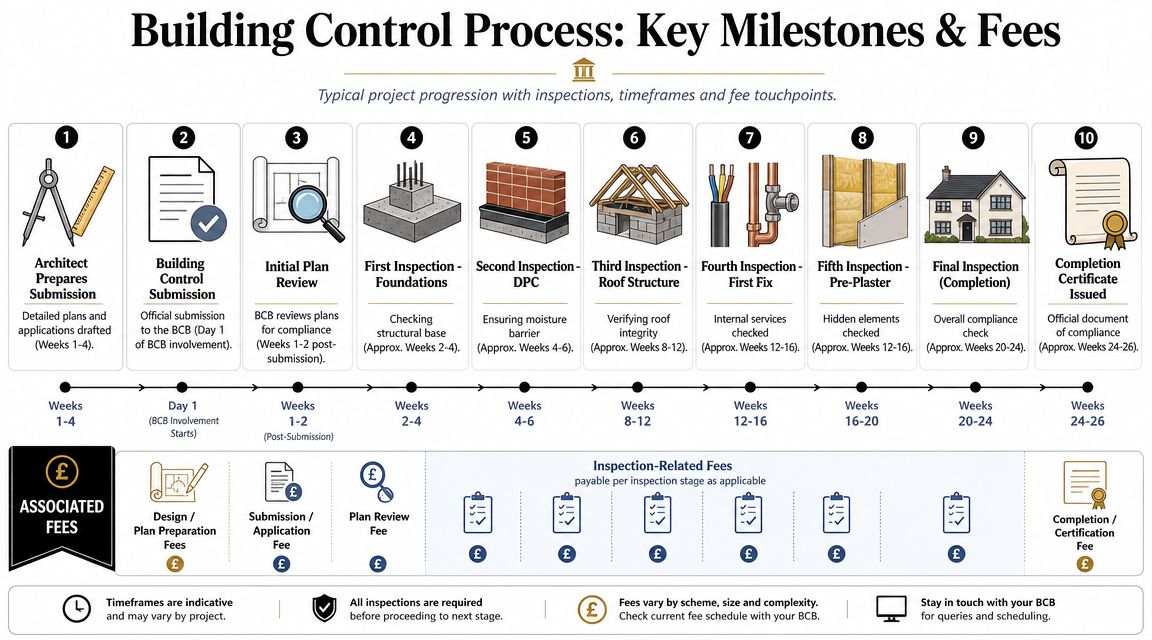
The broad process usually looks like this:
Preparation of technical information. The architect and consultants assemble coordinated drawings, specifications and calculations.
Submission to the building control body. This may be through a local authority building control team or another approved route, depending on the project setup.
Plan review and comments. Questions are raised, details are refined and approval progresses.
Phased inspections during construction. The inspector checks key stages before work is covered up.
Completion certification. Final sign-off depends on the built work and supporting certificates lining up properly.
What affects timing and cost
The variables are usually more important than the headline fee. A modest extension with straightforward structure and standard construction is one thing. A listed house with a new basement, significant internal reconfiguration and advanced building services is another.
Fees typically reflect:
Project type and complexity. More drawings, more reviews and more inspections usually mean higher cost.
Inspection demand. Below-ground works, drainage changes and staged structural work create more site involvement.
Coordination quality. Clear, consistent information reduces delay. Contradictory packages do the opposite.
Client advice: ask for clarity on what the fee covers. Plan check, site inspections, re-submissions and final certification should all be understood early.
The fee itself is rarely the expensive part of a troubled project. The primary cost sits in delays, uncovered work needing to be opened up, or technical redesign once construction has already started.
Your Next Steps for a Seamless and Compliant Project
The simplest way to approach building control requirements is to stop treating them as an isolated approval box. On a serious residential project, they are part of a wider compliance framework that includes planning, heritage consent and neighbour procedures. Each affects the others.
That is why experienced architectural coordination matters so much. The architect's role is not just to produce an attractive design. It is to make sure the design can survive contact with real approvals, real construction and real inspection without being diluted or derailed.
For homeowners, the practical takeaway is clear:
Start technical thinking early. Don't leave compliance until after planning.
Choose the right submission route. Simplicity on paper can create risk on site.
Expect evidence, not assumptions. Details, calculations and certificates matter.
Coordinate the whole picture. Planning, listed building consent, party wall matters and building control should inform one another.
Well-managed projects don't avoid complexity by ignoring it. They handle complexity early, clearly and in the right order. That is usually the difference between a calm build and a stressful one.
If you are planning a bespoke new build, basement extension, listed property renovation or substantial refurbishment in South West London or Surrey, a careful early review can save a great deal of difficulty later.
If you're considering a high-end residential project and want clear guidance on planning, building control and the wider approval process, Harper Latter Architects can discuss your brief and help shape a compliant route from the outset.