
A Guide to the Cost of House Extension UK

If you're thinking about expanding your home, the first question that probably springs to mind is about the cost of a house extension in the UK. It's the big unknown for most homeowners. As a rough guide, a straightforward single-storey extension can cost anywhere from £1,800 to over £3,400 per square metre (£/m²).
That’s a big range, and it all depends on where you live and the quality of finish you’re aiming for.
Understanding the Initial Costs of a House Extension
Before you get lost in mood boards and floor plans, it’s vital to get a realistic handle on the investment involved. The final cost isn't one single figure; it’s a spectrum influenced by three main things: your location, the complexity of the build, and the specification you choose for fixtures and fittings.
Think of it like buying a car. You could go for a practical, no-frills model that gets the job done, a well-equipped executive saloon with a few creature comforts, or a completely bespoke luxury vehicle with all the bells and whistles. Each one delivers a different experience at a very different price point.
An extension is exactly the same. You might just need a basic, functional space, or you could be dreaming of a high-end, architecturally stunning addition with premium materials and finishes. This initial cost-per-square-metre figure is your starting line—it gives you a foundational number to build upon.
Estimated Cost Per Square Metre for a Single-Storey Extension
It's no secret that building costs vary massively across the country. London and the South East carry a significant premium, mainly due to higher labour rates and the logistical headaches that come with building in a densely populated area.
To give you a clearer picture, we’ve broken down the numbers based on the level of finish you might be considering. The table below shows the typical cost ranges you can expect, comparing the national UK average with what you might pay here in South West London.
Specification Level | Average UK Cost per m² | South West London Cost per m² |
|---|---|---|
Basic Quality | £1,800 – £2,200 | £2,300 – £2,700 |
Standard Quality | £2,200 – £2,600 | £2,700 – £3,100 |
Premium Quality | £2,600 – £3,000+ | £3,100 – £3,400+ |
These figures give you a solid baseline to start thinking about your initial budget. For a much more detailed breakdown, have a look at our complete homeowner's guide to average extension costs in the UK.
Remember, this is just the construction cost. The total project budget will also need to account for professional fees (like architects and engineers), planning applications, and VAT, which we will explore in the next section.
Getting to grips with these initial numbers is the first, and most important, step in planning a successful home extension. It empowers you to match your ambitions with a realistic budget right from the start, ensuring a much smoother journey from your first ideas to the finished build.
Decoding Build Costs and Professional Fees
That initial cost per square metre is a brilliant starting point, but it's vital to know what it actually covers: the construction itself. A successful, legally compliant house extension relies on a team of skilled professionals and various official approvals, and each of these comes with its own price tag. Overlooking these fees is probably the most common budgeting mistake homeowners make.
Think of the build cost as the sticker price of a new car. The professional and statutory fees are the insurance, road tax, and registration—you can't legally or safely drive off the forecourt without them. These aren't optional extras; they're essential investments that safeguard your project's value, quality, and structural integrity.
To get to the true cost of a house extension in the UK, you have to factor in this next layer of spending right from the get-go.
The Role of Your Professional Team
Bringing an extension to life isn’t a one-person job. It requires a handful of specialists, each playing a distinct and vital role in turning your vision into a safe, well-designed, and legally approved reality. Their fees are usually calculated as a percentage of the build cost, though some work on a fixed-fee basis.
Here’s a quick rundown of the key players you'll likely need on your team:
Architect: Your architect is the creative and technical leader of the project. They’ll design the extension, produce the incredibly detailed drawings needed for planning and construction, navigate the approvals system, and can even oversee the build itself. Architect's fees typically range from 8% to 15% of the total construction cost, depending on how involved you want them to be. For a deeper dive, check out our detailed guide on the cost of an architect in the UK.
Structural Engineer: This is the expert who makes sure your extension will stand up safely. They handle all the crucial calculations for foundations, load-bearing walls, and any steel beams (RSJs) required. For a typical extension, you can expect their fees to be somewhere between £1,000 and £2,500.
Party Wall Surveyor: If your work affects a shared wall with a neighbour (the 'party wall') or involves digging foundations close to their property, you'll need to serve a Party Wall Notice. If your neighbour doesn't consent straight away, you'll need to appoint a surveyor, which can cost between £1,000 and £3,000 per neighbour.
This chart helps visualise how the main build cost is just the foundation of your budget, with the final figure tiered based on the quality of finish you choose.
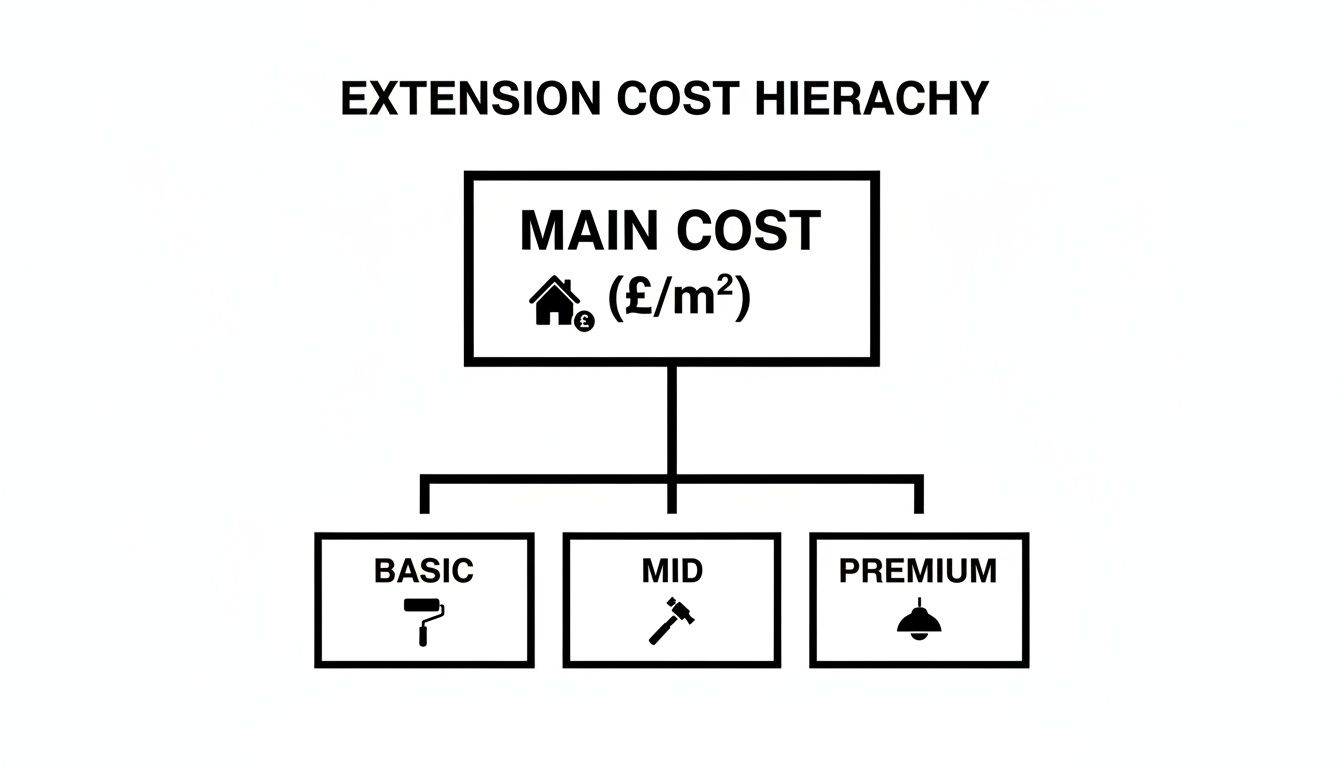
As you can see, the quality of materials and complexity of the design you opt for will directly influence where your project lands on this scale, from a basic finish to a premium one.
Navigating Statutory Fees and Other Costs
Beyond the fees for your professional team, you'll also need to budget for costs paid directly to your local council and other bodies for essential approvals. These are non-negotiable and make your project legal.
To help you get a clearer picture, here's a table of the typical professional and statutory fees you'll encounter.
Typical Professional and Statutory Fees for a House Extension
Fee Type | Description | Estimated Cost (£) |
|---|---|---|
Architect | Design, drawings, planning application, and project oversight. | 8%–15% of build cost |
Structural Engineer | Calculations for foundations, beams, and structural safety. | £1,000 – £2,500+ |
Party Wall Surveyor | Required if work affects a shared wall and neighbours dissent. | £1,000 – £3,000 per neighbour |
Planning Application | Fee paid to the local council to submit your application. | £258 (in England) |
Building Regulations | Fee for ensuring the build meets safety and construction standards. | £500+ |
VAT | Standard rate applied to most construction work and professional fees. | 20% of total costs |
Contingency Fund | A safety net for unexpected issues during the build. | 10%–15% of build cost |
Remember, these are separate from your main build contract, so it's crucial to account for them early on to avoid any nasty surprises.
One of the biggest budget items that often gets overlooked is Value Added Tax (VAT). Most residential extension work is subject to the standard 20% VAT rate, which gets added to your builder's invoices and the fees from most of your professional team. This can add a huge chunk to your final bill, so make sure it's factored into your budget from day one.
Finally, no project ever goes exactly to plan. That’s why setting aside a contingency fund of 10-15% of your total build cost is absolutely essential. This isn't money you plan to spend; it's a financial safety net for the unexpected, like discovering tricky ground conditions when digging foundations or needing to reroute hidden pipework. It's what keeps the project moving when unforeseen issues crop up.
How Project Scope Shapes Your Final Budget
Every extension is one-of-a-kind, and its ambition and complexity are the biggest drivers behind the final bill. The overall scale of your vision—whether you’re planning a simple single-storey addition or a complex basement conversion—directly shapes the cost of a house extension in the UK. Getting to grips with how different project types affect your budget is the first step in planning a build that makes financial sense.

One of the first major decisions you'll face is whether to build outwards or upwards. It’s a common myth that a two-storey extension will cost double a single-storey one, but the reality is far more budget-friendly.
Single-Storey Versus Two-Storey Extensions
When you build a single-storey extension, a huge chunk of the budget goes on the groundwork and foundations. These are expensive, labour-intensive tasks that form the base of your new structure. But when you add a second floor, you’re building on top of foundations that are already paid for.
This creates a surprising cost efficiency. A two-storey extension typically costs only 50% to 60% more than a single-storey extension with the same footprint—not double. This makes them remarkably economical when you look at the extra floor space you’re gaining for a relatively small increase in cost.
Think of it this way: by building upwards, you’re getting the second storey at a discounted rate. The foundations, drainage, and ground-floor structure are already in place, making the additional space far cheaper to construct than the ground floor.
This value proposition is exactly why two-storey extensions are often such a smart investment, especially in areas like South West London where maximising every square metre is key. You can add a new bedroom and bathroom directly above your new kitchen-diner for a fractional increase in the total project cost.
The Higher Costs of Specialised Projects
While two-storey extensions offer fantastic value, other projects demand a much higher investment due to their inherent complexity and the specialist skills required. These are the kinds of jobs where a standard cost-per-square-metre figure can be seriously misleading.
Basement Conversions: Digging down is always more expensive than building up or out. Basement projects involve major excavation, extensive structural work to support your home (and your neighbours'), and sophisticated waterproofing, known as tanking, to keep damp out. As a result, the cost per square metre for a basement can be 50% to 100% higher than for a standard above-ground extension.
Listed Buildings and Conservation Areas: Properties with historical significance come with a lot of strings attached. Any work on a listed building or a home in a conservation area will likely require specialist materials, traditional craftsmanship, and careful negotiations with planning authorities. This extra layer of compliance and expertise adds a considerable premium to the budget. You can learn more about navigating these rules in our UK house extension planning permission guide.
Ultimately, the scope of your project is the primary factor that dictates its cost. A simple, rectangular single-storey extension will always be the most straightforward and affordable option. As you start to introduce more complex elements like multiple storeys, bespoke structural work, or heritage considerations, the budget will naturally—and necessarily—increase to match. Understanding this from the outset allows you to align your creative vision with a realistic financial plan.
The Real Cost of High-End Finishes
While the structure provides the bones of your new space, it’s the finishes that give it a soul. This is where your vision truly comes to life, turning a well-built shell into a personalised, high-functioning part of your home. High-end finishes are more than just a pretty face; they're an investment in quality, durability, and the simple joy of living in a space that just works.
The choices you make here—from the joinery to the glazing—are what elevate a project from a standard build to something genuinely special. Naturally, these premium elements have a significant impact on the final cost of a house extension in the UK, often accounting for a huge chunk of the budget. Knowing where to invest for maximum impact is the key to getting it right.
Investing in Custom Joinery and Glazing
Off-the-shelf solutions can be functional, but there’s nothing quite like bespoke joinery and high-performance glazing to create truly seamless and luxurious spaces. These elements are designed to fit your home's unique character and your specific lifestyle, but that level of customisation comes at a price.
Custom joinery, like built-in wardrobes, media units, or a handcrafted kitchen, is tailored to the exact dimensions of your room. This doesn't just maximise storage; it creates a cohesive, architectural feel that freestanding furniture can rarely replicate.
Likewise, high-performance glazing does more than just let in light. Features like large-format bi-fold or sliding doors are engineered for superior thermal efficiency, security, and effortless operation. While a standard window might cost a few hundred pounds, a set of premium aluminium bi-fold doors can easily run from £5,000 to £10,000 or more, depending on the size and spec.
Think of these features as long-term investments. Bespoke joinery solves practical problems with elegant solutions, while high-quality glazing can fundamentally change how you interact with your home and garden, blurring the lines between indoors and out.
Premium Kitchen and Bathroom Specifications
Kitchens and bathrooms are easily the most complex and costly rooms to fit out, acting as major drivers of your final project budget. It’s in these spaces that the difference between a basic, standard, and high-end finish becomes most obvious.
Recent UK home renovation statistics show that even a modest 12-square-metre kitchen extension averages around £19,500, while adding a new bathroom can cost between £5,000 and £10,000. These figures highlight just how quickly premium fittings can escalate costs. You can explore more data on typical project budgets and learn about home renovation statistics in the UK.
So, where does the money go?
Kitchens: A high-end kitchen is about more than just the units. Costs are driven by solid worktops (think granite or quartz), premium appliances from brands like Miele or Gaggenau, custom-designed islands, and sophisticated lighting schemes.
Bathrooms: Luxury bathroom specifications can include designer sanitaryware, natural stone tiles, underfloor heating, walk-in showers with frameless glass, and bespoke vanity units.
Each one of these choices contributes to a superior finish, but they need to be carefully budgeted for right from the start.
Extending Your Vision to the Outdoors
A truly successful extension doesn’t just stop at the back door. Creating a seamless connection with the garden is a hallmark of high-end design, and this often involves a bit of landscape architecture. Integrating your new indoor space with a beautifully designed outdoor area completes the vision and genuinely enhances your lifestyle.
This can range from a simple paved terrace to a full garden redesign with features like:
Outdoor Kitchens: Complete with built-in grills, sinks, and preparation areas.
Bespoke Seating Areas: Think integrated benches and fire pits.
Garden Rooms: Insulated, powered outbuildings that can serve as a home office, gym, or studio.
These elements require significant investment in groundwork, materials, and services, adding another layer to the overall project cost. But by treating the garden as an extension of your home, you create a cohesive and highly desirable living environment that adds considerable value and enjoyment.
Practical Strategies for Managing Your Budget
A well-managed budget is what separates a successful, low-stress project from a chaotic one. Keeping a firm grip on the finances behind the cost of house extension UK projects is all about making sure your vision gets built without any nasty surprises along the way. It comes down to proactive planning, creating a sensible financial safety net, and understanding exactly how payments will flow throughout the build.

Effective cost control isn’t about cutting corners; it’s about making smart, informed decisions right from day one. Do this, and you’ll transform what can feel like an unpredictable process into a structured, manageable journey.
The Power of Detailed Planning
If there's one golden rule for controlling costs, it's this: finalise every single detail before you even think about appointing a builder. A vague brief will only ever get you vague quotes, and that’s a recipe for unexpected expenses down the line.
Your architect will produce a comprehensive set of drawings and a detailed Schedule of Works. Think of this as the project's instruction manual – it itemises everything, from the exact type of brickwork to the specific model of light switch. When builders tender for the job using this level of detail, their quotes are far more accurate and can be compared like-for-like, leaving very little room for ambiguity later on.
A formal building contract, such as a JCT contract, is completely non-negotiable for a project of this size. It’s your legal shield, protecting both you and the builder by clearly defining the scope, the cost, the timeline, and the rules for handling any changes. Consider this document your ultimate financial safeguard.
Building in a Financial Safety Net
No matter how meticulous your planning is, construction projects can always throw a curveball. You might discover tricky ground conditions once digging starts, or uncover hidden structural problems in the old part of the house. This is precisely what a contingency fund is for.
You absolutely must set aside 10% to 15% of the total construction cost as a contingency. This isn't money for upgrading your kitchen worktops; it's a separate pot reserved purely for the unexpected. Having this fund ready means an unforeseen issue won’t derail the entire project or force you to compromise on quality elsewhere.
Understanding Payment Milestones
You should never, ever pay for an entire extension project upfront. Instead, payments are made in stages as the build progresses, tied to specific, verifiable milestones. Your architect will help establish this schedule and will certify that each stage of work is complete before you release any money to the builder.
A typical payment schedule might look something like this:
Mobilisation Fee: A small initial payment (often 5-10%) is made once the contract is signed. This allows the builder to order initial materials and schedule their team.
Foundation and Groundworks: A payment is released once the foundations are dug, poured, and the ground floor slab is complete.
Superstructure (Watertight Shell): This is usually a significant payment, made once the main structure is built, the roof is on, and the windows are installed, making the shell watertight.
First Fix: Released after the initial plumbing, electrical wiring, and internal stud walls are in place.
Second Fix and Finishes: Paid out once plastering is done, joinery is fitted, and final connections for plumbing and electrics are made.
Practical Completion: When the project is finished and ready to use, the majority of the final balance is paid.
Retention: A small percentage (typically 2.5-5%) is held back for a ‘defects liability period’ of 6-12 months. This covers any minor snagging issues that might pop up after the builders have left.
This structured approach gives you complete control, ensuring you only pay for work that has been properly completed. Working with an experienced architect provides that extra layer of rigorous cost management, helping keep your project firmly on track and on budget.
Common Questions About Extension Costs Answered
Even with a detailed plan, starting a home extension brings up plenty of questions. Getting your head around the finances and practicalities is the key to feeling confident. Here are our answers to some of the most common queries we hear from homeowners.
How Much Value Does an Extension Add to a UK Property?
A well-designed extension almost always adds more value than it costs. As a rule of thumb, homeowners can expect a high-quality extension to increase their property's value by 10% to 20%.
The real magic happens when the design is exceptional, feels like a natural part of the original home, and adds something the local market is crying out for—think a much-needed extra bedroom or that highly desirable open-plan kitchen-diner. In prime spots like South West London, a bespoke, architect-designed extension can deliver an even bigger uplift.
Do I Always Need Planning Permission for an Extension?
Not always, no. Many smaller, single-storey rear extensions can be built under ‘Permitted Development’ rights, which is a great way to bypass a full planning application.
But be warned, these rights come with a long list of strict rules on size, height, and how close you can build to your boundaries. For anything bigger, like a two-storey addition, or any work on properties in Conservation Areas or on listed buildings, you’ll almost certainly need full planning permission. An experienced architect can give you definitive advice for your specific property and council.
How Long Does It Take to Build a House Extension?
For a straightforward single-storey extension, the on-site construction usually takes around three to four months.
However, that’s just the building part. The entire process is much longer. You have to factor in the design phase, submitting planning applications (which can easily take 8-12 weeks for a decision), structural engineering, and finding and appointing the right builder. A typical project often takes 6-12 months from the first sketch to the final coat of paint. More complex projects, especially those involving basements or major structural changes, will take longer still.
What Is the Difference Between an Architect's Estimate and a Builder's Quote?
It's easy to get these two mixed up, but they serve very different purposes. Think of an architect's cost estimate as an educated forecast. It's a professional projection used right at the start to help you budget, based on industry data for cost-per-square-metre and the general scope of what you want to achieve.
A builder's quote, on the other hand, is a firm, fixed-price offer to do the work. It’s calculated from the highly detailed technical drawings and specifications your architect prepares.
The quote is a formal, contractual figure you can sign on the dotted line for. The estimate is your sanity check to make sure the project is financially viable before you dive into the detailed design work.
Ready to turn your vision into a beautifully designed reality? The team at Harper Latter Architects has the expertise to guide you through every step, from the first conversation to a stunningly finished home.

Comments