
Condensation Prevention for Luxury & Listed Homes
You know the moment. The windows are spotless, the joinery is bespoke, the refurbishment is complete, and yet a fine line of moisture appears at the glazing or in the corner of a wardrobe. In a well-finished Wimbledon or South West London home, that is never just a housekeeping issue. It is often the first visible sign that moisture, temperature, and airflow are out of balance, and if that balance is ignored, condensation prevention stops being a comfort issue and becomes a fabric-protection issue.
For high-value and listed homes, condensation is a quiet threat because it does its damage in places clients don't see first. It marks paint, softens finishes, stresses timber, and can settle into cold junctions where expensive detailing has been carefully preserved. The right response is rarely a single gadget or a quick airing-out routine. It starts with understanding how moisture behaves inside the building, then designing the building so the moisture has somewhere to go.
The Science of Condensation in a Bespoke Home
A beautifully finished room can still show condensation if one surface is colder than the air around it. That's the simple physics at the heart of the problem. Warm air holds moisture, then releases it when it cools to the dew point, which is why a sleek kitchen, a dressing room, or a heritage sitting room can start misting up even when the architecture looks immaculate.
Why the building fabric matters
In a bespoke home, condensation is not only a nuisance, it's an early warning. Repeated moisture on windows, window reveals, timber, plaster, and internal linings can stain finishes and create conditions that encourage mould. The issue is often strongest where the building fabric is cold, airtight, or interrupted by a thermal bridge, which means the building itself can be creating the problem even when daily habits are reasonable.
A good condensation strategy starts with three linked variables, moisture, temperature, and ventilation. If one rises or falls out of step with the others, the building surfaces can drift below the dew point and water appears. That's why a quick cosmetic fix rarely lasts.
Practical rule: if a room keeps fogging, look at the balance of air change and heat, not just the visible water.
For owners of high-end homes, that distinction matters because the cost isn't limited to repainting. The risk extends to joinery, wardrobes, stone, period plaster, and the hidden structure behind them. In a conservation setting, the wrong intervention can also upset the building's original moisture behaviour.
Diagnosing the Source of Moisture in Your Property
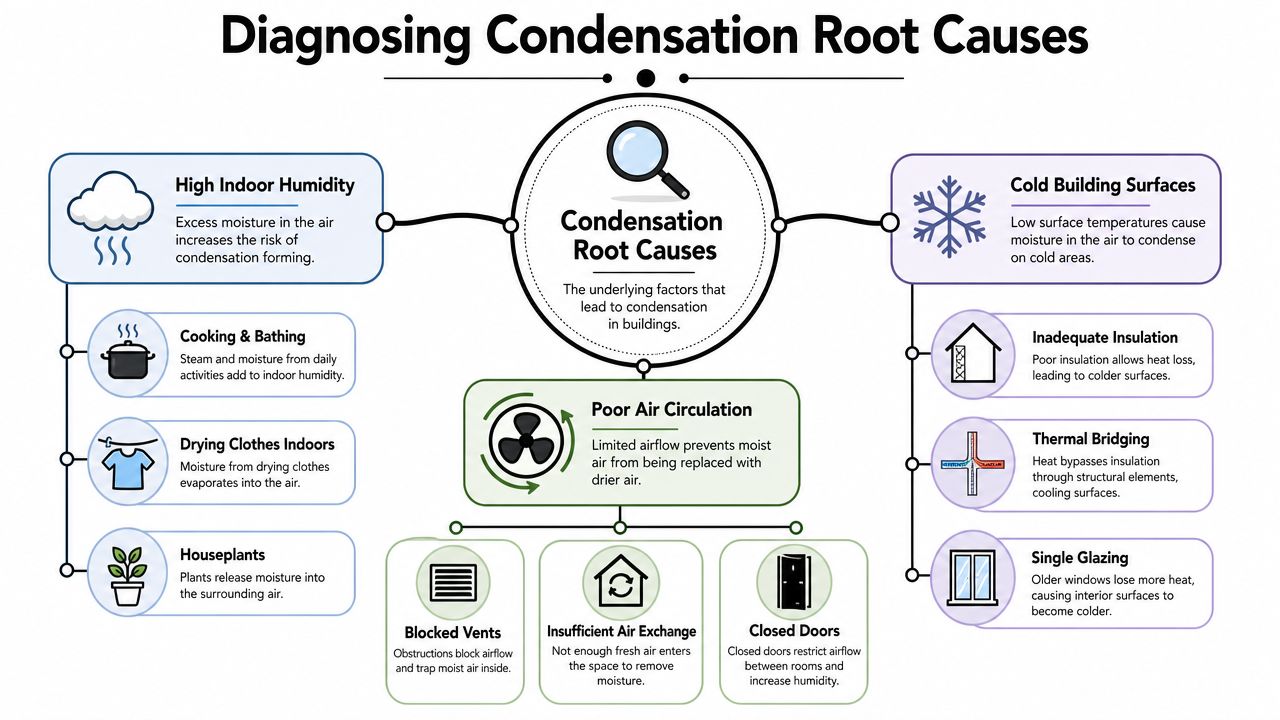
The first job is to separate where the moisture comes from from where it shows up. Those are rarely the same thing. Steam from cooking, showers, and indoor laundry can be enough to overwhelm a tightly sealed interior, but a cold bridge, blocked vent, or poor roof detail can create the same visible symptoms.
Moisture from daily use
Some of the biggest sources are domestic and predictable. A single load of air-dried laundry released indoors introduces over two pints, approximately 1.18 litres, of moisture into the home environment, according to AXA's guidance on what causes condensation and how to stop it. That one habit can be enough to tip a marginally ventilated property into regular condensation.
Cooking, bathing, and drying clothes are all manageable, but only if the room is designed to evacuate that moisture quickly. In a compact basement utility room, for example, the same activity creates a heavier burden than it would in a larger, naturally ventilated kitchen. The building type matters as much as the habit.
Moisture from the building itself
Period and listed homes often fail in different ways. A property that has been sealed up during an energy upgrade can trap moisture where the original fabric once breathed more freely. Existing vents can be blocked, junctions can be poorly detailed, and cold spots can form at reveals, corners, or roof edges.
A measured survey is often the right starting point before any serious intervention, because condensation problems in older homes are rarely isolated. See the practice guidance on a measured building survey if the property's geometry, alterations, or hidden voids aren't fully understood.
What to look for on site
Musty wardrobes and cupboards. These often point to poor air movement rather than a visible leak.
Localised mould in corners or around reveals. This usually suggests a cold surface or thermal bridge.
Condensation that appears after bathing or cooking. That is often a moisture-load issue.
Persistent damp patches without a clear source. These need a fabric diagnosis, not guesswork.
The distinction between lifestyle moisture and building moisture is critical, because the solution changes completely depending on which one is dominant.
Mastering Ventilation and Consistent Heating
In a well-designed home, condensation prevention is mostly about controlled air movement and steady temperatures. Opening a window can help, but it is not a strategy in itself. The better question is whether the property has enough continuous, predictable ventilation to remove moisture before it settles on cold surfaces.
Whole-house ventilation for airtight homes
In modern, airtight refurbishments and new builds, Mechanical Ventilation with Heat Recovery (MVHR) is often the cleanest answer. It extracts stale, moisture-laden air and replaces it with fresh, filtered air while limiting heat loss. In the UK, guidance cited by the Centre for Sustainable Energy says that reducing moisture, ventilating properly, and maintaining stable temperatures can reduce condensation-related mould by up to 70% in residential properties, as noted in CSE guidance on condensation prevention.
That figure matters less as a marketing line and more as a design lesson. The result comes from combining habits with systems, not from a single intervention. MVHR works best when the airtight layer is continuous and the air path is deliberately planned, so moisture doesn't just drift into cold voids and linger there.
Background heat in heritage properties
Older homes often need a different response. A conservation flat, Victorian terrace, or listed townhouse may not suit aggressive sealing, so the safer route is discreet extraction, reliable trickle ventilation, and consistent background heating. The aim is to keep internal surfaces warm enough that they stay above the dew point.
That doesn't mean turning the house into a furnace. It means avoiding overnight temperature drops that leave walls, reveals, and glazing cold enough for moisture to settle. In practice, a steady low-level heat strategy is more valuable than short bursts of high heat followed by rapid cooling.
Architectural insight: condensation control fails when heating and ventilation are treated as separate problems. They work as one system.
What works and what doesn't
MVHR suits airtight refurbishments. It manages air quality and moisture together.
Extractor fans need run-on time. They should keep clearing steam after bathing or cooking.
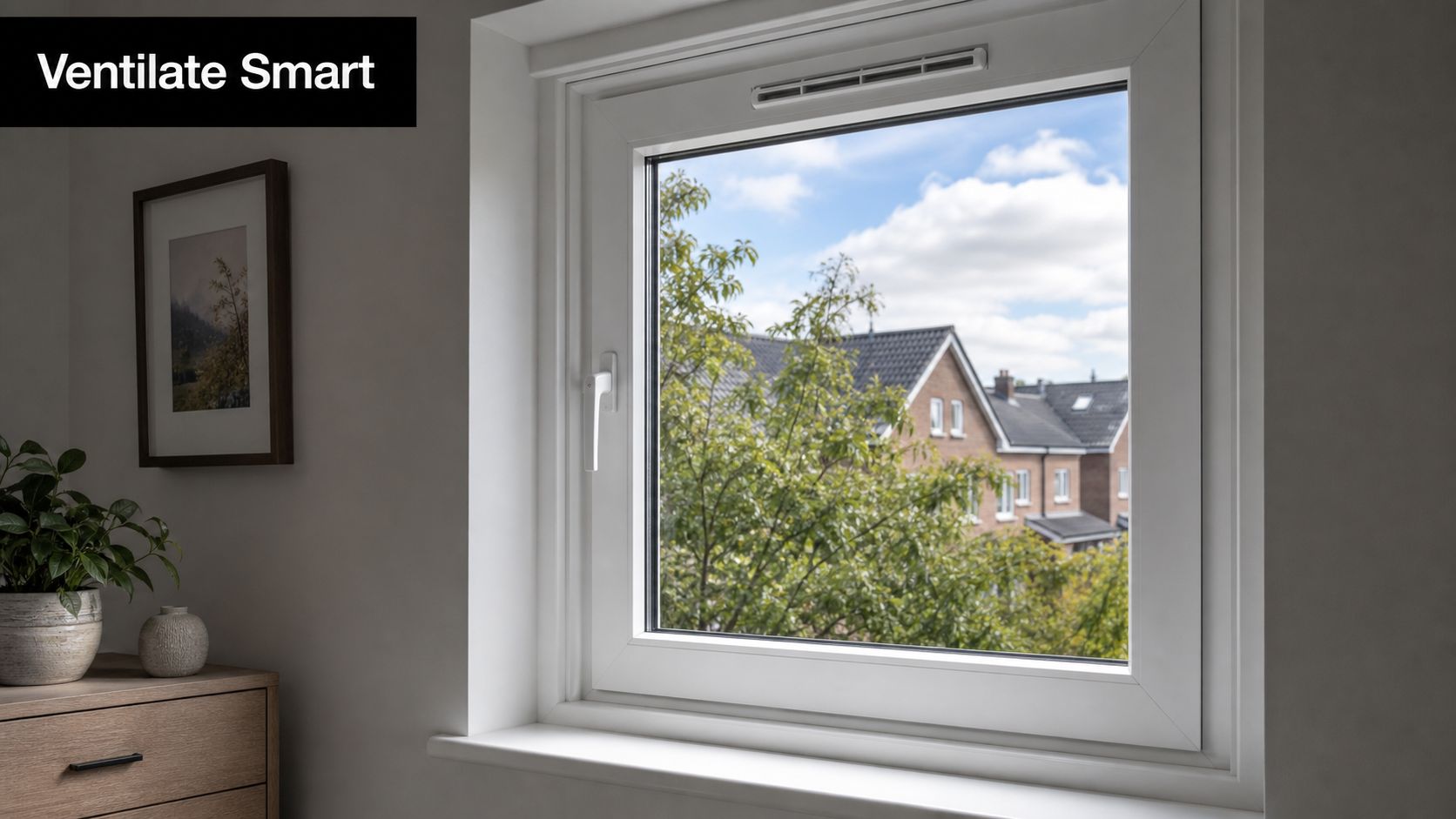
Trickle vents help when they're kept open and unobstructed. Closing them defeats the point.
Short, intense heating alone doesn't solve moisture. It warms the air, then the room cools again.
That combination of steady heat and continuous airflow is the difference between a room that merely feels warm and a room that resists condensation.
Architectural Solutions for Insulation and Thermal Bridging
Surface condensation is only part of the story. In better projects, the primary concern is interstitial condensation, where moisture forms inside the building fabric itself. Once water gets into insulation layers, roof zones, or wall junctions, it's harder to detect and more damaging to reverse.
Why the detail matters
UK building design uses a Condensation Risk Analysis (CRA) to predict condensation by modelling assembly order, vapour resistance, and climate data, with internal surface humidity required to remain below 80% to prevent mould, as specified in BS 5250:2011 guidance. That sounds technical, but the principle is straightforward. The wall, roof, and junction details must be designed so moisture can't migrate to a surface that's cold enough to condense it.
One of the most common failures in refurbishment work is a thermal bridge. At floor-wall-roof junctions, heat escapes more quickly, local surface temperatures fall, and condensation spots appear. In listed buildings, these cold bridges are reported as the most frequent cause of surface condensation, reducing local surface temperature by 3–5°C and degrading heritage materials, according to UK building regulation commentary on cold bridging.
What good detailing looks like
The right fix is usually geometric, not cosmetic. Insulation needs to be continuous at vulnerable junctions, vapour control layers need to be positioned on the warm side, and all penetrations should be taped and sealed so warm wet air doesn't leak into colder zones. That matters especially around eaves, window openings, and service penetrations, where poor workmanship can undo otherwise good specifications.
It also means treating insulated upgrades with caution in older masonry buildings. If traditional breathability is blocked without a proper moisture strategy, the building can behave worse after the upgrade than before it. A beautiful finish can still hide a poor condensation risk profile.
A good refurbishment sequence
Survey first. Confirm where the coldest surfaces and hidden voids are.
Model the build-up. Check the roof, wall, and floor assembly before work starts.
Detail every junction. Corners, reveals, and service holes matter as much as the main field.
Keep the vapour control layer continuous. Gaps are where problems begin.
If the specification doesn't address the junctions, it hasn't really addressed condensation.
For South West London refurbishments, this is the point where architectural judgement becomes decisive. The materials matter, but the interface between them matters more.
Targeted Strategies for Kitchens Bathrooms and Basements
Rooms that generate more moisture need their own rules. A family kitchen, a steam-heavy bathroom, and a basement leisure space all create a different loading on the building, so they can't be treated with a single generic fix.
Kitchens and bathrooms
Use extraction that is sized for real use, not just compliance. A good fan should clear moisture quickly, continue running after the activity has ended, and discharge to the outside through a properly detailed duct. Short, weak extraction is one of the most common reasons for recurring misting around mirrors, ceilings, and adjoining joinery.
Keep in mind that how moisture is created matters too. Simple habits, like using lids while cooking and limiting unnecessary steam, reduce the burden before mechanical systems have to deal with it. These small decisions don't replace design, but they make the design work more effectively.
Basements need a different mindset
Basements are not just lower rooms, they're different environmental conditions. They face hydrostatic pressure, limited natural air change, and a greater risk of moisture accumulation in voids, wall linings, and floors. In poorly designed basement leisure spaces, failure to ventilate the required air spaces in suspended floors and cladded walls can compromise structural integrity in 25–30% of cases, according to Scottish building standards guidance on condensation.
That matters for gyms, cinemas, wine rooms, and other amenity spaces because the room use itself can generate moisture and heat. The design response has to include proper waterproofing, ventilated construction where required, and a ventilation strategy that keeps the air moving without making the room feel oppressive. For projects with more complex below-ground conditions, the practical starting point is often a review of the basement drainage systems before any internal finishes are fixed.
Common basement mistakes
Sealing too early. Finishes go in before the moisture path is understood.
Ignoring wall linings and floor voids. Hidden cavities collect condensation unnoticed.
Relying on passive air alone. Subterranean spaces usually need more than that.
Treating leisure use like storage use. A gym or pool room needs tighter control.
A basement that feels dry on completion can still fail later if the moisture strategy is superficial. The room has to be built for its actual use, not for a generic residential template.
A Maintenance Checklist and When to Engage an Architect
Even the best specification needs upkeep. Condensation prevention is partly about design, but it's also about keeping the systems free to do their job. A blocked vent or clogged fan can undo a careful refurbishment faster than most owners expect.
Simple maintenance that protects the fabric
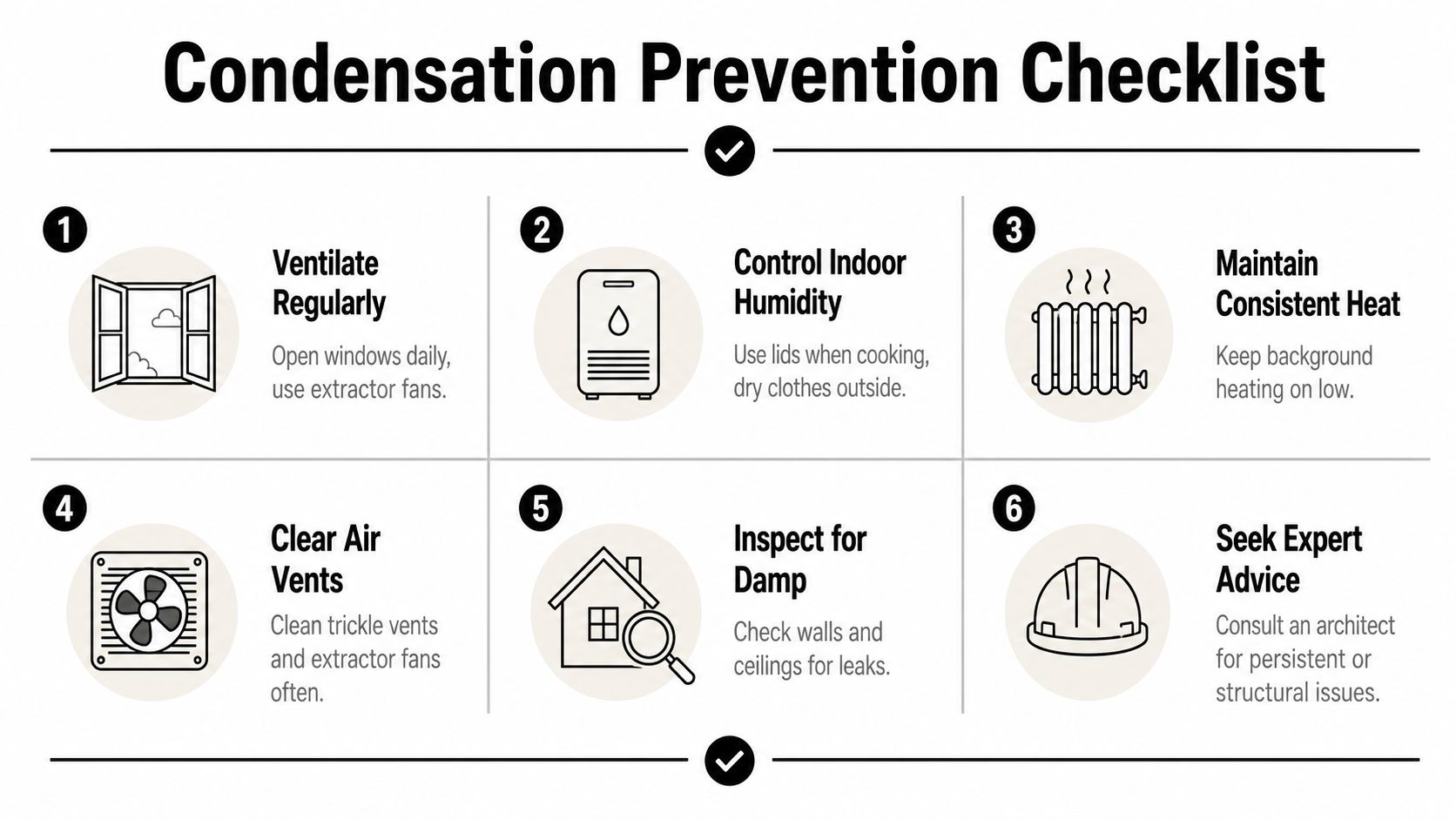
Ventilate regularly. Open windows where appropriate and use extractor fans after steam-heavy activities.
Control indoor humidity. Keep lids on pans, manage laundry moisture, and avoid unnecessary steam.
Maintain consistent heat. A stable background temperature is more protective than intermittent bursts.
Clear air vents. Trickle vents and extractor fan filters need regular cleaning.
Inspect for damp. Check ceilings, corners, and joinery for new staining or mould.
Seek expert advice. Persistent or structural issues need a professional diagnosis, not a guess.
That checklist sounds basic because the basics matter. But if the same stain keeps returning, or if one room is consistently colder than the rest, the problem is probably in the building fabric, not the household routine.
When the issue needs architectural input
Bring in an architect when condensation persists despite proper ventilation, when damp patches have no obvious source, or when work is happening in a listed building or conservation area. Those are the situations where detail, compliance, and fabric sensitivity all matter at once. A general contractor can replace a fan, but they can't always resolve a thermal bridge, a vapour path, or a junction detail that was never right to begin with.
The strongest warning sign is cold bridging at the junctions. In listed buildings, those floor-wall-roof edges are the most frequent cause of surface condensation and can drop local temperatures enough to create recurring condensation spots that damage heritage materials, as noted in UK building regulation commentary on cold bridging.
For a high-end home, that's the point at which condensation prevention stops being routine maintenance and becomes part of protecting the architecture itself.
If you're dealing with recurring misted glazing, mould at cold junctions, or a basement that never quite feels right, speak with Harper Latter Architects about a design-led condensation strategy that respects your home's fabric, its use, and its long-term value.