
Cost of Rear Extension: cost of rear extension in South West London
While the UK average for a rear extension hovers around £40,000, that figure tells you very little about what to expect for a high-quality project in South West London. In reality, you should anticipate investing anywhere from £75,000 to over £200,000 for a premium single-storey extension here. This isn't just an arbitrary price hike; it reflects the exceptional standards and unique challenges of building in sought-after areas like Wimbledon, Richmond, and Surrey.
Your Guide to Rear Extension Costs in South West London
A rear extension is one of the most rewarding home improvements you can make, creating space that completely changes how your family lives. But before you get lost in design ideas, the first and most critical question is always about the budget: what will it actually cost?
Here in South West London, the answer is worlds away from the national average. This guide is designed to give you a transparent, realistic financial starting point. We'll break down the numbers, explain the so-called 'London premium', and show you exactly what that extra investment gets you.
Understanding the London Premium
So, what drives costs up in the capital? It's a combination of factors. While a standard 30m² extension might cost £40,000 elsewhere, recent industry data shows that same project in Wimbledon could easily reach £77,957. That's a jump of around 21% above the UK norm.
This difference comes down to higher labour rates, more expensive materials, and the notoriously complex planning and building regulations we navigate here. It also reflects the sheer quality and complexity demanded by projects in this area. From preserving the delicate character of period properties to executing flawless designs in tight urban plots, the level of skill required simply costs more.
To give you a clearer picture, here’s a breakdown of what you might expect to budget for different specifications. These figures are a helpful starting point, but remember they exclude professional fees and VAT.
Estimated Rear Extension Costs in South West London (Excluding Fees & VAT)
This table summarises the typical cost ranges for a single-storey rear extension, giving you a quick financial overview based on size and the level of finish you're aiming for.
Extension Size | Standard Specification Cost | Mid-Range Specification Cost | Luxury Specification Cost |
|---|---|---|---|
20m² (Small) | £55,000 - £70,000 | £70,000 - £90,000 | £90,000+ |
30m² (Medium) | £75,000 - £95,000 | £95,000 - £125,000 | £125,000+ |
40m² (Large) | £90,000 - £120,000 | £120,000 - £160,000 | £160,000+ |
50m²+ (Very Large) | £110,000+ | £150,000+ | £200,000+ |
These figures act as a solid benchmark. A 'Standard' specification includes good quality, off-the-shelf fittings, while 'Mid-Range' allows for more bespoke elements. A 'Luxury' budget opens the door to high-end finishes, specialist glazing, and premium brand appliances.
At Harper Latter Architects, we believe that understanding the potential cost of a rear extension is the first step toward a successful project. Our role is to provide clarity and expert guidance, ensuring your budget is allocated effectively to achieve a beautiful, functional, and valuable addition to your home.
As RIBA-accredited architects, we’ve built our structured 8-step process around financial transparency and control. From our very first conversation, we help you establish a realistic budget that lines up perfectly with your ambitions. We’re here to navigate the complexities of London construction, protecting your investment and delivering an outstanding result.
You can read about our approach to London refurbishments and extensions to see how we manage every detail. Think of this cost guide as your strategic map—the foundation for a well-planned and truly rewarding transformation of your home.
Understanding Where Your Money Goes
When you first see a quote for a rear extension, the total figure can feel a little abstract, even daunting. But that number isn’t just pulled out of thin air; it’s a careful sum of distinct, essential parts. Getting to grips with this financial anatomy is the key to budgeting with confidence and seeing exactly where your investment is going.
The overall cost really boils down to three core pillars: Professional Fees, Statutory Fees, and the Build Cost itself.
Think of it like planning a complex, bespoke holiday. You have the cost of the expert guide who knows the terrain (your architect), the official permits and visas (planning and building control), and finally, the price of the transport, accommodation, and activities (the actual construction). Each part is non-negotiable for a successful trip. An experienced architect acts as your project's financial conductor, ensuring all these elements work in harmony to prevent costly surprises and make sure every pound is spent effectively.
The Three Pillars of Extension Costs
Before a single shovel hits the ground, your budget will be allocated across these three main categories. They're separate, but completely interconnected.
Professional Fees: This slice, typically 8-15% of the build cost, pays for the expertise needed to design, engineer, and manage your project. It includes your architect, structural engineer, and perhaps a party wall surveyor – the team that ensures your extension is safe, compliant, and beautifully realised.
Statutory Fees: These are the non-negotiable payments to your local council. They cover the processing of your planning application and the official inspections required to certify that the work meets all UK Building Regulations.
Build Cost: This is the big one. It’s the largest component of your budget, covering all the labour and materials your main contractor needs to turn architectural drawings into a physical reality.
The infographic below shows just how different costs in South West London are compared to the national average, highlighting the significant 'London premium'.
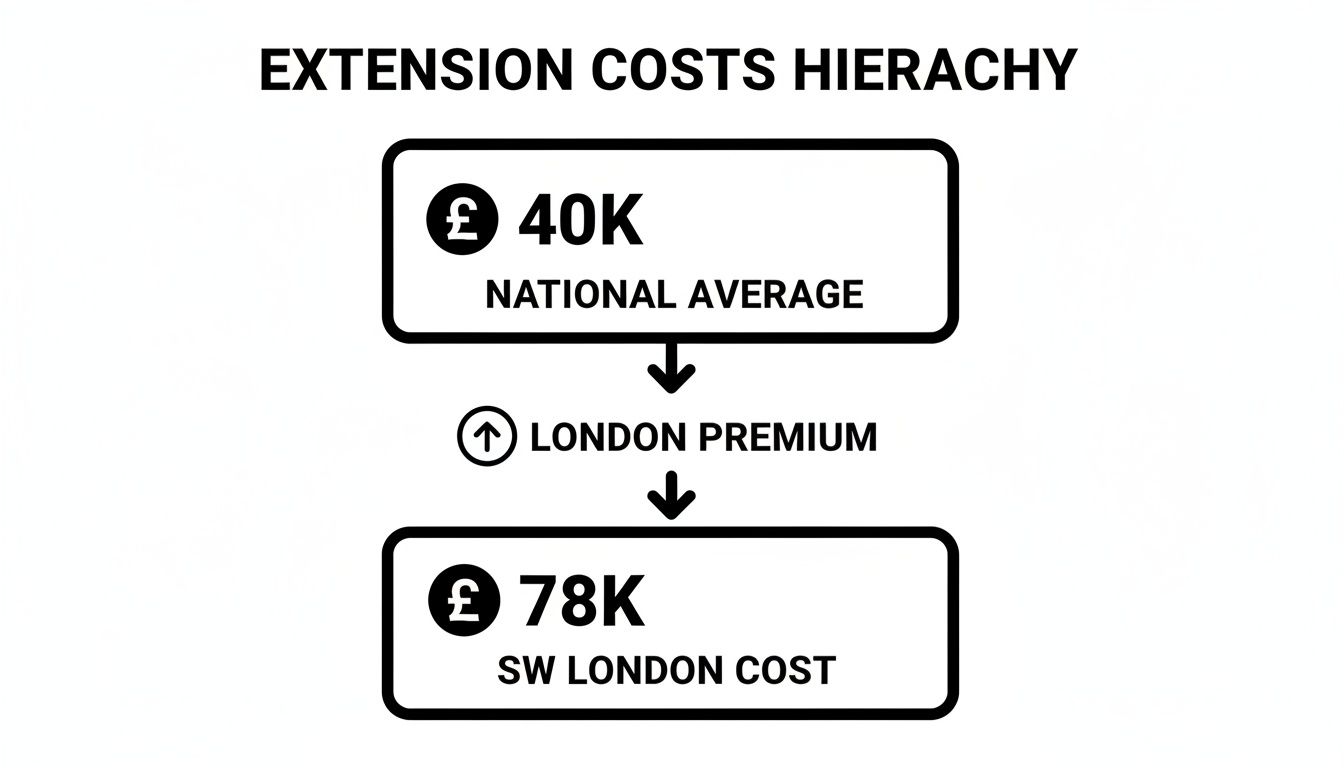
As you can see, while national figures provide a useful benchmark, the final cost in our local market is often nearly double. This is driven by factors we'll explore throughout this guide.
Dissecting the Build Cost
The build cost itself isn't a single lump sum either. We can break it down even further, which helps you see precisely where the bulk of your investment lies and why quality craftsmanship and materials are so fundamental to the final result.
While every project has its own unique character, the budget allocation tends to follow a familiar pattern. Here’s a typical percentage breakdown:
Substructure (Foundations & Groundworks): 15% This is the critical, unseen foundation of your entire extension. It involves excavation, pouring concrete foundations, installing drainage, and creating the ground floor slab that everything else rests on.
Superstructure (The Shell): 25% Next comes the main structural frame. This stage covers the external walls, roofing, structural steelwork, and the installation of windows and external doors to create a weathertight shell.
First Fix (Internal Services): 15% Once the shell is secure, the "first fix" begins. This is where all the essential services are routed through the structure – the initial plumbing, electrical wiring, and any cabling for AV or smart home systems, all before the walls are plastered.
Second Fix & Finishes: 45% This is the largest and most variable part of the budget. It covers all the elements you see and touch every day, turning the raw shell into a beautiful, finished space.
The finishes are where a budget can expand or contract most significantly. This stage covers everything from plastering and flooring to fitting kitchens and bathrooms, bespoke joinery, lighting fixtures, and final decoration. It is also where an architect’s expertise in material specification adds immense value.
Investing in an architect ensures this complex financial puzzle is expertly managed from day one. We provide detailed costings from the outset, help you make informed decisions on where to invest and where you can be savvy, and oversee the entire build to keep the project on track and on budget. That oversight is fundamental to protecting your investment and achieving an exceptional outcome.
Using Cost Per Square Metre to Plan Your Budget
When you start discussing your rear extension with architects and builders, you'll quickly find the conversation moves away from vague, total-project estimates towards a much more useful metric: the cost per square metre (£/m²). This isn't just industry jargon; it’s the single best tool for benchmarking your project, comparing quotes like-for-like, and accurately forecasting your budget from day one.
Think of it like buying a car. A total price doesn’t tell you much. Is it a basic model or one with all the optional extras? The cost per square metre acts in the same way, giving us a standard unit of measurement that clearly reflects the quality, complexity, and finish of the build. It allows us to model costs with real accuracy, so you can see exactly how adding or removing a few square metres will impact the final figure.
Why The £/m² Rate Varies So Much
It’s a simple truth: not all square metres are created equal. This is why a single, one-size-fits-all figure is so often misleading, especially in a prime market like South West London. The cost can fluctuate dramatically depending on what you’re putting into that square metre.
A simple, rectangular extension with standard off-the-shelf fittings will have a much lower £/m² rate than a complex design with vast panes of structural glass, bespoke joinery, and a high-end kitchen.
Here are the main things that drive the cost up or down:
Structural Complexity: An ambitious design with open corners, large unsupported spans that need significant steelwork, or unconventional shapes will naturally have a higher cost per metre.
Specification Level: This is the biggest factor by far. A 'standard' spec might use basic lighting and doors, but a 'luxury' spec could include underfloor heating, a designer kitchen, and premium flooring, each adding to the per-metre cost.
Type of Extension: Even the type of extension matters. A single-storey extension can sometimes have a higher relative £/m² cost than a two-storey one, simply because expensive elements like foundations and roofing are spread over a smaller internal area.
Benchmarking Extension Costs in London
The UK has seen significant shifts in building costs recently. A basic single-storey extension can range from £1,800 to £3,300+ per square metre, but that's just a national average. In a sought-after area like Wimbledon or Richmond, a luxury project can easily climb to £3,500/m² or more. That’s the London premium at work, which can be over 21% higher than elsewhere. For a deeper dive into UK-wide pricing trends, you can explore detailed cost analysis from construction experts.
Here’s a quick overview of how specification choices can influence the cost per square metre for typical South West London projects.
Cost Per Square Metre (£/m²) by Extension Type and Specification
Extension Type | Standard Spec (£/m²) | Mid-Range Spec (£/m²) | Luxury Spec (£/m²) |
|---|---|---|---|
Side-Return Extension | £2,200 – £2,800 | £2,800 – £3,400 | £3,400+ |
Wraparound Extension | £2,400 – £3,000 | £3,000 – £3,600 | £3,600+ |
Rear Extension (Full-Width) | £2,100 – £2,700 | £2,700 – £3,300 | £3,300+ |
Two-Storey Extension | £1,900 – £2,500 | £2,500 – £3,100 | £3,100+ |
As the table shows, your decisions on everything from glazing to flooring have a direct and measurable impact. This is where an experienced architect becomes essential.
At Harper Latter Architects, we use our deep understanding of the South West London market to give you realistic £/m² benchmarks that are tailored to your aspirations, not just generic averages. Our role is to guide you through the specification process, perfectly balancing your aesthetic goals with smart, pragmatic financial planning.
This expertise in value engineering is crucial. We know where to invest for maximum impact—perhaps on a stunning Crittall-style glass wall or a high-end worktop—and where more cost-effective solutions can be used without compromising the overall feel of the space. It’s about making sure every pound you spend adds tangible, lasting value to your home.
The Key Factors That Influence Your Final Cost
While a cost-per-square-metre estimate is a great starting point for budgeting, the final figure for your rear extension will be shaped by the unique realities of your property and the design choices you make. Getting to grips with these variables is the key to avoiding surprises and keeping your project on track.
These factors can range from the unseen challenges lurking beneath the ground to the high-end finishes you choose for your new kitchen. Each one plays a part in the total investment required to bring your vision to life.
Site Conditions and Access
Before a single line is drawn, the practicalities of your site come into play. A property with generous, straightforward access for machinery and deliveries will naturally be less costly to work on. Contrast that with a terraced house on a narrow street, where every bag of cement and every steel beam has to be carried through the home.
The ground itself is another huge variable. If the soil is unstable or the water table is high, your foundations will need to be deeper and more robust, which adds to the budget right from day one. It’s also common to discover buried drains that need diverting or large tree roots that require specialist foundation design, adding thousands to the initial groundwork phase.
Structural Glazing and Bespoke Features
The dream of a light-flooded, open-plan living space often involves vast expanses of glass, like bifold or sliding doors that open up the entire rear of the home. They look incredible, but they are a significant cost driver.
It's not just the glass itself that costs money; it's the hidden structural work needed to support it. Removing the back wall of a house requires massive steel beams (RSJs) to carry the load of the floors above. So, the cost includes not only the glazing units, which can run from £1,500 to £2,000 per linear metre, but also the complex structural engineering and steelwork that make it all possible.
The specification is where your personal vision really meets the budget. High-impact choices, like a state-of-the-art kitchen, polished concrete floors, or extensive smart home integration, can easily add £20,000 to £50,000+ to the final figure. An experienced architect helps you decide where to invest for the greatest impact.
Your choice of interior features will also heavily influence the final numbers. Popular additions that push the budget upwards include:
Underfloor Heating: A wonderfully luxurious feature that provides exceptional comfort, but it comes with a higher installation cost than conventional radiators.
High-End Kitchens: A bespoke kitchen from a premium supplier with stone worktops and top-tier appliances can easily become the single largest expense within the extension itself.
Smart Home Integration: Weaving in automated lighting, climate control, and security systems adds a layer of complexity to the electrical design and installation, increasing costs. Exploring sustainable architecture options here can also influence choices, often leading to excellent long-term savings on running costs.
Heritage Properties and Conservation Areas
Working on a listed building or a property inside a Conservation Area adds a completely different layer of complexity and cost to a rear extension. The planning process is far more rigorous, and design freedom is often limited by strict heritage policies designed to protect the character of the building and area.
This is where the input of a conservation-accredited architect is absolutely essential. Projects in these sensitive settings demand:
Specialist Materials: Planners will often insist on historically accurate materials, such as handmade bricks matched to the original or natural Welsh slate for the roof, which are significantly more expensive than their modern counterparts.
Traditional Craftsmanship: Techniques like lime mortar pointing or crafting timber sash windows require specialist tradespeople whose skills command higher rates.
Detailed Heritage Statements: The planning application itself is more involved, requiring specialist reports and assessments to justify every proposed change.
Because these requirements are non-negotiable, you can expect the building costs to be 15-25% higher than for a similar extension on a non-listed property. Trying to navigate this process without an expert on your side is a major risk, both financially and to your chances of getting approval.
Calculating Your Return on Investment
A rear extension isn’t just a line item on a spreadsheet; it's one of the smartest investments you can make in your property. While it's easy to get bogged down by the initial outlay, the real conversation is about the value it creates. Here, we’ll shift the focus from cost to outcome, exploring the significant uplift a well-designed extension delivers in the competitive South West London property market.
Thinking of an extension purely as an expense misses the point entirely. A better way to see it is as a strategic conversion of capital into both tangible equity and priceless lifestyle improvements. A thoughtfully designed space that improves your home's flow and connects it seamlessly to the garden doesn't just add square metres—it adds genuine desirability and a premium to your property's valuation.
The Financial Uplift of a Rear Extension
Industry data consistently shows that extensions offer a powerful return. In a market like South West London, creating sought-after features like a large, open-plan kitchen-diner is a proven way to boost your home’s appeal. In fact, these kinds of additions can increase your property's resale value by an impressive 12-20% on average.
This financial return more than justifies the initial outlay. For example, while a double-storey extension might average £118,114 nationally, costs for a high-specification 60m² build in prime areas like Chiswick or Cobham can climb towards £136,132. Yet, the corresponding jump in property value often outpaces this investment significantly. For a closer look at how these figures are projected, you can read more analysis on 2026 extension costs. This powerful return makes an extension a compelling choice for homeowners looking to maximise their property's potential.
Architect-Led Design Maximises Your Return
The greatest financial gains don't come from simply building the biggest box you can. The highest returns are consistently generated by architect-designed spaces that feel like a natural, intelligent evolution of the original home.
An architect brings a level of design consideration that elevates an extension from a simple addition to a transformative feature. We focus on:
Improving Flow: We don't just add a room; we reorganise layouts to create an intuitive and practical connection between old and new spaces.
Maximising Light: We use glazing, rooflights, and clever design to draw natural light deep into the property, making the entire home feel brighter and bigger.
Enhancing Character: We ensure the new design respects and enhances the home's original architectural character, rather than competing with it.
This considered approach is what discerning buyers notice and are willing to pay a premium for. It's the difference between a standard extension and a truly exceptional living space.
Beyond the balance sheet, the most profound return on your investment is the improvement to your daily life. A home perfectly tailored to your family's needs—with space to entertain, relax, and grow—offers a powerful non-financial dividend that you'll appreciate every single day.
Planning Your Project with Harper Latter Architects
This guide has walked you through the financial side of a rear extension in South West London, giving you a solid toolkit for budgeting. With this knowledge in hand, the next step is turning that ambitious vision into a tangible, beautifully executed reality. This is the moment where expert architectural guidance becomes your most valuable asset.
A successful, on-budget project isn’t just about good drawings. It hinges on meticulous planning and professional oversight—navigating complex regulations, managing contractors, and making thousands of small decisions that collectively shape the final outcome. Think of your architect as your advocate and project guardian, ensuring every pound is invested wisely to create lasting value.
Your Path to a Successful Extension
Our unique, RIBA-accredited 8-step process is designed from the ground up to give you cost certainty and complete peace of mind, right from our very first conversation. We believe in total transparency, breaking down the entire journey into clear, manageable stages. This structured approach takes the guesswork out of the equation and empowers you to make informed decisions at every turn.
Our role is to transform the daunting task of budgeting and building into a creative, collaborative, and ultimately rewarding experience. We handle the complexity so you can focus on the excitement of creating your ideal home.
We begin by establishing a realistic budget that aligns with your aspirations. From there, we move through detailed design, planning submissions, technical specifications, and contractor selection. Each step acts as a checkpoint, keeping the project on track both financially and creatively. You can learn more about how we de-risk the construction journey by exploring our proven 8-step process in detail.
If you are considering a luxury rear extension in Wimbledon, Richmond, or the surrounding areas, we invite you to start a conversation with our practice. Let's discuss your ambitions and explore how we can help you create a truly exceptional home.
Frequently Asked Questions
Planning a rear extension involves a lot of moving parts, and it’s only natural to have questions about the costs and practicalities. To give you some clarity, we’ve put together straightforward answers to the queries we hear most often from homeowners across South West London.
How Much Are Architect Fees for a Rear Extension in London?
You can typically expect architect fees to be calculated as a percentage of the total construction cost, usually falling somewhere between 8% and 15%. For a high-quality residential project in South West London, this isn't just a fee for drawings; it's an investment in a comprehensive, end-to-end service.
This covers everything from the initial creative concepts and highly detailed technical plans right through to navigating the tricky local planning system and managing the build on-site. At Harper Latter Architects, our fees reflect our full, RIBA-accredited 8-step process. It’s this meticulous oversight that ultimately saves you money by preventing expensive mistakes and ensuring the design delivers lasting value.
Do I Need to Pay VAT on a Rear Extension?
Yes, almost certainly. You’ll need to account for VAT at the standard rate of 20% on both the construction work and all professional fees. This is a significant figure, so it’s absolutely essential to factor it into your budget right from the start to avoid any nasty surprises down the line.
When you get quotes from builders or other consultants, always double-check whether their figures include or exclude VAT. We make a point of being crystal clear about this in our fee proposals and cost breakdowns, so you always have a complete, transparent picture of the total investment.
How Long Does It Take to Build a Rear Extension?
The time it takes to build an extension really depends on the scale and complexity of the project. A fairly straightforward single-storey extension might take around 12-16 weeks for the on-site construction phase.
On the other hand, a more ambitious project—like a double-storey extension or one involving a period property with complex structural changes—could easily take 6-9 months, sometimes longer. And remember, this is just the build time. The crucial pre-construction phase, which includes design, securing planning permission (often an 8-12 week process in itself), and finalising any party wall agreements with neighbours, happens before a single spade hits the ground. Our process maps out a realistic programme from day one to keep expectations clear.
What Are the Hidden Costs of a Rear Extension?
What people call 'hidden costs' are usually just expenses that weren't accounted for in the main building contract or popped up unexpectedly on-site. Good project planning is all about anticipating these.
A well-managed project prepares for the unexpected. We always advise clients to set aside a contingency fund of 10-15% of the build cost. Think of it as a financial safety net that can absorb surprises without causing stress or derailing the project.
Some common examples of these extra costs include:
Professional Surveys: Fees for Party Wall surveyors or specialist drainage investigations.
Unforeseen Groundworks: Discovering you need to divert a drain or deal with difficult soil conditions.
The Finishing Touches: The budget for decorating, new furniture, and window treatments.
External Works: Landscaping the garden or laying a new patio once the builders have left.
Temporary Accommodation: The potential cost of renting if you decide to move out during the most disruptive parts of the build.
Our detailed cost planning is designed to root out as many of these potential surprises as possible during the early design stages, giving you far greater financial certainty.
Ready to take the next step towards transforming your home? The team at Harper Latter Architects is here to provide the expert guidance you need to bring your vision to life, on time and on budget.