
Architect Costs Extension: UK Guide to Extending Your Home
Right then, let's get to the question on everyone's mind: what are the typical architect costs for an extension? The most straightforward way to think about it is as a percentage of the total construction cost. For a full architectural service in the UK, you can generally expect this to be somewhere between 8% and 15%.
Understanding the True Value of Architect Fees

When you're planning a home extension, it’s all too easy to see your architect’s fee as just another number on a spreadsheet. But that mindset misses the bigger picture entirely. You’re not just paying a fee; you're making a strategic investment in vision, expertise, and ultimately, the value of your home.
A skilled architect does so much more than just draw up plans. Their real talent lies in unlocking your home's hidden potential. They see the possibilities for light, space, and flow that you might have missed, transforming a simple addition into a seamless, lifestyle-enhancing part of your home. This is especially vital in premium areas of South West London like Wimbledon and Richmond, where every square metre is precious and maximising property value is always a priority.
Beyond the Blueprints
Think of an experienced architect as your advocate throughout the entire project. They are absolutely essential for navigating the often-tricky web of local planning permissions and building regulations, particularly for properties within Conservation Areas or those with listed status. Their guidance ensures your project not only gets the green light but also complies with every legal standard, saving you from costly delays and future headaches.
This professional oversight carries right through to the construction phase. Your architect is there to ensure the builder sticks to the design specifications, maintains quality standards, and respects the budget. This proactive management is what protects your investment and makes sure the finished space matches the vision you started with.
An architect's true contribution is measured not just in the lines they draw, but in the problems they solve, the value they create, and the peace of mind they provide from concept to completion.
A Financial Snapshot
In the dynamic South West London property market, architect costs for home extensions can often represent around 12% of the total project budget. To give you a concrete idea, professional fees—which include not just the architect but also structural engineers and building control—typically start from around £8,700 on a £72,800 extension project.
Of course, for the kind of luxury refurbishments and bespoke basement extensions that we specialise in at Harper Latter—think home cinemas or wine rooms—these fees can climb. This is down to the added complexity of integrating high-end features, sustainable design, and heritage-sensitive elements. For a more granular breakdown, you can explore this complete 2025 UK extension guide.
With this initial financial overview in mind, you can start setting realistic expectations. In the next sections, we'll dive deeper into how architect costs for your extension are actually calculated, what factors influence that final number, and how every pound you invest contributes directly to the success and long-term value of your home.
How Do Architects Actually Calculate Their Fees?
To get a real handle on the cost of an architect for your extension, you first need to understand how we structure our fees. Just like every project is different, there are a few different ways we calculate our fees to match the specific work involved.
Think of it like choosing a mobile phone plan. You could go for an all-inclusive monthly contract, a fixed price for a specific package, or simply pay as you go. Each model has its place, and knowing the difference will put you in a much better position to talk about your project budget.
There are three main ways an architect will calculate their fees. While one is more common for full-scope projects from start to finish, others are better suited to smaller, more defined tasks. Let’s break them down.
Percentage Fees Explained
The most common method you'll see for a full-service extension project is the percentage fee. With this approach, the architect's fee is a percentage of the final, agreed construction cost. This typically falls somewhere between 8% and 15%, depending on how complex and large-scale your project is.
This model is popular for a good reason: it keeps the architect’s interests aligned with yours. If the project scope changes or evolves, the fee adjusts with it, making sure the level of service always matches the work required. It’s a very effective model for complex, high-end extensions where the final build cost might not be set in stone from day one.
For example, on a £300,000 rear extension in Richmond, a 10% fee would come to £30,000. If design choices or material upgrades later push the build cost to £320,000, the fee would be recalculated to £32,000, reflecting the extra architectural work involved.
The Certainty of Fixed Fees
Another common structure is the fixed fee, sometimes called a lump-sum fee. It’s exactly what it sounds like: a set price for a very clearly defined scope of work. This model gives you complete cost certainty right from the start, which is a massive plus for budgeting.
Fixed fees are perfect for distinct project stages where the deliverables are crystal clear, such as:
Feasibility studies to figure out what's possible on your property.
Concept design to get initial ideas and sketches down on paper.
Planning application submissions where the scope of work is well-defined.
A fixed fee gives you a transparent, predictable cost for a specific set of architectural services. It’s the ideal choice when the project deliverables are well-understood and unlikely to change, giving you real confidence in your initial financial planning.
We often use this model for the early stages of our process. It allows you to move forward with a clear understanding of the initial investment before committing to the entire project. As you can imagine, this fee structure hinges on having a precise brief from the get-go.
The Flexibility of Hourly Rates
Finally, we have hourly rates. This 'pay-as-you-go' model is generally used for services where it’s difficult to predict the time needed. It offers maximum flexibility, letting you bring an architect in for specific advice or one-off tasks.
You might come across hourly rates for things like initial consultations, attending pre-planning meetings with the local council, or for extra advice that falls outside a fixed-fee agreement. While it’s transparent, it’s less common for an entire extension project simply because it doesn’t offer the cost predictability of the other models.
Getting your head around these fee structures is the first step in decoding the architect costs for your extension. Each has its strengths, and the right one really depends on what your project needs. To see the full range of work these fees cover, you can learn more about our comprehensive architectural services and how they align with your vision.
So, we’ve looked at how architects structure their fees. Now for the big question: why do those fees vary so much from one project to the next?
The simple answer is that not all extensions are created equal. Several key factors will directly influence the final figure on your architect's quotation. Getting your head around these drivers is the best way to anticipate your own architect costs for an extension.
Think of it like commissioning a bespoke suit. A simple, off-the-rack design will always cost less than a complex, hand-stitched garment made from rare materials. The same principle applies to architecture; the more intricate, demanding, and specialised the project, the more time and expertise are required.
The fee is a direct reflection of the skill, responsibility, and time your architect will invest in your home. From navigating complex planning laws in South West London to designing intricate structural solutions, each challenge adds a layer of work that has to be accounted for.
Project Complexity and Scope
The single biggest factor driving your architect’s fee is the complexity and scale of your vision.
A straightforward, single-storey rear extension with a flat roof and standard fittings is a relatively simple design task. But compare that to a multi-storey side return that also incorporates a new basement. Suddenly, the project is in a different league.
For instance, designing a basement conversion for a Wimbledon property involves a huge amount of coordination with structural engineers. It demands specialist knowledge of waterproofing and clever light-well design to make the space feel bright and liveable. This is a far more involved undertaking than a simple ground-floor addition, and the fee will reflect that.
Greater complexity means more detailed drawings, more time spent liaising with consultants, and a more intensive design process. It all adds up.
Heritage and Location Constraints
Where your property is and its historical status play a huge role in the architectural process. Is your home a Listed Building? Is it located within a Conservation Area, like so many beautiful properties in Richmond or Wimbledon Village? If the answer is yes, then the design and planning journey becomes far more rigorous.
Working on a Listed Building or in a Conservation Area requires a specialist skill set. Your architect will need to produce highly detailed heritage statements, create designs that respect the building's historical character, and negotiate meticulously with conservation officers. This additional layer of work, responsibility, and specialist knowledge is directly reflected in the fee.
These projects demand a deep understanding of traditional materials and construction techniques, plus a very sensitive design approach. An architect’s proven experience in conservation is invaluable here, and their fees will account for this rare expertise. For homeowners who also want to blend modern efficiency with historical preservation, an understanding of sustainable architecture becomes essential.
The Level of Service Required
Finally, your architect’s fee will be shaped by how much you want them involved. Architectural services are typically broken down into stages aligned with the RIBA Plan of Work. You get to choose how far along that journey you want your architect to guide you.
A partial service, for instance, might just cover the initial design and planning application (RIBA Stages 0-3). This is a more budget-friendly option if you feel confident managing the builders and the construction phase yourself.
On the other hand, a full service offers complete peace of mind. This includes the technical design, tendering to builders, and contract administration during the build itself (RIBA Stages 4-6). While the upfront fee is higher, this comprehensive oversight ensures the design is built to the specified quality, helps keep the budget on track, and resolves issues on-site before they become big problems. For complex, high-end extensions where quality control is everything, this level of project management is worth its weight in gold.
The more stages an architect is engaged for, the higher their overall fee will be, but the more support and value you receive.
To make this clearer, let's break down how different project features can push costs up or down.
How Project Features Impact Your Architect's Fee
Project Feature | Impact on Cost | Reasoning |
|---|---|---|
Simple Box Extension | Lower | Features a standardised design, fewer complex structural details, and a more straightforward planning process. |
Listed Building Renovation | Higher | Requires specialist conservation expertise, detailed heritage reports, and highly sensitive design work. |
Basement Conversion | Higher | Involves complex structural engineering, specialist waterproofing, and clever light-well design. |
Design & Planning Only | Lower | This is a partial service that only covers the initial stages of the project, leaving you to manage the build. |
Full Project Management | Higher | A comprehensive service providing professional oversight from the first sketch right through to final completion. |
As you can see, the fee isn't just an arbitrary number. It’s a carefully calculated figure based on the time, risk, and specialist expertise your unique project demands.
Mapping Fees to Your Project Journey
Understanding the theory behind architect fees is one thing, but seeing how they apply to the practical steps of your extension is where the real clarity comes. An architect’s fee isn’t a single, upfront cost. Instead, it's a phased investment that aligns with the progress of your project, meaning you only pay for services as they’re delivered.
This approach gives you a transparent financial roadmap. It lets you budget effectively for each stage of the journey, from the very first conversation to the final handover. Think of it less like a one-off purchase and more like a series of agreed-upon payments tied to tangible milestones.
At Harper Latter, we follow a rigorous, RIBA-aligned process that breaks down the complex journey of creating a home extension into clear, manageable stages. Let's walk through how fees are typically allocated across this timeline, showing you exactly what you're paying for at every step.
Stage 1: Feasibility and Concept Design
This is where your ideas first start to take shape. It’s arguably one of the most crucial parts of the process because the decisions made here influence everything that follows.
During this initial phase, your architect gets to work on a few key things:
Initial Consultation: A deep dive into your vision, your lifestyle, and what you want to achieve with the new space.
Site Analysis: A thorough assessment of your property to spot both opportunities and constraints, like planning restrictions or potential structural challenges.
Feasibility Sketches: The first drawings and layout options that explore what’s actually possible within your brief and budget.
The fee for this stage is often a small, fixed amount or a specific slice of the overall estimated fee (say, 10-15%). This initial investment allows you to explore your project's viability with expert guidance before committing to the full design and construction process.
Stage 2: Developed Design and Planning
Once a concept clicks, the focus shifts to developing the design with enough detail to submit for planning permission. This is where the architect costs for an extension become more defined, as the project's scope is now much clearer.
In this stage, the architect will:
Refine the chosen concept into a detailed set of architectural drawings, including floor plans, elevations, and sections.
Prepare and pull together all the necessary documents for the planning application, including a Design and Access Statement.
Liaise with the local planning authority on your behalf, managing the submission and fielding any questions.
The fees for this stage are typically invoiced once the planning application has been successfully submitted. This milestone-based payment structure ensures you see clear progress before the next portion of the fee is due.
A structured payment schedule, tied to key project milestones like the submission of a planning application, provides financial transparency and builds trust. It ensures that the architect's incentives are aligned with moving your project forward efficiently and effectively.
This helpful diagram illustrates how the overall complexity of a project—from a simple box extension to a complex, heritage-sensitive renovation—directly influences the fee structure.
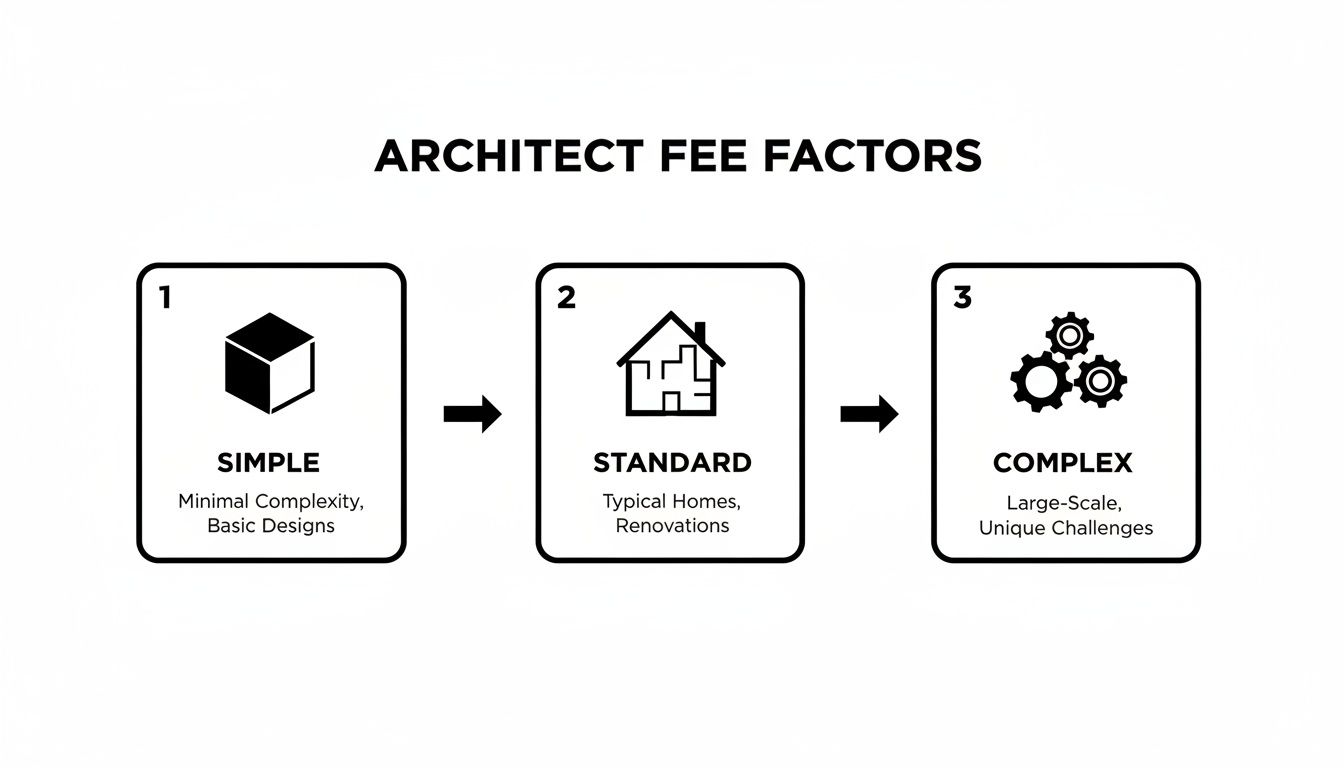
As you can see, a more complex project requires a significantly greater investment of an architect's time and expertise, which is reflected in the fee allocation across each stage.
Stage 3: Technical Design and Building Regulations
With planning permission secured, the project moves into the technical phase. This is where the beautiful concept drawings are transformed into a highly detailed set of construction drawings and specifications that a builder can actually work from.
This stage is incredibly detailed and includes:
Detailed Construction Drawings: These are the technical blueprints the builder will follow, specifying everything from wall thicknesses to insulation types.
Structural Coordination: Working closely with a structural engineer to integrate the steelwork and foundations seamlessly into the design.
Building Regulations Submission: Preparing and submitting a full set of technical documents to ensure the project complies with all legal building standards.
This phase represents a substantial chunk of the design work, and the associated fees are usually invoiced once the technical package is complete and ready to be sent out to builders.
Stage 4: Construction and Handover
This is the final stage, where your architect's role can shift from designer to project administrator, depending on the level of service you've chosen. If you opt for a full service, their involvement during the build itself is invaluable.
Services at this stage can include:
Tendering: Managing the process of sending the technical drawings to several trusted builders to get competitive, comparable quotes.
Contract Administration: Setting up a formal building contract between you and your chosen builder to protect your interests.
Site Inspections: Regularly visiting the site to check on progress, ensure the quality of work matches the drawings, and resolve any issues that crop up.
Fees for the construction stage are typically paid in monthly instalments throughout the build, aligning with the architect’s ongoing site visits and admin duties. This structured approach ensures continuous professional oversight right up to the moment you get the keys. To see how these stages fit into our client journey, you can learn more about our structured 8-step process.
Budgeting for Your London Extension

Putting together a realistic budget is the bedrock of any successful extension. It’s the moment your vision moves from an abstract idea to a tangible, achievable plan, giving you the financial clarity to move forward with confidence. To truly get a grip on the total project cost, you need to see how your architect’s fees slot into the bigger picture alongside all the other expenses.
For a high-end project here in South West London, your budget must account for the premium that comes with building in the capital. Everything from materials and contractor day rates to logistical challenges adds up, creating a larger overall figure than you’d see elsewhere in the UK. A well-thought-out budget brings everything into the open and prevents nasty surprises down the line.
So, how do the numbers actually break down? Recent analysis of a typical £80,000 single-storey extension reveals that professional fees—including the architect’s—usually make up around 12% of the total, or £8,700. This percentage becomes even more significant for complex heritage jobs or basement conversions. The same analysis shows that while materials account for 46% (£33,500), the contingency fund should be around 8% (£5,800). You can dive deeper into how London's 9% regional premium affects these figures in this detailed extension cost breakdown.
The Crucial Role of Contingency
If there’s one golden rule in budgeting for an extension, it’s this: always include a contingency fund. This is a pot of money, typically 10-15% of the total construction cost, that you set aside purely for the unexpected.
What could possibly go wrong? During the build, you might uncover hidden structural issues, hit difficult ground conditions, or simply change your mind and decide to upgrade a finish. Without a contingency, these moments can derail your project or force you into painful compromises.
Think of your contingency fund as project insurance. It's the financial safety net that allows you to handle unexpected challenges without sacrificing quality or adding significant stress to the process. A robust contingency is the hallmark of a well-planned, realistic budget.
Your Architect as a Budget Guardian
It might sound strange, but one of the most valuable roles your architect plays is protecting your budget. Their expertise is your first line of defence against costly overruns and miscalculations. This is where the initial investment in professional fees really starts to pay for itself.
A good architect will safeguard your budget in several key ways:
Detailed Costings: Right from the start, they can provide realistic cost estimates based on their experience with similar local projects, stopping you from heading down a path with an unachievable budget.
Smart Material Advice: They can recommend alternative materials or clever construction methods that give you the aesthetic you want without blowing the budget.
Managing the Tender Process: Your architect will send the detailed technical drawings to a curated list of trusted builders. This ensures you get competitive, like-for-like quotes, preventing builders from pricing in unknowns and giving you the best possible value.
On-Site Oversight: During the build, their regular site visits ensure the work is being done to the specified standard, which helps prevent costly mistakes that would need fixing later on.
By actively managing these financial elements, your architect does far more than just design. They act as your financial advocate, making sure your investment is spent wisely and effectively to deliver the home you imagined, on budget.
Your Questions Answered
To help you move forward with complete confidence, we’ve put together a few straightforward answers to the questions we hear most often. Drawing on our years of experience with high-end home extensions across South West London, this is designed to clear up any lingering uncertainties you might have.
Our aim is to demystify the process, offering practical advice on everything from council fees to what happens if your budget needs to adapt along the way.
Do Architect Fees Include Planning Application and Building Control Charges?
This is an excellent question and a very common point of confusion. The short answer is no; an architect's professional fees typically cover their time, expertise, and management of the process, but not third-party statutory fees. These are separate costs you’ll pay directly to your local council.
Your architect will handle the entire submission process for you, but the cost of the planning application itself (currently around £206 for a home extension in England) and the fees for building control inspections will be itemised separately in your overall project budget. We make sure these costs are clearly flagged from the very beginning, so there are absolutely no surprises.
Can I Hire an Architect for Just the Design and Planning Stages?
Yes, you certainly can. It’s possible to engage an architect for a partial service, which usually covers the initial RIBA Work Stages 0-3 – that’s everything from feasibility studies and concept design right through to submitting the planning application. This can be a more budget-friendly route if you have solid experience managing construction projects yourself.
However, for most clients embarking on the kind of complex, high-end projects we specialise in across South West London, we always recommend a full service. Having an architect's eye on the construction phase is invaluable for quality control, ensuring the builder is sticking to the design, and managing that crucial relationship. Ultimately, it protects your investment and delivers a far superior finish.
For a bespoke, high-end extension—especially on a period property or in a conservation area where design sensitivity is paramount—the holistic skills of a RIBA-chartered architect are crucial. The initial investment in an architect often pays for itself many times over in the value they add.
What Happens if My Construction Budget Changes?
This really depends on the fee structure you’ve agreed on at the start of your project. If your fee is based on a percentage of the final construction cost, it will naturally adjust if the scope—and therefore the budget—grows or shrinks.
For instance, if you decide halfway through the design phase to add a bespoke garden room, the construction cost will rise, and the fee will be recalculated to reflect the additional design and management work involved. If you have a fixed-fee agreement for a specific stage, any significant changes to the brief would be handled through an 'instruction for variation,' where a fee for the extra work is agreed upon upfront. Transparency is everything, and we always maintain open communication about any fee changes before proceeding with more work.
Is It Cheaper to Use an Architectural Technologist Instead of an Architect?
While an architectural technologist can be a more cost-effective choice for producing technical drawings on very straightforward projects, their expertise is squarely focused on the technical side of construction. Their real strength lies in the ‘how-to’ of building documentation.
For a bespoke, high-end extension where the goal is to maximise light, space, and property value, the holistic design skills of a RIBA-chartered architect are essential. An architect adds value far beyond just producing drawings; they are trained to solve complex design problems, create a home that genuinely enhances your lifestyle, and navigate the subtle nuances of planning in sensitive London boroughs. The architect costs for an extension should be seen as an investment in a vision that delivers a return far beyond the paper it’s drawn on.
Ready to transform your vision into a beautifully crafted reality? Contact Harper Latter Architects today for a complimentary initial consultation and discover how we can add lasting value to your home.